
骨科实习生使用尸体肘关节积液训练模型进行肘关节穿刺术的信心
Orthopaedic Trainee Confidence in Elbow Arthrocentesis Using a Cadaveric Elbow Effusion Training Model.
作者信息
Farooq Hassan, Chen Andrew, Boubekri Amir M, Tiee Madeline S, Salazar Dane, Garbis Nickolas G
机构信息
From the Department of Orthopaedic Surgery and Rehabilitation, Loyola University Medical Center, Maywood, IL.
出版信息
J Am Acad Orthop Surg Glob Res Rev. 2025 Mar 28;9(4). doi: 10.5435/JAAOSGlobal-D-24-00333. eCollection 2025 Apr 1.
INTRODUCTION
Elbow arthrocentesis facilitates diagnosis of infectious versus noninfectious elbow joint pathologies. Arthrocentesis is considered minimally invasive, but there is still risk for injury to surrounding structures and an associated learning curve. The purpose of this investigation was to compare orthopaedic trainee confidence and success at different levels of training while performing an elbow arthrocentesis through lateral and posterior approaches.
METHODS
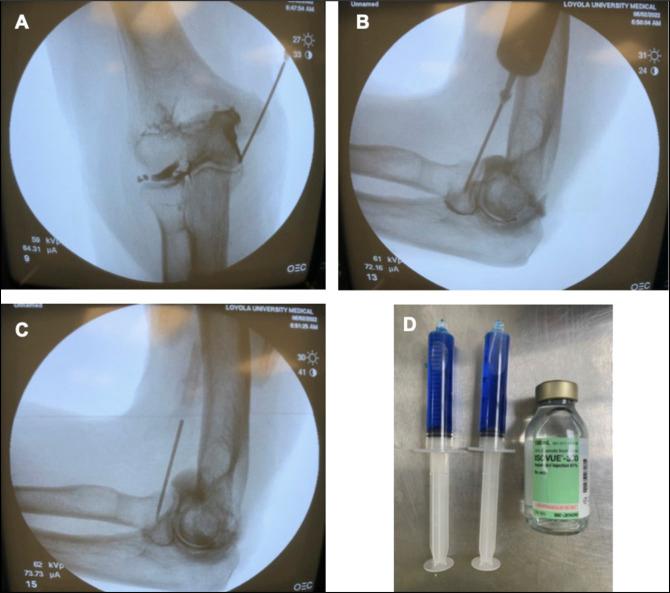
Ten, fresh-frozen, cadaveric specimens were assigned to senior residents, junior residents, and interns. Two milliliters of ISOVUE contrast and fluoroscopic imaging was used to confirm needle placement. Twenty milliliters of blue dye was used to create a simulated effusion. Standardized instructions on performing a lateral and posterior elbow arthrocentesis were provided. Three consecutive lateral or posterior aspirations on three specimens were done and level of confidence (1 to 5) and number of attempts to successful aspiration were recorded. Data were analyzed using analysis of variance, t-tests, Kruskal-Wallis, and Mann-Whitney tests.
RESULTS
Mean attempts to successful aspiration did not differ between seniors, juniors, and interns (1.6, 1.5, and 2.4, respectively, P = 0.068). For all trainees, posterior approach required a mean of 2.7 attempts, whereas the lateral approach required a mean of 1.3 attempts (P < 0.001). Interns were not as confident as seniors and juniors during any aspiration (P < 0.05). Juniors and seniors had equivalent confidence (P = 0.234). Finally, trainees were more confident (mean rank = 73.5) with the lateral approach compared with the posterior approach (mean rank = 47.5; P < 0.001).
CONCLUSION
Procedural confidence was dependent on the level of trainee and familiarity with approach. The number of attempts leading to successful aspiration only differed with approach and did not vary with respect to the level of training or confidence. These results provide important implications to consider while teaching orthopaedic trainees at varying levels of experience.
引言
肘关节穿刺有助于诊断感染性与非感染性肘关节病变。关节穿刺被认为是微创操作,但仍存在损伤周围结构的风险以及相关的学习曲线。本研究的目的是比较骨科实习生在不同培训水平下,通过外侧和后侧入路进行肘关节穿刺时的信心和成功率。
方法
将10个新鲜冷冻的尸体标本分配给高年资住院医师、低年资住院医师和实习医师。使用2毫升碘海醇造影剂和透视成像来确认针头位置。使用20毫升蓝色染料制造模拟积液。提供了关于进行外侧和后侧肘关节穿刺的标准化指导。对三个标本连续进行三次外侧或后侧穿刺抽吸,并记录信心水平(1至5级)和成功抽吸的尝试次数。使用方差分析、t检验、Kruskal-Wallis检验和Mann-Whitney检验对数据进行分析。
结果
高年资、低年资和实习医师成功抽吸的平均尝试次数无差异(分别为1.6次、1.5次和2.4次,P = 0.068)。对于所有实习生,后侧入路平均需要2.7次尝试,而外侧入路平均需要1.3次尝试(P < 0.001)。实习医师在任何一次抽吸过程中的信心都不如高年资和低年资住院医师(P < 0.05)。低年资和高年资住院医师的信心相当(P = 0.234)。最后,与后侧入路(平均秩次 = 47.5;P < 0.001)相比,实习生对外侧入路更有信心(平均秩次 = 73.5)。
结论
操作信心取决于实习生的水平和对入路的熟悉程度。成功抽吸的尝试次数仅因入路不同而有所差异,与培训水平或信心无关。这些结果为在不同经验水平的骨科实习生教学中提供了重要的参考。



 Zotero 插件