
斑马鱼胚胎-幼体测试揭示了新型精神活性物质的不同毒性。
Zebrafish embryo-larval testing reveals differential toxicity of new psychoactive substances.
作者信息
Rodrigues Leonardo Costalonga, Godoi Alexandre Barcia de, Fais Viviane Cristina, Peterson Randall Theodore, Maurer-Morelli Claudia Vianna, Costa Jose Luiz
机构信息
School of Medical Sciences, Universidade Estadual de Campinas (UNICAMP), Campinas, Sao Paulo 13083-887, Brazil.
Campinas Poison Control Center, Universidade Estadual de Campinas (UNICAMP), Campinas, Sao Paulo 13083-881, Brazil.
出版信息
Toxicol Rep. 2025 Mar 31;14:102018. doi: 10.1016/j.toxrep.2025.102018. eCollection 2025 Jun.
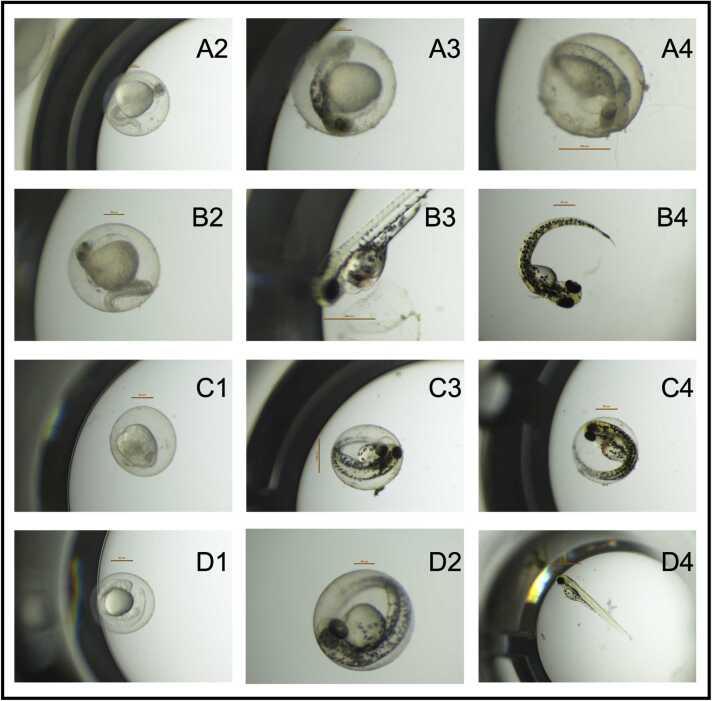
New psychoactive substances (NPS) have emerged as a significant public health concern, with synthetic cannabinoid receptor agonists (SCRAs) and ketamine derivatives being among the most frequently detected compounds in the forensic context worldwide. The Fish Embryo Acute Toxicity (FET) and Maximum Tolerated Concentration (MTC) tests are used to evaluate the acute toxicity of chemicals. In this study, we used these assays to evaluate the acute toxicity of three NPS in zebrafish embryos and larvae: the SCRA MDMB-4en-PINACA and the ketamine derivatives deschloroketamine (DCK) and 2-fluorodeschloroketamine (2F-DCK). Our findings demonstrated that MDMB-4en-PINACA induced severe developmental abnormalities, including pericardial edema and yolk edema, along with high embryo mortality (10 µM), characterized by endpoints such as coagulation, lack of heartbeat, and lack of somite formation. In contrast, DCK and 2F-DCK exhibited low embryo mortality even at higher concentrations. In larval stages, MDMB-4en-PINACA presented 8 % larvae mortality (10 µM) at eight days post-fertilization (dpf), whereas ketamine derivatives led to 100 % mortality at 2000 µM in the MTC test at eight dpf. The LC was calculated for the FET test with MDMB-4en-PINACA, and MTC test for both DCK and 2F-DCK. Additionally our results support the absence of N-methyl-D-aspartate (NMDA) receptors in the early life stages of zebrafish described in previous studies and highlight the significance of ketamine derivatives intoxications when the NMDA receptor is expressed. Notably, MDMB-4en-PINACA exhibited significantly higher toxicity, with an LC of approximately 26 times lower than that of the ketamine derivatives. These results are particularly relevant given the increasing global prevalence of NPS-related intoxications and fatalities. Using zebrafish as an model for toxicological research provides an efficient approach for screening the acute effects of emerging compounds such as NPS.
新型精神活性物质(NPS)已成为一个重大的公共卫生问题,合成大麻素受体激动剂(SCRAs)和氯胺酮衍生物是全球法医环境中最常检测到的化合物。鱼类胚胎急性毒性(FET)和最大耐受浓度(MTC)试验用于评估化学物质的急性毒性。在本研究中,我们使用这些试验评估了三种NPS对斑马鱼胚胎和幼体的急性毒性:SCRAs MDMB-4en-PINACA以及氯胺酮衍生物去氯氯胺酮(DCK)和2-氟去氯氯胺酮(2F-DCK)。我们的研究结果表明,MDMB-4en-PINACA会导致严重的发育异常,包括心包水肿和卵黄水肿,同时胚胎死亡率很高(10µM),其特征表现为凝血、心跳停止和体节形成缺失等终点指标。相比之下,即使在较高浓度下,DCK和2F-DCK的胚胎死亡率也较低。在幼体阶段,MDMB-4en-PINACA在受精后8天(dpf)时幼体死亡率为8%(10µM),而在8 dpf的MTC试验中,氯胺酮衍生物在2000µM时导致100%的死亡率。计算了MDMB-4en-PINACA的FET试验的半数致死浓度(LC),以及DCK和2F-DCK的MTC试验的半数致死浓度。此外,我们的结果支持了先前研究中所述斑马鱼早期生命阶段不存在N-甲基-D-天冬氨酸(NMDA)受体的观点,并强调了NMDA受体表达时氯胺酮衍生物中毒的重要性。值得注意的是,MDMB-4en-PINACA表现出显著更高的毒性,其LC比氯胺酮衍生物低约26倍。鉴于全球与NPS相关的中毒和死亡事件日益增多,这些结果尤为重要。使用斑马鱼作为毒理学研究模型为筛选NPS等新兴化合物的急性效应提供了一种有效的方法。




 Zotero 插件