
美国从青春期到成年期的体重轨迹:种族认同和童年不良经历的影响。
Body mass trajectories from adolescence to adulthood in the United States: Effects of racial identification and adverse childhood experiences.
作者信息
Omisakin Olusola A, Park Hyojun, Schwartz Sarah E, Noll Jennie G, Buxton Orfeu M, Marquez-Velarde Guadalupe, Lim Sojung, Reither Eric N
机构信息
Center for Safe & Healthy Children, College of Health and Human Development, The Pennsylvania State University, University Park, Pennsylvania, USA.
Department of Sociology & Anthropology, Utah State University, Logan, Utah, USA.
出版信息
J Res Adolesc. 2025 Jun;35(2):e70025. doi: 10.1111/jora.70025.
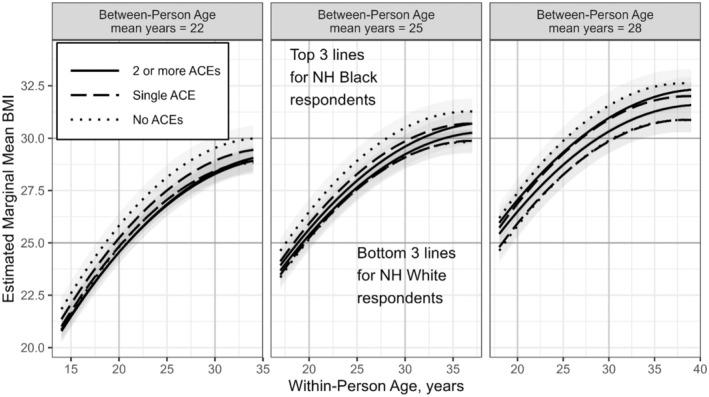
The non-Hispanic Black population in the U.S. has experienced one of the highest obesity rates, relative to the non-Hispanic White population and other racial groups. This study explores how adverse childhood experiences (ACEs) and racial identification influence body mass trajectories from adolescence to adulthood. Participants include non-Hispanic Black and non-Hispanic White individuals from the National Longitudinal Study of Adolescent to Adult Health (n = 5438). The outcome measure was body mass index (BMI). The Behavioral Risk Factor Surveillance System ACE Module and the CDC's Kaiser ACE research were used to create ACE categories. Multilevel growth curve models were utilized to address the study's objectives. BMI trajectories were steeper among female respondents who experienced multiple ACEs ( = 0.035; p < .01) than among females without any ACE. Among females, BMI trajectories were jointly moderated by ACEs and race (likelihood ratio test: = 130.76, p < .001), showing stronger ACE effects among non-Hispanic Black respondents. However, ACEs were not statistically associated with mean BMI or BMI trajectories among male respondents. Results further indicated that the effects of multiple ACEs were more evident at early ages and had a more marked impact on BMI among non-Hispanic Black females than non-Hispanic White females. Unhealthy BMI gains, especially among females, could be reduced through targeted interventions designed to support non-Hispanic Black children and adolescents.
与非西班牙裔白人及其他种族群体相比,美国非西班牙裔黑人的肥胖率一直处于最高水平之一。本研究探讨童年不良经历(ACEs)和种族认同如何影响从青春期到成年期的体重轨迹。研究对象包括来自“青少年到成人健康全国纵向研究”的非西班牙裔黑人和非西班牙裔白人个体(n = 5438)。结果指标为体重指数(BMI)。使用行为危险因素监测系统ACE模块和美国疾病控制与预防中心的凯撒ACE研究来创建ACE类别。采用多水平生长曲线模型来实现研究目标。经历多种ACEs的女性受访者的BMI轨迹(β = 0.035;p < 0.01)比没有任何ACEs的女性更陡峭。在女性中,BMI轨迹受到ACEs和种族的共同调节(似然比检验:χ² = 130.76,p < 0.001),表明非西班牙裔黑人受访者中ACEs的影响更强。然而,ACEs与男性受访者的平均BMI或BMI轨迹在统计学上无关联。结果还表明,多种ACEs的影响在早期更为明显,且对非西班牙裔黑人女性BMI的影响比对非西班牙裔白人女性更显著。通过旨在支持非西班牙裔黑人儿童和青少年的针对性干预措施,可以减少不健康的BMI增加,尤其是在女性中。

 Zotero 插件