
与成功的微创肺叶切除术相关的因素及结果
Factors and outcomes associated with successful minimally invasive pneumonectomy.
作者信息
Trope Winston L, Kapula Ntemena, Elliott Irmina A, Guenthart Brandon A, Lui Natalie S, Backhus Leah M, Berry Mark F, Shrager Joseph B, Liou Douglas Z
机构信息
Yale School of Medicine, New Haven, Conn.
Division of Thoracic Surgery, Department of Cardiothoracic Surgery, Stanford University School of Medicine, Stanford, Calif.
出版信息
JTCVS Open. 2025 Feb 21;24:423-437. doi: 10.1016/j.xjon.2025.02.006. eCollection 2025 Apr.
OBJECTIVE
To test the hypothesis that patients undergoing minimally invasive pneumonectomy at high-volume minimally invasive lung surgery centers have improved survival compared with patients who undergo open pneumonectomy.
METHODS
Patients from the National Cancer Database who underwent pneumonectomy for lung cancer between 2010 and 2020 were stratified into 3 groups according to surgical technique (open, minimally invasive, converted from minimally invasive to open). Institutions were categorized as low-, mid-, or high-volume minimally invasive lung surgery centers according to percentage of total anatomic lung resections performed by video-assisted or robotic-assisted thoracoscopic surgery. Outcomes were compared using Cox regression, Kaplan-Meier survival analysis, and propensity score matching.
RESULTS
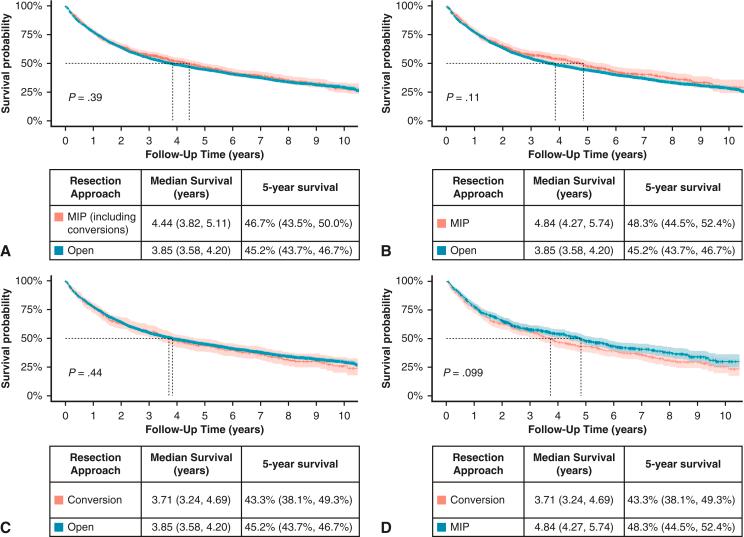
In total, 5750 patients from 850 facilities were included, with 4597 (79.9%) undergoing upfront open pneumonectomy. Among the 1153 attempted minimally invasive pneumonectomies, 364 (31.6%) required conversion to open pneumonectomy. Surgery at a non-high-volume center was associated with greater conversion risk (adjusted odds ratio, 4.16; < .001), whereas neoadjuvant therapy was associated with lower risk (adjusted odds ratio, 0.60; = .015). Similar 5-year overall survival was seen among the 3 groups (open 45.2%, minimally invasive 48.3%, converted 43.3%); however, conversion from minimally invasive to open pneumonectomy demonstrated a trend towards increased risk of death (hazard ratio, 1.16; = .058).
CONCLUSIONS
Minimally invasive pneumonectomy for lung cancer had similar 5-year survival compared with open pneumonectomy. However, conversion from minimally invasive to open pneumonectomy showed a trend toward increased risk of death, and conversion rates were high irrespective of institutional minimally invasive lung surgery volume. Careful patient selection is necessary when considering minimally invasive pneumonectomy so that long-term outcomes are not compromised.
目的
检验以下假设:在高容量微创肺手术中心接受微创肺叶切除术的患者与接受开胸肺叶切除术的患者相比,生存率有所提高。
方法
将2010年至2020年间在美国国家癌症数据库中因肺癌接受肺叶切除术的患者,根据手术技术(开胸、微创、由微创转为开胸)分为3组。根据电视辅助或机器人辅助胸腔镜手术在全部解剖性肺切除术中所占的百分比,将医疗机构分为低容量、中等容量或高容量微创肺手术中心。使用Cox回归、Kaplan-Meier生存分析和倾向评分匹配对结果进行比较。
结果
总共纳入了来自850家机构的5750例患者,其中4597例(79.9%)接受了初次开胸肺叶切除术。在1153例尝试进行的微创肺叶切除术中,364例(31.6%)需要转为开胸肺叶切除术。在非高容量中心进行手术与更高的转为开胸手术的风险相关(调整优势比,4.16;P<0.001),而新辅助治疗与更低的风险相关(调整优势比,0.60;P=0.015)。3组患者的5年总生存率相似(开胸组45.2%,微创组48.3%,转为开胸组43.3%);然而,从微创转为开胸肺叶切除术显示出死亡风险增加的趋势(风险比,1.16;P=0.058)。
结论
肺癌微创肺叶切除术与开胸肺叶切除术的5年生存率相似。然而,从微创转为开胸肺叶切除术显示出死亡风险增加的趋势,并且无论机构的微创肺手术量如何,转换率都很高。在考虑微创肺叶切除术时,必须仔细选择患者,以免影响长期预后。




 Zotero 插件