
一种使用双能X线吸收测定扫描的深度学习性别特异性身体成分衰老生物标志物。
A deep learning sex-specific body composition ageing biomarker using dual-energy X-ray absorptiometry scan.
作者信息
Lian Jie, Cai Pei, Huang Fan, Huang Jianpan, Vardhanabhuti Varut
机构信息
Department of Diagnostic Radiology, Li Ka Shing Faculty of Medicine, The University of Hong Kong, Hong Kong, Hong Kong SAR, China.
Snowhill Science Ltd, Units 801-803, Level 8, Core C, Hong Kong, Hong Kong SAR, China.
出版信息
Commun Med (Lond). 2025 May 13;5(1):171. doi: 10.1038/s43856-025-00850-6.
BACKGROUND
Chronic diseases are closely linked to alterations in body composition, yet there is a need for reliable biomarkers to assess disease risk and progression. This study aimed to develop and validate a biological age indicator based on body composition derived from dual-energy X-ray absorptiometry (DXA) scans, offering a novel approach to evaluating health status and predicting disease outcomes.
METHODS
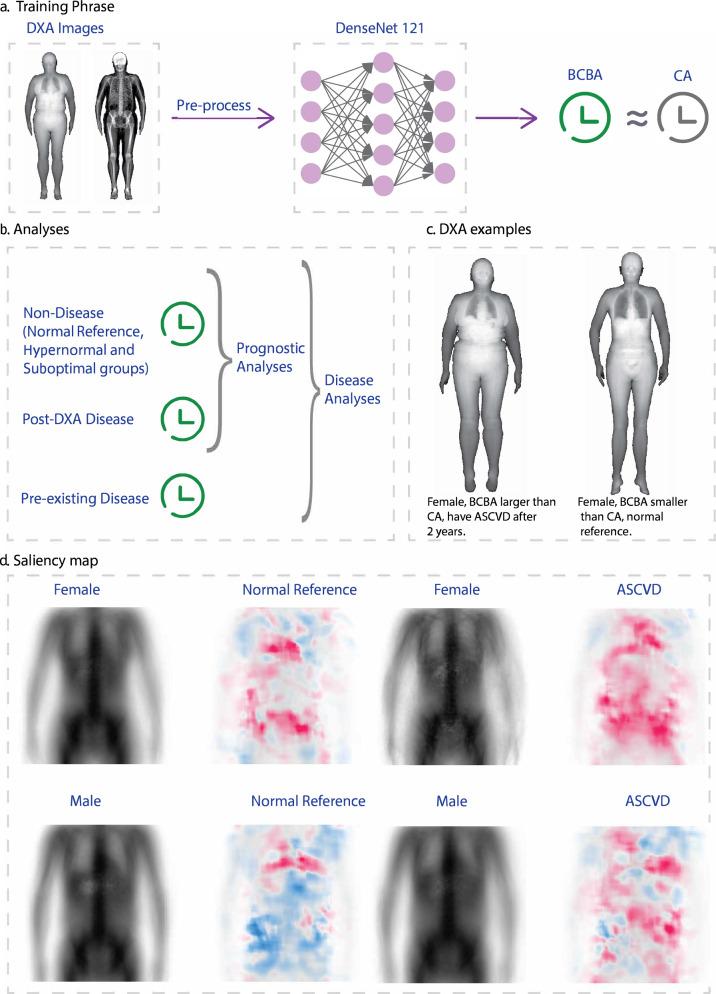
A deep learning model was trained on a reference population from the UK Biobank to estimate body composition biological age (BCBA). The model's performance was assessed across various groups, including individuals with typical and atypical body composition, those with pre-existing diseases, and those who developed diseases after DXA imaging. Key metrics such as c-index were employed to examine BCBA's diagnostic and prognostic potential for type 2 diabetes, major adverse cardiovascular events (MACE), atherosclerotic cardiovascular disease (ASCVD), and hypertension.
RESULTS
Here we show that BCBA strongly correlates with chronic disease diagnoses and risk prediction. BCBA demonstrated significant associations with type 2 diabetes (odds ratio 1.08 for females and 1.04 for males, p < 0.0005), MACE (odds ratio 1.10 for females and 1.11 for males, p < 0.0005), ASCVD (odds ratio 1.07 for females and 1.10 for males, p < 0.0005), and hypertension (odds ratio 1.06 for females and 1.04 for males, p < 0.0005). It outperformed standard cardiovascular risk profiles in predicting MACE and ASCVD.
CONCLUSIONS
BCBA is a promising biomarker for assessing chronic disease risk and progression, with potential to improve clinical decision-making. Its integration into routine health assessments could aid early disease detection and personalised interventions.
背景
慢性病与身体成分的改变密切相关,但仍需要可靠的生物标志物来评估疾病风险和进展。本研究旨在开发并验证一种基于双能X线吸收测定法(DXA)扫描得出的身体成分的生物学年龄指标,为评估健康状况和预测疾病结局提供一种新方法。
方法
在来自英国生物银行的参考人群上训练一个深度学习模型,以估计身体成分生物学年龄(BCBA)。在包括具有典型和非典型身体成分的个体、患有既往疾病的个体以及在DXA成像后患病的个体等不同组中评估该模型的性能。采用诸如c指数等关键指标来检验BCBA对2型糖尿病、主要不良心血管事件(MACE)、动脉粥样硬化性心血管疾病(ASCVD)和高血压的诊断及预后潜力。
结果
我们在此表明,BCBA与慢性病诊断和风险预测密切相关。BCBA与2型糖尿病(女性优势比为1.08,男性为1.04,p<0.0005)、MACE(女性优势比为1.10,男性为1.11,p<0.0005)、ASCVD(女性优势比为1.07,男性为1.10,p<0.0005)和高血压(女性优势比为1.06,男性为1.04,p<0.0005)显著相关。在预测MACE和ASCVD方面,它优于标准心血管风险概况。
结论
BCBA是一种有前景的用于评估慢性病风险和进展的生物标志物,具有改善临床决策的潜力。将其纳入常规健康评估可有助于早期疾病检测和个性化干预。


 Zotero 插件