
从简单物质中选择性合成大面积单层硫化锡
Selective Synthesis of Large-Area Monolayer Tin Sulfide from Simple Substances.
作者信息
Koyama Kazuki, Ishihara Jun, Matsui Nozomi, Mori Atsuhiko, Li Sicheng, Yang Jinfeng, Entani Shiro, Odagawa Takeshi, Aoyama Makito, Zhang Chaoliang, Fan Ye, Kitakami Ibuki, Yamamoto Sota, Omori Toshihiro, Cho Yasuo, Hofmann Stephan, Kohda Makoto
机构信息
Department of Materials Science, Graduate School of Engineering, Tohoku University, Sendai 980-8579, Japan.
Electrical Engineering Division, Department of Engineering, University of Cambridge, Cambridge CB3 0FA, United Kingdom.
出版信息
Nano Lett. 2025 Jun 25;25(25):9985-9993. doi: 10.1021/acs.nanolett.5c01639. Epub 2025 May 20.
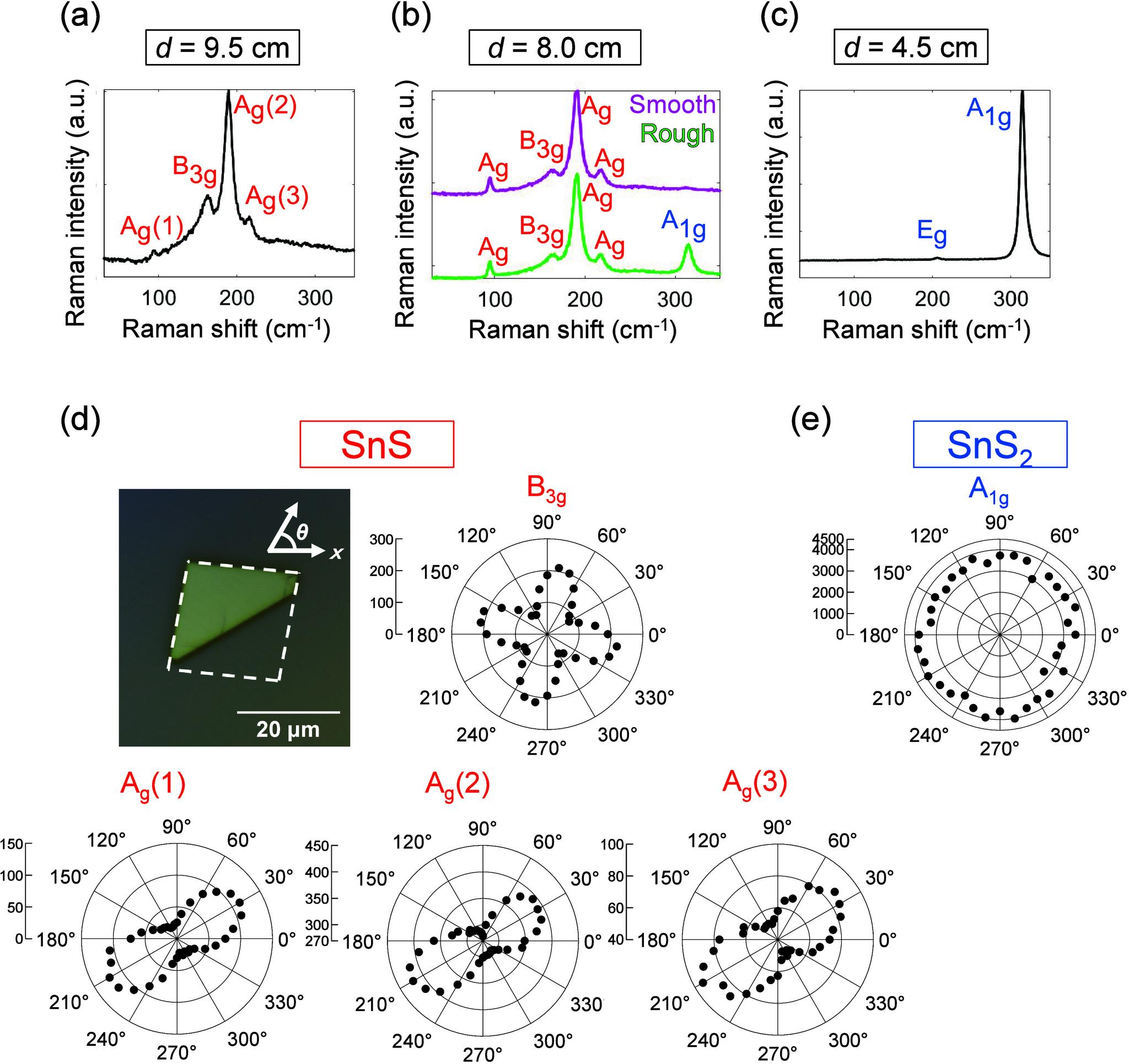
Both tin monosulfide (SnS) and tin disulfide (SnS) are thermodynamically stable layered materials with the potential for spin-valleytronic devices and photodetectors. Notably, SnS, owing to its low symmetry, exhibits interesting properties such as ferroelectricity, shift-current, and a persistent spin helix state in the monolayer limit. Unlike SnS, however, creating large-area atomic-thickness crystals of SnS is challenging, owing to the enhanced interlayer interactions caused by lone pair electrons. Here, we demonstrate that p-type SnS can be selectively grown by varying the sulfur vapor concentration relative to tin using high-purity elemental precursors in a chemical vapor deposition setup. Based on that, we further show that monolayer SnS crystals, up to several tens of micrometers in lateral scale, can be obtained by controlled sublimation of bulk SnS crystals. These findings pave the way for device applications based on high-quality tin sulfide.
硫化亚锡(SnS)和二硫化锡(SnS₂)都是热力学稳定的层状材料,具有用于自旋谷电子器件和光电探测器的潜力。值得注意的是,SnS由于其低对称性,在单层极限下表现出诸如铁电性、转移电流和持久自旋螺旋态等有趣的性质。然而,与SnS₂不同的是,由于孤对电子引起的层间相互作用增强,制备大面积原子厚度的SnS晶体具有挑战性。在这里,我们证明了在化学气相沉积装置中使用高纯度元素前驱体,通过改变相对于锡的硫蒸气浓度可以选择性地生长p型SnS。基于此,我们进一步表明,通过对块状SnS晶体进行可控升华,可以获得横向尺寸达几十微米的单层SnS晶体。这些发现为基于高质量硫化锡的器件应用铺平了道路。




 Zotero 插件