
对约旦口腔健康错误信息的初步洞察;网络内容与信息寻求行为分析
First insight into oral health misinformation in Jordan; an analysis of web content and information-seeking behaviors.
作者信息
Rasheed Issam B, Ababneh Bayan F, Al-Habsheh Yara I
机构信息
Department of Oral Medicine and Oral Surgery, Faculty of Dentistry, Jordan University of Science and Technology, Irbid, Jordan.
Dental Surgery Interns, Faculty of Dentistry, Jordan University of Science and Technology, Irbid, Jordan.
出版信息
PLoS One. 2025 Jun 6;20(6):e0325513. doi: 10.1371/journal.pone.0325513. eCollection 2025.
BACKGROUND
Integrating the internet into daily life has profoundly influenced the public's behavior of seeking health information. Free access to cyberspace created a fertile environment for the spread of oral health misinformation, which can have a detrimental impact on the public's oral health. The prevalence of oral health misinformation in Jordan has not been investigated; therefore, it is crucial to understand how oral health misinformation originates and what contributes to its dissemination.
OBJECTIVES
This study aims to examine the prevalence of oral health misinformation published on web pages in Jordan and to offer insight into the public's information-seeking behaviors regarding oral health.
METHODS
This study is a mixed methods infodemiological analysis of oral health misinformation. A systematic content analysis was executed on web pages published in the Arabic language in Jordan from 2019 to 2023.
RESULTS
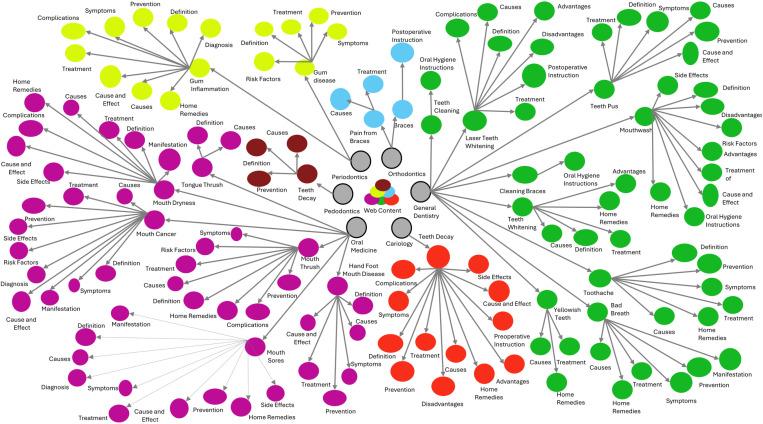
704 web pages were retrieved, of which 320 relevant web pages were included in the content analysis. Among these, 193 web pages (60.3%) published oral health misinformation. Publishers without a professional background published 185 web pages (95.9%) of the total misinformation-expressing web pages. According to the dental field, the highest frequency of misinformation occurred in oral medicine-101 web pages (52.3%). The validity of published oral health information was significantly influenced by the publishers' interest (P = 0.006), the articles' main themes (P = 0.005), and the publishers' professional background (P < 0.001). Contextual analysis of oral health misinformation showed significant differences among dental fields (P = 0.019), with the most frequent occurences related to causes (18.8%), home remedies (15.7%), and treatment (15.5%). Geographical variations in interest in oral health searches were observed across Jordanian governorates (P < 0.001), and temporal trends in interest varied significantly across the five-year period(P = 0.019).
CONCLUSION
The findings of this study suggest a need for public health interventions to restrict the dissemination of oral health misinformation.
背景
互联网融入日常生活深刻影响了公众寻求健康信息的行为。免费访问网络空间为口腔健康错误信息的传播创造了肥沃的环境,这可能对公众的口腔健康产生不利影响。约旦口腔健康错误信息的流行情况尚未得到调查;因此,了解口腔健康错误信息的起源以及促成其传播的因素至关重要。
目的
本研究旨在调查约旦网页上发布的口腔健康错误信息的流行情况,并深入了解公众在口腔健康方面的信息寻求行为。
方法
本研究是对口腔健康错误信息的混合方法信息流行病学分析。对2019年至2023年在约旦以阿拉伯语发布的网页进行了系统的内容分析。
结果
检索到704个网页,其中320个相关网页被纳入内容分析。其中,193个网页(60.3%)发布了口腔健康错误信息。没有专业背景的发布者发布了185个网页(占表达错误信息的网页总数的95.9%)。根据牙科领域,错误信息出现频率最高的是口腔医学——101个网页(52.3%)。已发布的口腔健康信息的有效性受到发布者的兴趣(P = 0.006)、文章的主要主题(P = 0.005)和发布者的专业背景(P < 0.001)的显著影响。口腔健康错误信息的语境分析显示,不同牙科领域之间存在显著差异(P = 0.019),最常出现的与病因(18.8%)、家庭疗法(15.7%)和治疗(15.5%)有关。约旦各省份在口腔健康搜索兴趣方面存在地理差异(P < 0.001),并且在这五年期间兴趣的时间趋势也有显著变化(P = 0.019)。
结论
本研究结果表明需要采取公共卫生干预措施来限制口腔健康错误信息的传播。

 Zotero 插件