
基于树突状细胞的癌症疫苗:调节固有淋巴细胞对抗肿瘤疗效的影响
Dendritic Cell-Based Cancer Vaccines: The Impact of Modulating Innate Lymphoid Cells on Anti-Tumor Efficacy.
作者信息
Mehrani Yeganeh, Morovati Solmaz, Keivan Fatemeh, Sarmadi Soroush, Shojaei Sina, Forouzanpour Diba, Bridle Byram W, Karimi Khalil
机构信息
Department of Pathobiology, Ontario Veterinary College, University of Guelph, Guelph, ON N1G 2W1, Canada.
Division of Biotechnology, Department of Pathobiology, School of Veterinary Medicine, Shiraz University, Shiraz 71557-13876, Iran.
出版信息
Cells. 2025 May 30;14(11):812. doi: 10.3390/cells14110812.
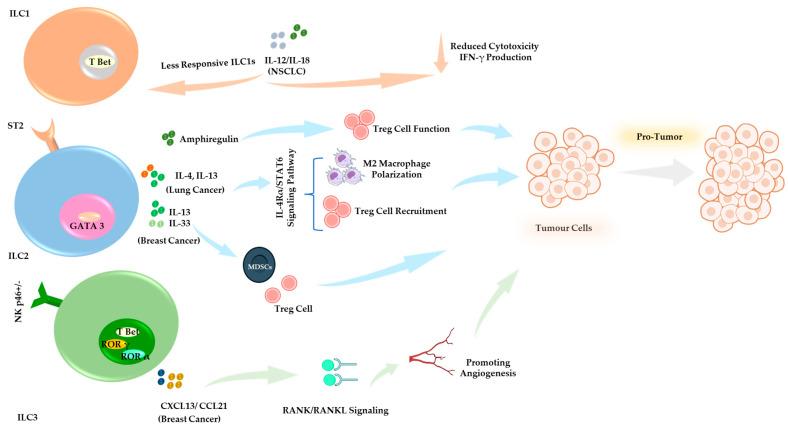
Dendritic cell (DC) vaccines stimulate the immune system to target cancer antigens, representing a promising option for immunotherapy. However, clinical trials have demonstrated limited effectiveness, emphasizing the need for enhanced immune responses. Improving the production of DC vaccines, assessing their impact on immune components, and observing responses could improve the results of DC-based therapies. Innate lymphoid cells (ILCs) represent a heterogeneous population of innate immune components that generate cytokines and modulate the immune system, potentially enhancing immunotherapies. Recent research highlights the different functions of ILCs in cancer, demonstrating their dual capabilities to promote tumors and exhibit anti-tumor actions. DCs and ILCs actively communicate under physiological and pathological conditions, and the activation of ILCs by DCs or DC vaccines has been shown to influence ILC cytokine production and function. Gaining insights into the interaction between DC-activated ILCs and tumors is essential for creating exciting new therapeutic strategies. These strategies aim to boost anti-tumor immunity while reducing the support that tumors receive. This review examines the effect of DC vaccination on host ILCs, illustrating the complex relationship between DC-based vaccines and ILCs. Furthermore, it explores some exciting strategies to enhance DC vaccines, aiming to boost anti-tumor immune responses by fostering better engagement with ILCs.
树突状细胞(DC)疫苗可刺激免疫系统靶向癌症抗原,是免疫疗法的一个有前景的选择。然而,临床试验表明其有效性有限,这凸显了增强免疫反应的必要性。改进DC疫苗的生产、评估其对免疫成分的影响以及观察反应可能会改善基于DC的治疗效果。固有淋巴细胞(ILC)是固有免疫成分的异质性群体,可产生细胞因子并调节免疫系统,有可能增强免疫疗法。最近的研究突出了ILC在癌症中的不同功能,表明它们具有促进肿瘤和展现抗肿瘤作用的双重能力。DC和ILC在生理和病理条件下会积极相互作用,并且已证明DC或DC疫苗激活ILC会影响ILC细胞因子的产生和功能。深入了解DC激活的ILC与肿瘤之间的相互作用对于制定令人兴奋的新治疗策略至关重要。这些策略旨在增强抗肿瘤免疫力,同时减少肿瘤获得的支持。本综述研究了DC疫苗接种对宿主ILC的影响,阐述了基于DC的疫苗与ILC之间的复杂关系。此外,还探讨了一些增强DC疫苗的令人兴奋的策略,旨在通过促进与ILC更好地相互作用来增强抗肿瘤免疫反应。




 Zotero 插件