
伴有腺泡成分的肺腺癌的临床病理特征、分子特征及预后的综合评估
A Comprehensive Evaluation of Clinicopathologic Characteristics, Molecular Features and Prognosis in Lung Adenocarcinoma with an Acinar Component.
作者信息
Abolfathi Hanie, Kordahi Manal, Armero Victoria Saavedra, Gaudreault Nathalie, Boudreau Dominique K, Gagné Andréanne, Orain Michèle, Fiset Pierre Oliver, Desmeules Patrice, Lamaze Fabien Claude, Bossé Yohan, Joubert Philippe
机构信息
Institut Universitaire de Cardiologie et de Pneumologie de Québec, Laval University, Quebec, QC G1V 4G5, Canada.
Department of Pathology, McGill University, Montreal, QC H3A 0G4, Canada.
出版信息
Cancers (Basel). 2025 May 30;17(11):1825. doi: 10.3390/cancers17111825.
INTRODUCTION
Lung adenocarcinoma (LUAD) is the leading cause of cancer-related mortality worldwide. Acinar is the most prevalent architectural pattern and is associated with an intermediate prognosis. Several studies have investigated the prognosis of acinar-predominant LUAD patients. Here, we aimed to move beyond the acinar-predominant classification and gain a more comprehensive understanding of how acinar minor components influence prognosis specifically when accompanying other histological patterns in LUAD.
METHODS
Patients were grouped by the proportion of acinar patterns in their tumors: acinar-predominant (AP), and acinar component (AC; non-acinar predominant LUAD with an acinar component of ≥5%). The clinicopathologic characteristics, recurrence-free survival (RFS), and a panel of well-characterized driver mutations, including , , , , and , were investigated in the two groups of patients.
RESULTS
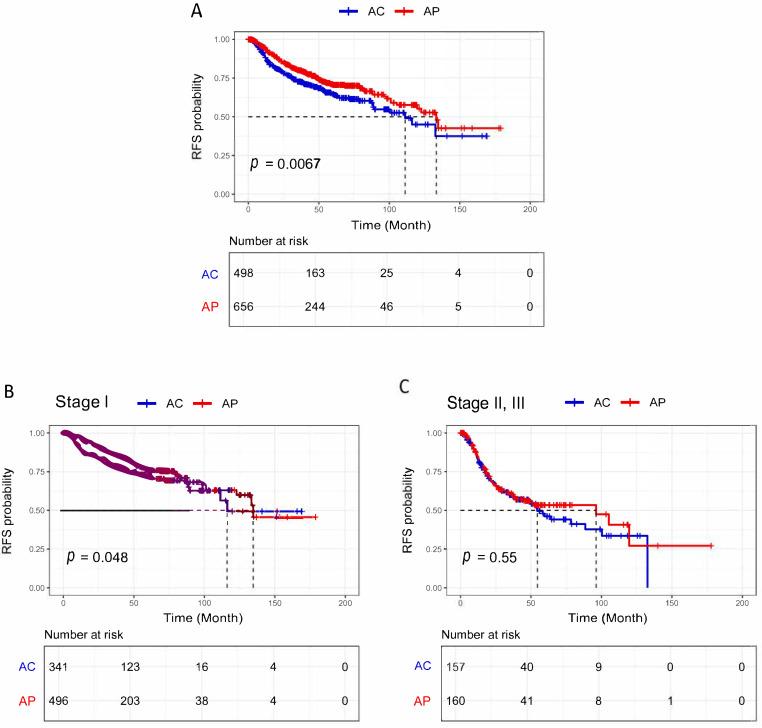
Among 1263 LUAD patients, 716 (56.7%) were AP, and 547 (43.3%) were AC. In AP, the frequency of exon 19 deletions () was significantly higher than in AC ( = 0.014). AC demonstrated a worse RFS than AP in the unadjusted analysis (log-rank : 0.006). In stage I, the difference in the RFS of AC in comparison to AP remained significant ( = 0.048). In the multivariable analysis, AC was significantly associated with a worse RFS in comparison to AP (hazard ratio [HR] AC vs. AP: 1.240, 95% CI: 1.103-1.312, : 0.04), even after adjusting for other histological patterns, the mutational status, and relevant clinicopathological features. The post-recurrence survival was significantly better in patients with an acinar component of ≥5% who received EGFR tyrosine kinase inhibitors (TKIs) compared to those who did not receive TKIs ( = 0.033).
CONCLUSIONS
While the predominant pattern primarily dictates prognosis in LAUD, the presence of an acinar minor component alongside other high-grade patterns may further worsen outcomes. This underscores the necessity of considering the broader histological landscape rather than focusing solely on predominant patterns, as our findings show that minor acinar components can impact RFS alongside other histological patterns.
引言
肺腺癌(LUAD)是全球癌症相关死亡的主要原因。腺泡状是最常见的结构模式,与中等预后相关。多项研究调查了以腺泡状为主的LUAD患者的预后。在此,我们旨在超越以腺泡状为主的分类,更全面地了解腺泡状次要成分如何具体影响预后,特别是当它与LUAD中的其他组织学模式同时出现时。
方法
根据肿瘤中腺泡状模式的比例对患者进行分组:腺泡状为主(AP)和腺泡成分(AC;非腺泡状为主的LUAD,腺泡成分≥5%)。在两组患者中研究了临床病理特征、无复发生存期(RFS)以及一组特征明确的驱动基因突变,包括 、 、 、 和 。
结果
在1263例LUAD患者中,716例(56.7%)为AP,547例(43.3%)为AC。在AP组中,第19外显子缺失( )的频率显著高于AC组( = 0.014)。在未调整分析中,AC组的RFS比AP组差(对数秩检验: 0.006)。在I期,AC组与AP组相比,RFS的差异仍然显著( = 0.048)。在多变量分析中,与AP组相比,AC组与更差的RFS显著相关(风险比[HR],AC组与AP组:1.240,95%置信区间:1.103 - 1.312, = 0.04),即使在调整了其他组织学模式、突变状态和相关临床病理特征后也是如此。与未接受表皮生长因子受体酪氨酸激酶抑制剂(TKIs)的患者相比,接受EGFR-TKIs治疗的腺泡成分≥5%的患者复发后的生存期显著更好( = 0.033)。
结论
虽然主要模式在很大程度上决定了LUAD的预后,但腺泡状次要成分与其他高级别模式同时存在可能会进一步恶化预后。这强调了考虑更广泛的组织学情况的必要性,而不是仅仅关注主要模式,因为我们的研究结果表明,腺泡状次要成分可与其他组织学模式一起影响RFS。


 Zotero 插件