
外墙材料中的封装型杀生剂会影响浸出和紫外线稳定性,从而降低洗脱液的水生毒性。
Encapsulated biocides in facade materials impact leaching and UV stability, resulting in lower aquatic toxicity of the eluates.
作者信息
Nichterlein Moritz, Kiefer Nadine, Hohner Jenny, Stapf Dominik, Schatz Madeleine, Noll Matthias, Kalkhof Stefan
机构信息
Institute for Bioanalysis, University of Applied Sciences Coburg, Coburg, Germany.
Institute for Analytical Chemistry, Universität Leipzig, Leipzig, Germany.
出版信息
Environ Sci Pollut Res Int. 2025 Jun;32(27):16324-16339. doi: 10.1007/s11356-025-36647-2. Epub 2025 Jun 25.
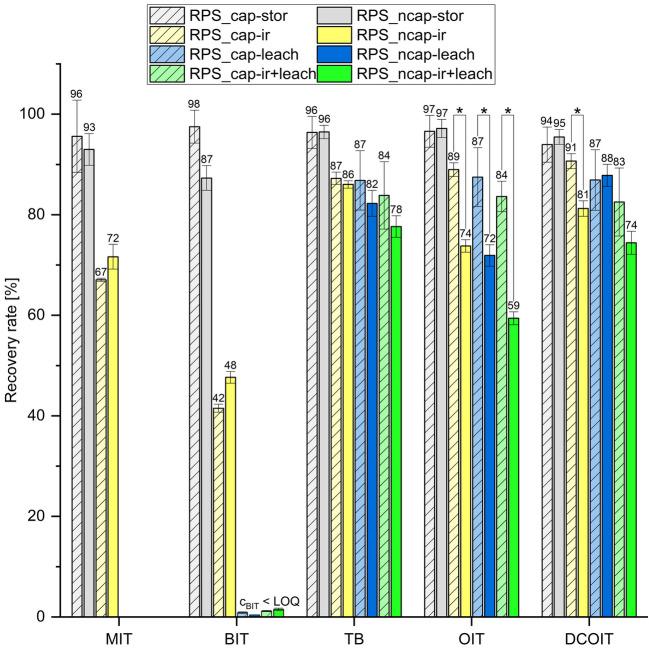
In the construction or reconstruction of building facades, user-friendly, dispersion-based renders and paints, which contain organic polymers, are increasingly being used. These materials are susceptible to microbial colonization, potentially causing both esthetic and structural damages. To prevent this, biocides are often added, which in turn can have harmful environmental effects after leaching induced by wind-driven rain. To reduce leaching rates, biocides are widely utilized in encapsulated form. In this study, we investigated, using test facades and standardized leaching with and without sunlight irradiation, whether and to what extent sunlight-caused UV exposure additionally impacts the leaching of encapsulated biocides compared to unencapsulated biocides, and how this affects the chemical composition as well as the toxicity of the resulting eluates. Our results show that encapsulation significantly improves the UV stability of the biocides 2-Octyl-1,2-thiazol-3-one (OIT) and 4,5-Dichloro-2-octyl-1,2-thiazol-3-one (DCOIT), thereby extending their effectiveness in facade materials, while Terbutryn is only slightly affected. Furthermore, encapsulation leads to a reduction in the concentrations of the leached biocides, both without and especially with irradiation, along with a corresponding decrease in the toxicity of the eluates towards aquatic model organisms, luminescent bacteria, and green algae. These findings emphasize the relevance of encapsulation as an effective strategy for improving the sustainability and safety of biocides in facade materials, as well as the need to consider the influence of UV irradiation in toxicological evaluations of renders and paints.
在建筑外立面的新建或重建过程中,越来越多地使用含有有机聚合物的、用户友好型的、基于分散体的抹灰和涂料。这些材料易受微生物定植影响,可能导致美观和结构损坏。为防止这种情况,通常会添加杀生剂,而这些杀生剂在风雨淋洗后可能会产生有害的环境影响。为降低淋洗率,杀生剂广泛以胶囊形式使用。在本研究中,我们使用测试外立面并采用有阳光照射和无阳光照射的标准化淋洗方法,研究与未封装的杀生剂相比,阳光引起的紫外线照射是否以及在多大程度上会额外影响封装杀生剂的淋洗,以及这如何影响所得洗脱液的化学成分和毒性。我们的结果表明,封装显著提高了杀生剂2-辛基-1,2-噻唑-3-酮(OIT)和4,5-二氯-2-辛基-1,2-噻唑-3-酮(DCOIT)的紫外线稳定性,从而延长了它们在外墙材料中的有效性,而特丁净仅受到轻微影响。此外,封装导致淋洗出的杀生剂浓度降低,无论有无照射,尤其是有照射时,同时洗脱液对水生模式生物、发光细菌和绿藻的毒性相应降低。这些发现强调了封装作为提高外墙材料中杀生剂可持续性和安全性的有效策略的相关性,以及在抹灰和涂料的毒理学评估中考虑紫外线照射影响的必要性。



 Zotero 插件