
面向可扩展量子网络的光子结构中固态量子发射器的原位三维应变工程
In situ three-dimensional strain engineering of solid-state quantum emitters in photonic structures towards scalable quantum networks.
作者信息
Chen Yan, Li Xueshi, Liu Shunfa, Yang Jiawei, Wei Yuming, Xiong Kaili, Wang Yangpeng, Wang Jiawei, Chen Pingxing, Li Xiao, Zhang Chaofan, Yu Ying, Jiang Tian, Liu Jin
机构信息
College of Advanced Interdisciplinary Studies, National University of Defense Technology, 410073, Changsha, China.
Institute for Quantum Science and Technology, College of Science, National University of Defense Technology, 410073, Changsha, China.
出版信息
Nat Commun. 2025 Jul 1;16(1):5564. doi: 10.1038/s41467-025-60403-2.
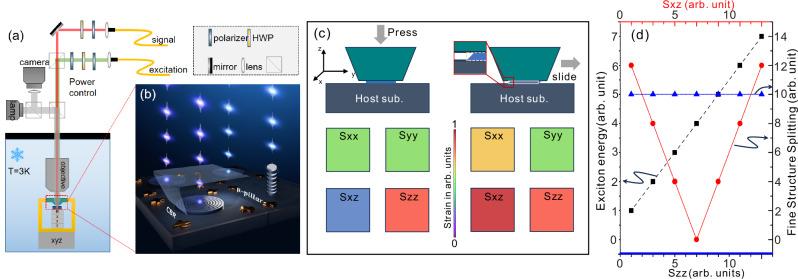
Solid-state quantum emitters are pivotal for modern photonic quantum technology, yet their inherent spectral inhomogeneity imposes a critical challenge in pursuing scalable quantum network. Here, we develop a cryogenic-compatible strain-engineering platform based on a polydimethylsiloxane (PDMS) stamp, which we show can also work properly at cryogenic temperature. In-situ three-dimensional (3D) strain control is achieved for quantum dots (QDs) embedded in photonic nanostructures. The compliant PDMS enables independent tuning of emission energy and strong reduction of fine structure splitting (FSS) of single QDs, as demonstrated by a 7 meV spectral shift with a near-vanishing FSS in circular Bragg resonators and an unprecedented 15 meV tuning range in the micropillar. The PDMS-based 3D strain-engineering platform, compatible with diverse photonic structures at cryogenic temperature, provides a powerful and versatile tool for exploring fundamental strain-related physics and advancing integrated photonic quantum technology.
固态量子发射器对现代光子量子技术至关重要,然而其固有的光谱不均匀性在构建可扩展量子网络方面带来了严峻挑战。在此,我们基于聚二甲基硅氧烷(PDMS)印章开发了一种低温兼容的应变工程平台,该平台在低温下也能正常工作。对于嵌入光子纳米结构中的量子点(QD),实现了原位三维(3D)应变控制。柔性PDMS能够独立调节发射能量,并显著降低单个量子点的精细结构分裂(FSS),如在圆形布拉格谐振器中实现了7 meV的光谱位移且FSS几乎消失,在微柱中实现了前所未有的15 meV调谐范围。基于PDMS的3D应变工程平台在低温下与多种光子结构兼容,为探索与应变相关的基础物理以及推动集成光子量子技术发展提供了强大且通用的工具。



 Zotero 插件