
硫丹诱导肝损伤的单细胞转录组学见解:关键途径与炎症反应
Single-cell transcriptomic insights into endosulfan-induced liver injury: Key pathways and inflammatory responses.
作者信息
Huang Pan, Bai Yunmeng, Zhou Chaohua, Zhong Xiaoru, Iyaswamy Ashok, Chen Peng, Wei Xu, Zhang Wei, Yang Chuanbin, Wang Jigang
机构信息
Department of Epidemiology, School of Public Health, Guangxi Medical University, Nanning, Guangxi, China.
Department of Critical Care Medicine, Guangdong Provincial Clinical Research Center for Geriatrics, Shenzhen Clinical Research Center for Geriatrics, Shenzhen People's Hospital (The Second Clinical Medical College, Jinan University; The First Affiliated Hospital, Southern University of Science and Technology), Shenzhen, Guangdong, China.
出版信息
Liver Res. 2025 May 17;9(2):144-156. doi: 10.1016/j.livres.2025.05.002. eCollection 2025 Jun.
BACKGROUND AND AIMS
Environmental pollutants, particularly organochlorine insecticides like endosulfan (ENDO), are increasingly linked to liver toxicity and related diseases. Despite its widespread historical use, the mechanisms underlying ENDO-induced liver damage remain poorly understood. This study aims to elucidate the cellular and molecular mechanisms of ENDO-induced hepatotoxicity.
METHODS
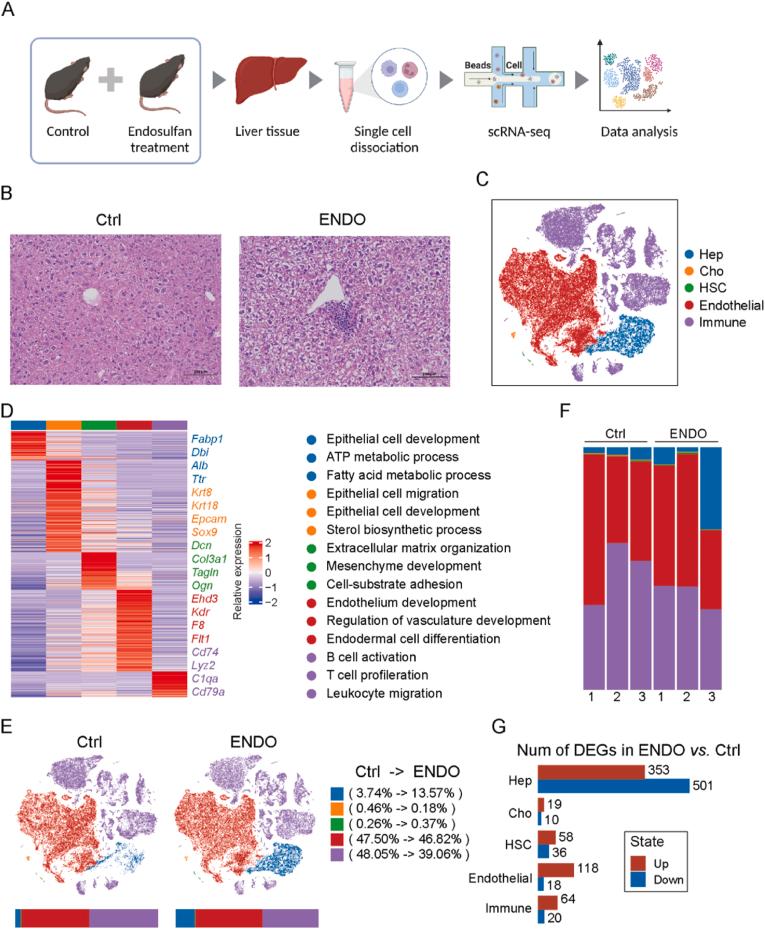
C57BL/6 mice were exposed to ENDO for two weeks. Single-cell RNA sequencing (scRNA-seq) was subsequently performed on mouse livers to explore ENDO-induced hepatotoxicity at the single-cell level. Differentially expressed genes (DEGs) across cell types and treatments were identified and then subjected to pathway enrichment to uncover key biological processes affected by ENDO. Transcription factor (TF) regulatory network, pseudotime trajectory, and cellular communication analysis were used to explore the molecular and cellular changes after ENDO exposure.
RESULTS
ENDO not only caused direct hepatocyte injury but also activated hepatic stellate cells and lymphocytes, triggering inflammatory responses with upregulation of multiple key chemokines and cytotoxic genes. Additionally, ENDO exposure led to the recruitment and activation of myeloid cells, contributing to the inflammatory milieu. An increase in intercellular communication and changes to the hepatic microenvironment, especially the interaction between activated hepatic stellate cells and CD8 T cells were observed, further implicating these processes in ENDO-induced liver damage.
CONCLUSIONS
This study provides new insights into the cellular and molecular mechanisms underlying liver injury induced by organochlorine insecticides like ENDO. Key genes and pathways involved in ENDO-associated liver toxicity have been identified at a single-cell resolution. These findings suggest that altered cellular communications and inflammatory responses may play pivotal roles in the pathogenesis of ENDO-induced liver injury.
背景与目的
环境污染物,尤其是像硫丹(ENDO)这样的有机氯杀虫剂,与肝脏毒性及相关疾病的关联日益紧密。尽管其在历史上被广泛使用,然而ENDO诱导肝损伤的潜在机制仍知之甚少。本研究旨在阐明ENDO诱导肝毒性的细胞和分子机制。
方法
将C57BL/6小鼠暴露于ENDO两周。随后对小鼠肝脏进行单细胞RNA测序(scRNA-seq),以在单细胞水平上探究ENDO诱导的肝毒性。鉴定不同细胞类型和处理组之间的差异表达基因(DEG),然后进行通路富集以揭示受ENDO影响的关键生物学过程。利用转录因子(TF)调控网络、伪时间轨迹和细胞通讯分析来探索ENDO暴露后的分子和细胞变化。
结果
ENDO不仅导致直接的肝细胞损伤,还激活肝星状细胞和淋巴细胞,通过上调多个关键趋化因子和细胞毒性基因引发炎症反应。此外,ENDO暴露导致髓系细胞的募集和激活,促成炎症环境。观察到细胞间通讯增加以及肝脏微环境的变化,特别是激活的肝星状细胞与CD8 T细胞之间的相互作用,进一步表明这些过程与ENDO诱导的肝损伤有关。
结论
本研究为像ENDO这样的有机氯杀虫剂诱导肝损伤的细胞和分子机制提供了新的见解。已在单细胞分辨率下鉴定出与ENDO相关肝毒性有关的关键基因和通路。这些发现表明,细胞通讯改变和炎症反应可能在ENDO诱导肝损伤的发病机制中起关键作用。




 Zotero 插件