
急性呼吸道感染导致的死亡与空腹血糖升高及低密度脂蛋白/小而密低密度脂蛋白水平降低有关。
Deaths from Acute Respiratory Infections are Linked to High Fasting Blood Glucose and Decreased Levels of Low-Density Lipoprotein/Small Dense Low-Density Lipoprotein.
作者信息
Li Li, Du Wei, Song Jing, Lu Ye, Wan Jing, Wang Wenjie, Feng Yunhai, Yin Jun
机构信息
Department of Endocrinology and Metabolism, Shanghai Eighth People's Hospital, Shanghai, People's Republic of China.
Department of Otolaryngology, Head and Neck Surgery, Shanghai Eighth People's Hospital, Shanghai, People's Republic of China.
出版信息
Int J Gen Med. 2025 Jun 30;18:3557-3567. doi: 10.2147/IJGM.S516326. eCollection 2025.
PURPOSE
Winter poses a significant threat to acute respiratory infections (ARIs), often leading to severe outcomes including mortality. This study investigated the effect of glucose and lipid metabolism on mortality rates among individuals with ARIs.
PATIENTS AND METHODS
We collected clinical data including indicators related to glucose and lipid metabolism, liver and kidney function, complete blood count, coagulation function, and other parameters from 1675 hospitalized patients with ARIs who were consecutively admitted during the winter season. The clinical characteristics and influencing factors associated with mortality in these patients were analyzed.
RESULTS
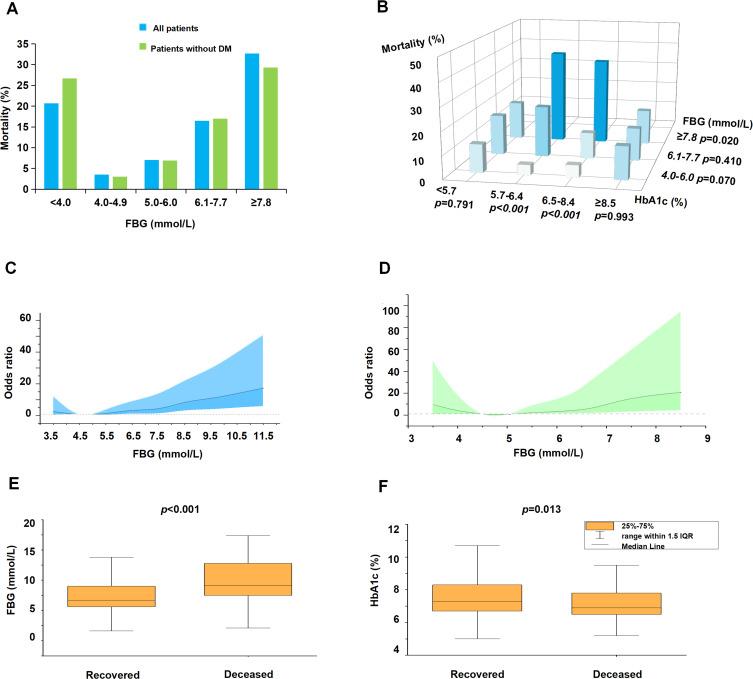
Risk factors contributing to mortality in patients with ARIs include fasting blood glucose (FBG), low-density lipoprotein (LDL), apolipoprotein E (ApoE), small dense LDL (sdLDL), D-dimer, lymphocyte count, blood urea nitrogen, and a history of diabetes. Notably, when FBG above 7.8 mmol/L, mortality followed a parabolic association with HbA1c-lowest at extremes (<5.7% or ≥8.5%) but markedly higher in the mid-range (5.7-8.4%). Among patients with diabetes, those who succumbed to the infection exhibited higher FBG levels but lower glycated hemoglobin (HbA1c) levels than those who recovered. Moreover, low levels of LDL/sdLDL and high levels of ApoE were inversely and positively linked, respectively, to mortality rates.
CONCLUSION
In patients with ARIs, FBG level, rather than HbA1c level, is a risk factor for mortality. Moreover, low LDL/sdLDL levels and high ApoE levels are associated with increased mortality. The retrospective design and lack of long-term follow-up may limit the findings, highlighting the need for prospective validation.
目的
冬季对急性呼吸道感染(ARI)构成重大威胁,常导致包括死亡在内的严重后果。本研究调查了糖脂代谢对ARI患者死亡率的影响。
患者与方法
我们收集了1675例冬季连续入院的ARI住院患者的临床数据,包括与糖脂代谢、肝肾功能、全血细胞计数、凝血功能及其他参数相关的指标。分析了这些患者的临床特征及与死亡相关的影响因素。
结果
ARI患者死亡的危险因素包括空腹血糖(FBG)、低密度脂蛋白(LDL)、载脂蛋白E(ApoE)、小而密LDL(sdLDL)、D-二聚体、淋巴细胞计数、血尿素氮及糖尿病史。值得注意的是,当FBG高于7.8 mmol/L时,死亡率与糖化血红蛋白(HbA1c)呈抛物线关系,在极端值(<5.7%或≥8.5%)时最低,但在中间范围(5.7 - 8.4%)时明显更高。在糖尿病患者中,死于感染的患者比康复患者的FBG水平更高,但糖化血红蛋白(HbA1c)水平更低。此外,低水平的LDL/sdLDL和高水平的ApoE分别与死亡率呈负相关和正相关。
结论
在ARI患者中,FBG水平而非HbA1c水平是死亡的危险因素。此外,低LDL/sdLDL水平和高ApoE水平与死亡率增加有关。回顾性设计和缺乏长期随访可能会限制研究结果,这突出了前瞻性验证的必要性。


 Zotero 插件