
一种使用奥罗拉系统对神经肌肉接头和骨骼肌功能进行定量电生理评估的优化体外实验方案。
An Optimized Ex Vivo Protocol for Quantitative Electrophysiological Assessment of Neuromuscular Junctions and Skeletal Muscle Function Using the Aurora System.
作者信息
Cui Can, Bao Zhengyuan, Chow Simon Kwoon-Ho, Wang Qianjin, Chai Senlin, Xu Zhihong, Jiang Qing, Cheung Wing Hoi
机构信息
Musculoskleletal Research Laboratory, Department of Orthopaedics and Traumatology, Prince of Wales Hospital, The Chinese University of Hong Kong, Hong Kong SAR, China.
Li Ka Shing Institute of Health Sciences, The Chinese University of Hong Kong, Hong Kong SAR, China.
出版信息
Bio Protoc. 2025 Jun 20;15(12):e5353. doi: 10.21769/BioProtoc.5353.
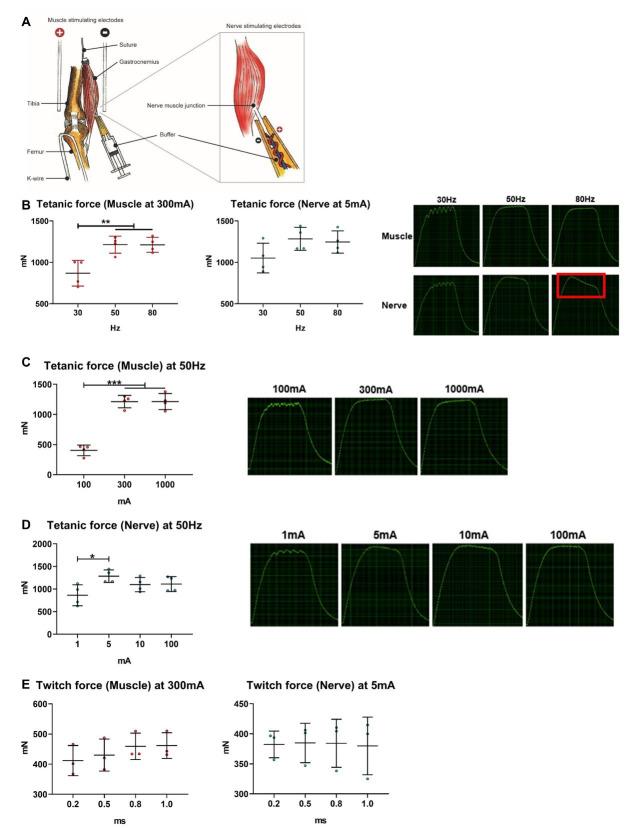
The neuromuscular junction (NMJ) is critical for muscle function, and its dysfunction underlies conditions such as sarcopenia and motor neuron diseases. Current protocols for assessing NMJ function often lack standardized stimulation parameters, limiting reproducibility. This study presents an optimized ex vivo method to evaluate skeletal muscle and NMJ function using the Aurora Scientific system, incorporating validated stimulation protocols for both nerve and muscle to ensure consistency. Key steps include tissue preparation in a low-calcium, high-magnesium solution to preserve NMJ integrity, determination of optimal muscle length, and sequential stimulation protocols to quantify neurotransmission failure and intratetanic fatigue. By integrating rigorous standardization, this approach enhances reproducibility and precision, providing a robust framework for investigating NMJ pathophysiology in aging and disease models. Key features • Dual stimulation modes enable direct muscle and indirect nerve stimulation to isolate NMJ-specific dysfunction. • Optimized stimulation parameters for nerve (5 mA, 0.8 ms pulse width) and muscle (300 mA, 0.2 ms pulse width) on mouse model. • Preservation of NMJ integrity through dissection in low-calcium, high-magnesium artificial cerebrospinal fluid (aCSF) and synthetic interstitial fluid (SIF). • Quantitative analysis of neurotransmission failure and intratetanic fatigue using standardized equations. Ageing Cell (2024), DOI: 10.1111/acel.14156.
神经肌肉接头(NMJ)对肌肉功能至关重要,其功能障碍是肌肉减少症和运动神经元疾病等病症的基础。目前评估NMJ功能的方案往往缺乏标准化的刺激参数,限制了可重复性。本研究提出了一种优化的离体方法,使用奥罗拉科学系统评估骨骼肌和NMJ功能,纳入了经过验证的神经和肌肉刺激方案以确保一致性。关键步骤包括在低钙、高镁溶液中进行组织制备以保持NMJ完整性、确定最佳肌肉长度以及采用顺序刺激方案来量化神经传递失败和强直内疲劳。通过整合严格的标准化,这种方法提高了可重复性和精度,为研究衰老和疾病模型中的NMJ病理生理学提供了一个强大的框架。关键特性 • 双刺激模式可实现直接肌肉刺激和间接神经刺激,以分离NMJ特异性功能障碍。 • 在小鼠模型上针对神经(5 mA,0.8 ms脉冲宽度)和肌肉(300 mA,0.2 ms脉冲宽度)优化了刺激参数。 • 通过在低钙、高镁人工脑脊液(aCSF)和合成组织液(SIF)中进行解剖来保持NMJ完整性。 • 使用标准化方程对神经传递失败和强直内疲劳进行定量分析。 《衰老细胞》(2024年),DOI:10.1111/acel.14156 。




 Zotero 插件