
基于网络药理学对肠道微生物群代谢产物在胰岛素抵抗中作用的见解。
Network pharmacology-based insights into the role of gut microbiota metabolites in insulin resistance.
作者信息
Xiao Bing, Chen Xin, Zong Ruiyu, Guan Yiming, Zhu Zhu, Bi Siling
机构信息
College of Acupuncture and Massage, Shandong University of Traditional Chinese Medicine, Jinan, China.
College of Health Sciences, Shandong University of Traditional Chinese Medicine, Jinan, China.
出版信息
Front Microbiol. 2025 Jun 23;16:1617496. doi: 10.3389/fmicb.2025.1617496. eCollection 2025.
BACKGROUND
Extensive research has demonstrated that the gut microbiota plays a critical role in maintaining homeostasis and promoting overall human health. However, the pharmacological mechanisms and functional roles of gut microbiota metabolites remain insufficiently understood. This study employs a network pharmacology approach to elucidate the metabolic transformation processes of gut microbiota metabolites and their molecular mechanisms in the pathogenesis of insulin resistance (IR), aiming to uncover the complex interactions among gut microbiota, metabolites, and therapeutic targets.
METHODS
Gut microbiota metabolites and their corresponding target genes were retrieved from the gutMGene database. Potential targets of the metabolites were predicted using the SEA and STP databases. Disease-related targets for insulin resistance were collected from the GeneCards, DisGeNET, and OMIM databases. Core targets were identified via a protein-protein interaction (PPI) network, followed by comprehensive GO and KEGG enrichment analyses. Finally, a network illustrating the relationship among microbiota-substrate-metabolite-target was established.
RESULTS
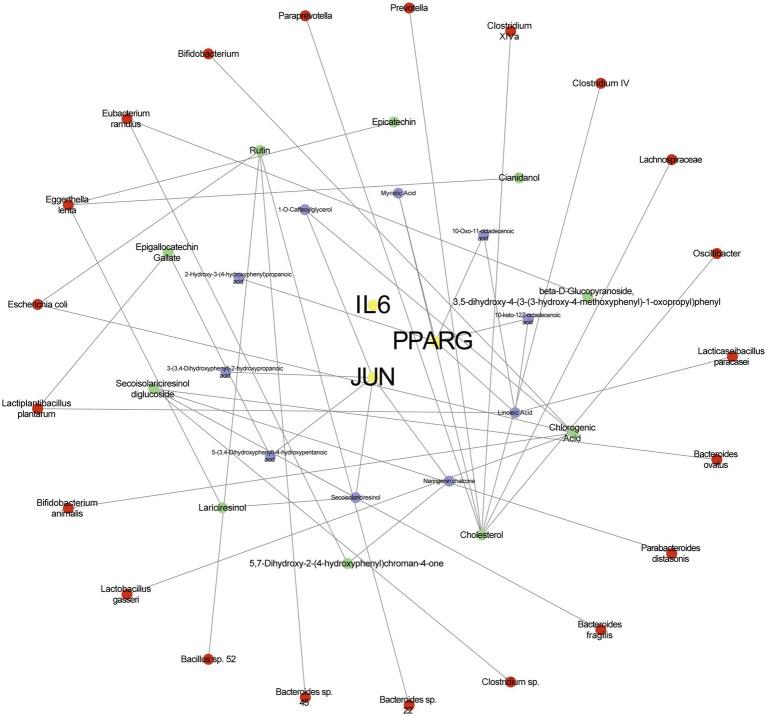
Thirteen overlapping targets between the gut microbiota and insulin resistance were identified, among which IL6, JUN, and PPARG were recognized as hub genes. The MSMT (microbiota-substrate-metabolite-target) network revealed that these three hub genes exert therapeutic effects through 10 gut microbiota metabolites, 10 substrates, and 21 microbial species. KEGG pathway analysis indicated that the IL-17, Toll-like receptor, HIF-1, NOD-like receptor, TNF, and VEGF signaling pathways are the primary pathways involved in the pathogenesis of IR.
CONCLUSION
Gut microbiota metabolites may exert therapeutic effects on insulin resistance primarily through the targets IL6, JUN, and PPARG. The regulatory mechanisms are likely associated with several key signaling pathways, including the IL-17, Toll-like receptor and HIF-1, pathways. These three pathways collectively form an interconnected inflammation-metabolism-hypoxia network. Targeting key nodes within this network-such as the IL-17 receptor, TLR4, or HIF-1α-may offer a multidimensional therapeutic strategy for insulin resistance (IR) and its associated complications.
背景
广泛的研究表明,肠道微生物群在维持体内平衡和促进人类整体健康方面发挥着关键作用。然而,肠道微生物群代谢产物的药理机制和功能作用仍未得到充分了解。本研究采用网络药理学方法,阐明肠道微生物群代谢产物的代谢转化过程及其在胰岛素抵抗(IR)发病机制中的分子机制,旨在揭示肠道微生物群、代谢产物和治疗靶点之间的复杂相互作用。
方法
从gutMGene数据库中检索肠道微生物群代谢产物及其相应的靶基因。使用SEA和STP数据库预测代谢产物的潜在靶点。从GeneCards、DisGeNET和OMIM数据库中收集与胰岛素抵抗相关的疾病靶点。通过蛋白质-蛋白质相互作用(PPI)网络鉴定核心靶点,随后进行全面的基因本体(GO)和京都基因与基因组百科全书(KEGG)富集分析。最后,建立一个阐明微生物群-底物-代谢产物-靶点之间关系的网络。
结果
确定了肠道微生物群与胰岛素抵抗之间的13个重叠靶点,其中白细胞介素6(IL6)、原癌基因蛋白c-Jun(JUN)和过氧化物酶体增殖物激活受体γ(PPARG)被识别为枢纽基因。微生物群-底物-代谢产物-靶点(MSMT)网络显示,这三个枢纽基因通过10种肠道微生物群代谢产物、10种底物和21种微生物发挥治疗作用。KEGG通路分析表明,白细胞介素-17(IL-17)、Toll样受体、低氧诱导因子-1(HIF-1)、核苷酸结合寡聚化结构域样受体、肿瘤坏死因子(TNF)和血管内皮生长因子(VEGF)信号通路是参与IR发病机制的主要通路。
结论
肠道微生物群代谢产物可能主要通过IL6、JUN和PPARG靶点对胰岛素抵抗发挥治疗作用。其调节机制可能与包括IL-17、Toll样受体和HIF-1通路在内的几个关键信号通路有关。这三条通路共同形成一个相互关联的炎症-代谢-缺氧网络。靶向该网络中的关键节点,如IL-17受体、Toll样受体4(TLR4)或HIF-1α,可能为胰岛素抵抗(IR)及其相关并发症提供一种多维治疗策略。


 Zotero 插件