
癌症患者非计划性住院90天死亡率的预测:三种预后评分的回顾性验证研究
Prediction of 90-day mortality among cancer patients with unplanned hospitalisation: a retrospective validation study of three prognostic scores.
作者信息
Uyar Galip Can, Mirallas Oriol, Başkurt Kadriye, Martin-Cullell Berta, Yeşilbaş Enes, Recuero-Borau Jordi, Kaya Seher, Garcés Victor Navarro, Yücel Sevgi Eryıldız, Vega Cano Kreina Sharela, Gómez-Puerto Diego, Gómez Anna Pedrola, Salva de Torres Clara, Çakmak Öksüzoğlu Ömür Berna, Serradell Sonia, Dienstmann Rodrigo, Sütcüoğlu Osman
机构信息
Medical Oncology Department, Etlik City Hospital, Ankara, Turkey.
Medical Oncology Department, Vall d'Hebron Hospital Campus and Vall d'Hebron Institute of Oncology (VHIO), Barcelona, 08035, Spain.
出版信息
Lancet Reg Health Eur. 2025 May 8;54:101317. doi: 10.1016/j.lanepe.2025.101317. eCollection 2025 Jul.
BACKGROUND
Accurate prediction of 90-day mortality in hospitalised cancer patients is critical for guiding personalised treatment decisions and optimising oncologic care. However, existing prognostic models often lack sufficient precision, particularly in distinguishing between high- and low-risk patients. In this retrospective study, we independently evaluated the prognostic performance of three scoring systems-the Prognostic Score for Hospitalised Cancer Patients (PROMISE), the Gustave Roussy Immune (GRIm) score, and the C-reactive protein-Triglyceride-Glucose Index (CTI)-in patients admitted for unplanned hospitalisations.
METHODS
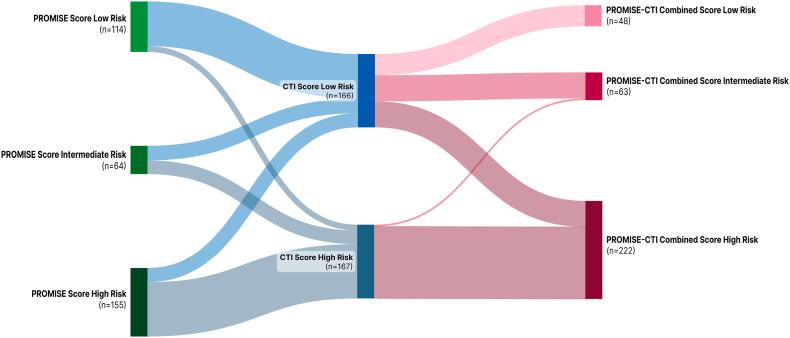
This retrospective observational study was conducted at the Medical Oncology Clinic of Ankara Etlik City Hospital, Turkey, and included patients aged 18 years or older with a diagnosis of cancer who were hospitalised unexpectedly between February 2023 and February 2024. Laboratory data were retrieved from the institutional hospital information system. The PROMISE score was calculated using its original specification via the online tool (https://promise.vhio.net/). The GRIm score was calculated based on neutrophil-to-lymphocyte ratio (NLR), albumin, and lactate dehydrogenase (LDH). The CTI score was computed as: CTI = [0.412 × ln (C-reactive protein [CRP])] + ln [Triglyceride × Glucose/2], with a cut-off value of 4.78. A PROMISE-CTI Combined score was derived using regression-based weighting. Risk stratification was performed for all three scores using validated thresholds. Statistical analyses included Kaplan-Meier survival analysis, log-rank tests, univariable and multivariable logistic regression to assess predictors of 90-day mortality, and receiver operating characteristic (ROC) curve analysis to evaluate discriminatory performance.
FINDINGS
Among 1657 hospitalised cancer patients screened during the study period, 1109 met the inclusion criteria and were included in the analysis. PROMISE and GRIm scores were calculated for all 1109 patients, while CTI score was assessed in 333 patients with complete laboratory data. The 90-day mortality rate was 63.7% (n = 707). High PROMISE score (OR: 3.32, 95% CI: 1.40-7.86; p = 0.006) and high CTI score (OR: 2.85, 95% CI: 1.32-6.18; p = 0.008) were associated with increased 90-day mortality. Low PROMISE score (OR: 0.22, 95% CI: 0.10-0.49; p = 0.001) and low CTI score (OR: 0.35, 95% CI: 0.17-0.73; p = 0.003) were associated with reduced 90-day mortality. High GRIm score (OR: 1.83, 95% CI: 0.83-2.91; p = 0.07) and low GRIm score (OR: 0.73, 95% CI: 0.47-1.20; p = 0.08) were not significantly associated with 90-day mortality. The area under the curve (AUC) of the PROMISE-CTI Combined score was 0.884 (95% CI: 0.849-0.919; p < 0.0001). Sensitivity, specificity, positive predictive value (PPV), negative predictive value (NPV), and accuracy of the PROMISE-CTI Combined score were 92.4%, 81.1%, 85.3%, 89.6%, and 86.7%, respectively.
INTERPRETATION
The PROMISE score demonstrated strong discriminatory ability in predicting 90-day mortality among cancer patients admitted for unplanned hospitalisations. Integration of the CTI score further improved risk stratification by incorporating nutritional and inflammatory markers. The PROMISE-CTI Combined score may serve as a practical clinical tool for short-term prognostic assessment in this setting. Prospective, multicentre, randomised studies are needed to confirm the clinical utility and generalisability of the PROMISE-CTI Combined score.
FUNDING
This study received no funding.
背景
准确预测住院癌症患者的90天死亡率对于指导个性化治疗决策和优化肿瘤护理至关重要。然而,现有的预后模型往往缺乏足够的精度,尤其是在区分高风险和低风险患者方面。在这项回顾性研究中,我们独立评估了三种评分系统——住院癌症患者预后评分(PROMISE)、古斯塔夫·鲁西免疫(GRIm)评分和C反应蛋白-甘油三酯-葡萄糖指数(CTI)——在非计划住院患者中的预后性能。
方法
这项回顾性观察性研究在土耳其安卡拉埃特利克市立医院的肿瘤内科诊所进行,纳入了2023年2月至2024年2月期间意外住院的18岁及以上癌症诊断患者。实验室数据从机构医院信息系统中检索。PROMISE评分通过在线工具(https://promise.vhio.net/)按照其原始规格计算。GRIm评分基于中性粒细胞与淋巴细胞比值(NLR)、白蛋白和乳酸脱氢酶(LDH)计算。CTI评分计算为:CTI = [0.412 × ln(C反应蛋白[CRP])] + ln [甘油三酯×葡萄糖/2],临界值为4.78。使用基于回归的加权得出PROMISE-CTI联合评分。对所有三个评分使用验证阈值进行风险分层。统计分析包括Kaplan-Meier生存分析、对数秩检验、单变量和多变量逻辑回归以评估90天死亡率的预测因素,以及受试者工作特征(ROC)曲线分析以评估区分性能。
结果
在研究期间筛选的1657名住院癌症患者中,1109名符合纳入标准并纳入分析。为所有1109名患者计算了PROMISE和GRIm评分,而在333名有完整实验室数据的患者中评估了CTI评分。90天死亡率为63.7%(n = 707)。高PROMISE评分(OR:3.32,95%CI:1.40 - 7.86;p = 0.006)和高CTI评分(OR:2.85,95%CI:1.32 - 6.18;p = 0.008)与90天死亡率增加相关。低PROMISE评分(OR:0.22,95%CI:0.10 - 0.49;p = 0.001)和低CTI评分(OR:0.35,95%CI:0.17 - 0.73;p = 0.003)与90天死亡率降低相关。高GRIm评分(OR:1.83,95%CI:0.83 - 2.91;p = 0.07)和低GRIm评分(OR:0.73,95%CI:0.47 - 1.20;p = 0.08)与90天死亡率无显著关联。PROMISE-CTI联合评分的曲线下面积(AUC)为0.884(95%CI:0.849 - 0.919;p < 0.0001)。PROMISE-CTI联合评分的敏感性、特异性、阳性预测值(PPV)、阴性预测值(NPV)和准确性分别为92.4%、81.1%、85.3%、89.6%和86.7%。
解读
PROMISE评分在预测非计划住院癌症患者的90天死亡率方面表现出很强的区分能力。CTI评分的整合通过纳入营养和炎症标志物进一步改善了风险分层。PROMISE-CTI联合评分可作为这种情况下短期预后评估的实用临床工具。需要进行前瞻性、多中心、随机研究以确认PROMISE-CTI联合评分的临床实用性和可推广性。
资金
本研究未获得资金。


 Zotero 插件