
社区居住老年人活动能力的决定因素:COVID-19大流行爆发前、期间及两年后的网络分析
Determinants of mobility in community-dwelling older adults: a network analysis before, during, and two years after the onset of the COVID-19 pandemic.
作者信息
Lindeman Katja, Rantanen Taina, Tuomola Essi-Mari, Eronen Johanna, Karavirta Laura, Koivunen Kaisa
机构信息
Faculty of Sport and Health Sciences, Gerontology Research Center, University of Jyväskylä, Jyväskylä, Finland.
出版信息
J Gerontol A Biol Sci Med Sci. 2025 Jul 24;80(8). doi: 10.1093/gerona/glaf162.
BACKGROUND
We conceptualized out-of-home mobility as life space mobility and autonomy outdoors. Both are correlated with quality of life and influenced by multiple underlying factors. We used a complex systems approach and network models to explore changes in networks consisting of out-of-home mobility indicators and their determinants before, during and two years after the onset of the COVID-19 pandemic.
METHODS
Participants were older adults aged 75, 80 and 85 years at baseline (2017-2018), with follow-ups in 2020 and 2021-2022 (n = 607). Life-space mobility, autonomy outdoors, and socio-demographic, physical, psychosocial, financial, and environmental determinants were assessed using the same validated scales at all three time points. Mixed graphical model networks were estimated for each time point. Differences in network properties and the relative importance of determinants associated with life-space mobility and autonomy outdoors were compared across time points.
RESULTS
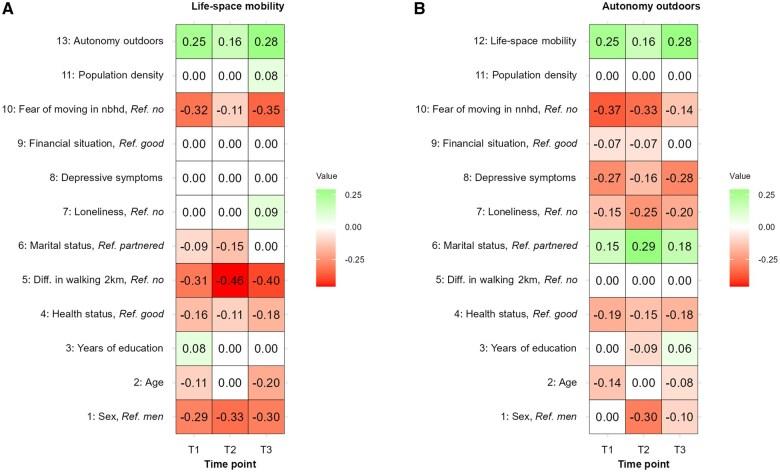
During the COVID-19 pandemic, both life-space mobility and autonomy outdoors declined (P < .05). Throughout the follow-up, walking difficulty and sex remained consistently associated with life-space mobility and psychosocial factors with autonomy outdoors. At the onset of the pandemic, being female (vs male) was more strongly associated with reduced autonomy outdoors than at other times, while the associations with older age and poorer health were weaker.
CONCLUSIONS
The pandemic reduced older adults' out-of-home mobility and altered the factors underlying it. During the pandemic, environmental support for out-of-home mobility diminished as destinations of interest for older people were closed. This especially affected women, potentially leading to less favorable participation trajectories in the future.
背景
我们将户外移动性概念化为生活空间移动性和户外自主性。两者都与生活质量相关,并受到多种潜在因素的影响。我们采用复杂系统方法和网络模型,探讨了由户外移动性指标及其决定因素组成的网络在2019年冠状病毒病大流行开始前、期间和之后两年的变化。
方法
参与者为基线时(2017 - 2018年)年龄在75岁、80岁和85岁的老年人,在2020年以及2021 - 2022年进行随访(n = 607)。在所有三个时间点使用相同的经过验证的量表评估生活空间移动性、户外自主性以及社会人口统计学、身体、心理社会、财务和环境决定因素。对每个时间点估计混合图形模型网络。比较不同时间点网络属性的差异以及与生活空间移动性和户外自主性相关的决定因素的相对重要性。
结果
在2019年冠状病毒病大流行期间,生活空间移动性和户外自主性均下降(P < 0.05)。在整个随访期间,行走困难和性别始终与生活空间移动性相关,而心理社会因素与户外自主性相关。在大流行开始时,女性(与男性相比)与户外自主性降低的关联比其他时候更强,而与年龄较大和健康状况较差的关联较弱。
结论
大流行降低了老年人的户外移动性,并改变了其背后的因素。在大流行期间,由于老年人感兴趣的目的地关闭,对户外移动性的环境支持减少。这对女性影响尤其大,可能导致未来参与轨迹不太有利。

 Zotero 插件