
牛和羊基底外侧出及顶端外侧出回肠类器官的表征
Characterization of bovine and ovine basal-out and apical-out ileum organoids.
作者信息
Chapuis Ambre F, Harte Tanith, Price Daniel R G, Faber Marc N, Anderson William M, Shih Barbara, Hope Jayne C, Moore Jo, Smith David
机构信息
Moredun Research Institute, Penicuik, Scotland, UK.
The University of Edinburgh The Roslin Institute, Edinburgh, Scotland, UK.
出版信息
R Soc Open Sci. 2025 Jul 30;12(7):250326. doi: 10.1098/rsos.250326. eCollection 2025 Jul.
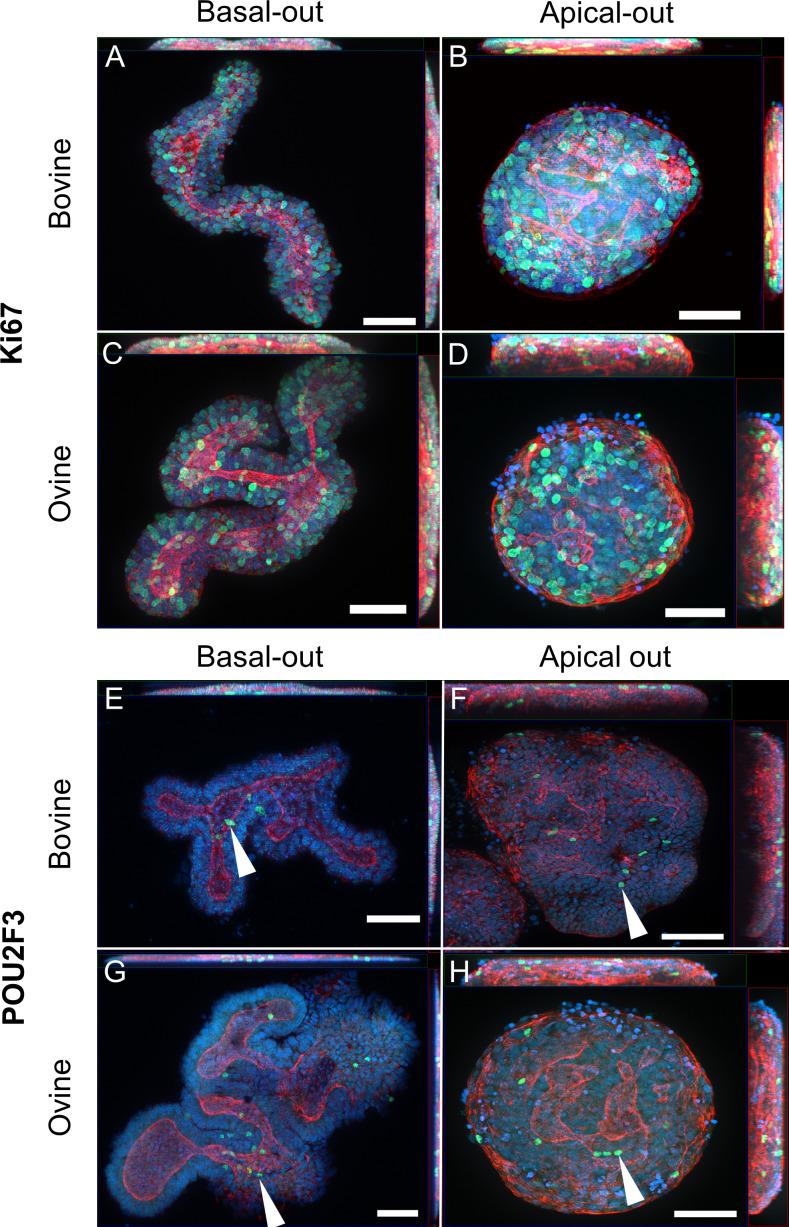
Organoids are three-dimensional stem cell-derived structures that differentiate into multiple cell types. Their capacity to self-organize, coupled with the presence of diverse cell types, means that organoids resemble their organ of origin in architecture and function. Organoids from intestinal tissues have been extensively used as a three-dimensional model for studies of the gut. However, they typically self-organize with basal-out polarity when cultured in a three-dimensional extracellular matrix scaffold, presenting a hurdle for experiments that require access to the apical epithelial surface. Methods to invert the surface polarity of intestinal organoids have been reported, but little information exists on how this change of polarity impacts gene expression and cell populations present within the organoids. To address this knowledge gap, we modelled both polarity states in intestinal organoids from two different ruminant species. Apical-out organoids largely retained the same gene expression profile as basal-out organoids. Moreover, a combination of RNA-seq and immunohistochemistry analyses demonstrated the retention of specific markers of enterocytes, enteroendocrine, goblet and tuft cells present in organoids of both polarity states. This study presents a comprehensive validation of apical-out ileal organoids, providing supporting evidence for the utility of this model in experiments that require access to the apical surface.
类器官是由三维干细胞衍生而来的结构,可分化为多种细胞类型。它们的自我组织能力,加上多种细胞类型的存在,意味着类器官在结构和功能上类似于其起源器官。肠道组织来源的类器官已被广泛用作肠道研究的三维模型。然而,当在三维细胞外基质支架中培养时,它们通常以基底向外的极性进行自我组织,这给需要接触顶端上皮表面的实验带来了障碍。虽然已有报道称有方法可以反转肠道类器官的表面极性,但关于这种极性变化如何影响类器官内的基因表达和细胞群体的信息却很少。为了填补这一知识空白,我们对来自两种不同反刍动物物种的肠道类器官的两种极性状态进行了建模。顶端向外的类器官在很大程度上保留了与基底向外的类器官相同的基因表达谱。此外,RNA测序和免疫组织化学分析相结合表明,两种极性状态的类器官中均保留了肠细胞、肠内分泌细胞、杯状细胞和簇状细胞的特定标志物。本研究对顶端向外的回肠类器官进行了全面验证,为该模型在需要接触顶端表面的实验中的实用性提供了支持证据。




 Zotero 插件