
硅铁共同施用对番茄幼苗镉积累及细胞壁组成的调控作用
Silicon and iron co-application modulates cadmium accumulation and cell wall composition in tomato seedlings.
作者信息
Zhou Xiaoting, Xia Ruihan, Zhong Jiayi, Liu Xiaoru, Xia Tian, Tang Yunxin, Yang Qianke, Bao Encai, Cao Kai, Chen Qiang, He Zhongqun
机构信息
College of Horticulture, Sichuan Agricultural University, Chengdu, Sichuan, 611130, China.
The Agriculture Ministry Key Laboratory of Agricultural Engineering in the Middle and Lower Reaches of Yangtze River, Institute of Agricultural Facilities and Equipment, Jiangsu Academy of Agricultural Sciences, Nanjing, Jiangsu, 210014, China.
出版信息
BMC Plant Biol. 2025 Jul 31;25(1):1001. doi: 10.1186/s12870-025-06915-x.
BACKGROUND
Cadmium (Cd) in farmland soils has severely hindered agricultural production. Our previous studies have found that the combined application of silicon (Si) and iron (Fe) can effectively alleviate cadmium toxicity in tomatoes. But the underlying mechanisms remain unclear. In this study, authors investigated the effects of individual or combined application of silicon and iron by physiological, biochemical (mainly on cell wall components) and transcriptomic analysis under cadmium stress.
RESULTS
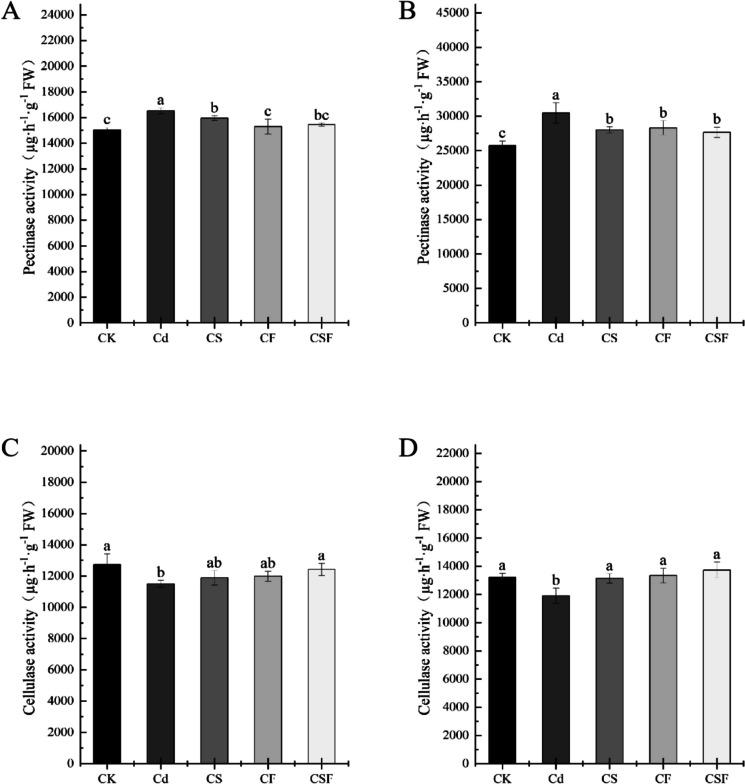
The results showed that the application of silicon and iron under cadmium stress effectively reduced cadmium accumulation in the roots of tomato seedlings, with the combined application of silicon and iron showing the best effect. It also significantly reduced cadmium accumulation in the stems and leaves of the aboveground parts. The cadmium content in the cell wall was significantly higher than that in the soluble fraction and organelles. Compared to the cadmium treatment alone, the application of silicon and iron increased the content of pectin and hemicellulose in the root cell wall, decreased cellulose content, downregulated the expression of ABCA1, and upregulated the expression of HMA5. However, the application of silicon alone resulted in higher cadmium accumulation in pectin and hemicellulose in the root cell wall, while the combined application of Silicon and Iron reduced cadmium content in the cell wall components and resulted in the highest expression of HMA5, which reduced the accumulation of cadmium in roots and its translocation to the aboveground parts. Based on transcriptome KEGG differential enrichment analysis, CSF vs Cd phenylpropane synthesis pathway and pectin metabolism gene expression were up-regulated and down-regulated, respectively, suggesting that the application of Si and Fe may remodel the cell wall and enhance Cd fixation by alleviating excessive cellular lignification as well as sustaining pectin methyl esterification. This indicated that the combined application of silicon and iron could reduce cadmium uptake and accumulation in tomato seedlings by regulating cell wall components and cadmium transport-related gene expression.
CONCLUSIONS
The synergistic application of silicon and iron effectively reduces cadmium uptaking and accumulation in tomato seedlings by modifying cell wall composition and regulating key metal transport genes. This strategy presents a promising approach for mitigating cadmium toxicity in crops.
背景
农田土壤中的镉(Cd)严重阻碍了农业生产。我们之前的研究发现,硅(Si)和铁(Fe)的联合施用可以有效缓解番茄中的镉毒性。但其潜在机制仍不清楚。在本研究中,作者通过生理、生化(主要针对细胞壁成分)和转录组分析,研究了镉胁迫下硅和铁单独或联合施用的效果。
结果
结果表明,镉胁迫下硅和铁的施用有效降低了番茄幼苗根系中的镉积累,硅和铁联合施用效果最佳。它还显著降低了地上部分茎和叶中的镉积累。细胞壁中的镉含量显著高于可溶性部分和细胞器中的镉含量。与单独镉处理相比,硅和铁的施用增加了根细胞壁中果胶和半纤维素的含量,降低了纤维素含量,下调了ABCA1的表达,并上调了HMA5的表达。然而,单独施用硅导致根细胞壁中果胶和半纤维素中的镉积累更高,而硅和铁联合施用降低了细胞壁成分中的镉含量,并导致HMA5的表达最高,从而减少了根中镉的积累及其向地上部分的转运。基于转录组KEGG差异富集分析,CSF与Cd苯丙烷合成途径和果胶代谢基因表达分别上调和下调,表明硅和铁的施用可能通过减轻细胞过度木质化以及维持果胶甲酯化来重塑细胞壁并增强镉固定。这表明硅和铁联合施用可以通过调节细胞壁成分和镉转运相关基因表达来减少番茄幼苗对镉的吸收和积累。
结论
硅和铁的协同施用通过改变细胞壁组成和调节关键金属转运基因,有效降低了番茄幼苗对镉的吸收和积累。该策略为减轻作物镉毒性提供了一种有前景方法。




 Zotero 插件