
伊朗核果果园中核果链核盘菌的多相特征及交配型等位基因分布
Polyphasic characterization and mating type allele distribution of Monilinia laxa in Iranian stone fruit orchards.
作者信息
Golmohammadi Hadi, Arzanlou Mahdi, Jafary Hossein, Bakhshi Mounes
机构信息
Department of Plant Protection, Faculty of Agriculture, University of Tabriz, Tabriz, Iran.
Iranian Research Institute of Plant Protection, Agricultural Research, Education and Extension Organization (AREEO), Tehran, Iran.
出版信息
Sci Rep. 2025 Aug 11;15(1):29336. doi: 10.1038/s41598-025-15129-y.
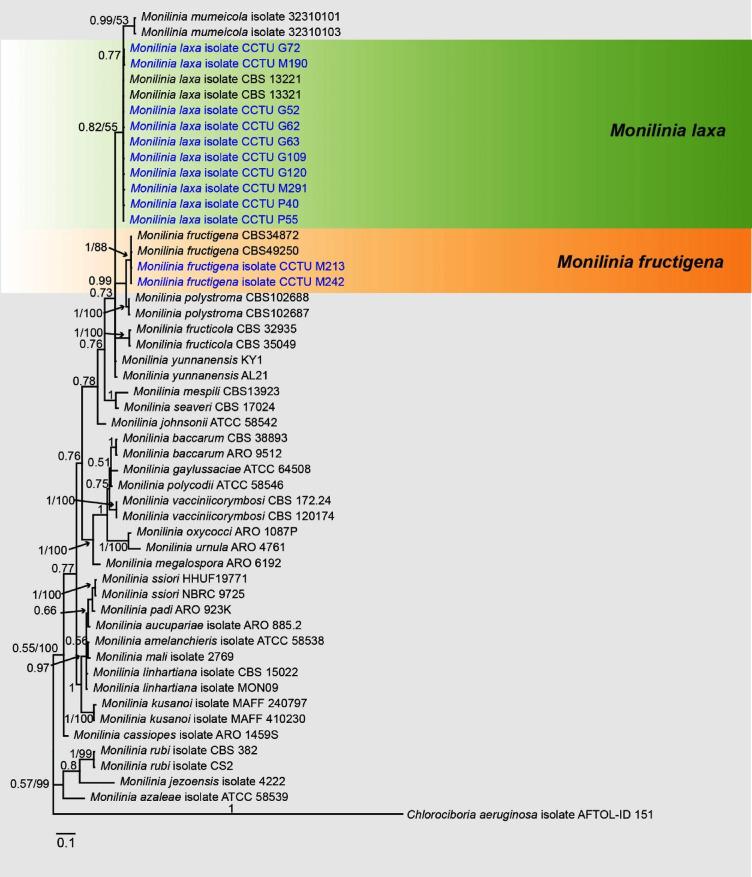
Brown rot disease, caused by species of the genus Monilinia, is a significant fungal disease affecting pome and stone fruit trees. In this study, 565 samples were collected from symptomatic trees across six provinces of Iran between 2018 and 2022. A total of 430 fungal isolates were obtained and identified using both morphological and molecular techniques. PCR assays with species-specific primers revealed that 403 isolates belonged to Monilinia laxa and 27 to Monilinia fructigena. Sequencing of the ITS and Ef-1α gene regions was performed for 12 representative isolates, and Bayesian phylogenetic analysis confirmed species-level identification. Mating-type determination was carried out using newly designed primers targeting the Mat1-1-1 and Mat1-2-1 genes, successfully detecting both mating types in the two species. Pathogenicity tests on apricot, sour cherry, sweet cherry, and plum fruits demonstrated that all selected isolates were highly pathogenic, producing visible symptoms within 3 to 4 days post-inoculation, which led to complete fruit rot and mummification within 23 days. Morphological characterization showed that M. laxa colonies exhibited lobed margins and variable pigmentation, while M. fructigena had smooth colony margins with peach-colored centers. Conidia were blastic, aseptate, and formed in chains, with distinguishable size differences between species. This study provides comprehensive data on the distribution, genetic diversity, mating-type structure, and pathogenic potential of Monilinia spp. in Iran, offering valuable insights for disease monitoring and integrated management strategies in affected orchards.
由链核盘菌属物种引起的褐腐病是一种影响梨果和核果类果树的重要真菌病害。在本研究中,2018年至2022年期间从伊朗六个省份的有症状树木上采集了565个样本。共获得430个真菌分离株,并使用形态学和分子技术进行了鉴定。用物种特异性引物进行的PCR分析表明,403个分离株属于 lax链核盘菌,27个属于果生链核盘菌。对12个代表性分离株进行了ITS和Ef-1α基因区域的测序,贝叶斯系统发育分析证实了物种水平的鉴定。使用新设计的靶向Mat1-1-1和Mat1-2-1基因的引物进行交配型测定,成功检测到这两个物种中的两种交配型。对杏、酸樱桃、甜樱桃和李果实进行的致病性测试表明,所有选定的分离株都具有高度致病性,接种后3至4天内产生可见症状,23天内导致果实完全腐烂和干缩。形态学特征表明,lax链核盘菌菌落边缘呈叶状,色素沉着可变,而果生链核盘菌菌落边缘光滑,中心呈桃色。分生孢子为芽生,无隔膜,呈链状形成,不同物种之间大小有明显差异。本研究提供了关于伊朗链核盘菌属物种的分布、遗传多样性、交配型结构和致病潜力的全面数据,为受影响果园的病害监测和综合管理策略提供了有价值的见解。



 Zotero 插件