
使用预测建模方法识别动态可重复的脑状态。
Identifying dynamic reproducible brain states using a predictive modelling approach.
作者信息
O'Connor David, Horien Corey, Mandino Francesca, Constable Robert Todd
机构信息
Department of Biomedical Engineering, Yale University, New Haven, CT, United States.
Yale MRRC Neuroscience, Yale School of Medicine, New Haven, CT, United States.
出版信息
Imaging Neurosci (Camb). 2025 Apr 17;3. doi: 10.1162/imag_a_00540. eCollection 2025.
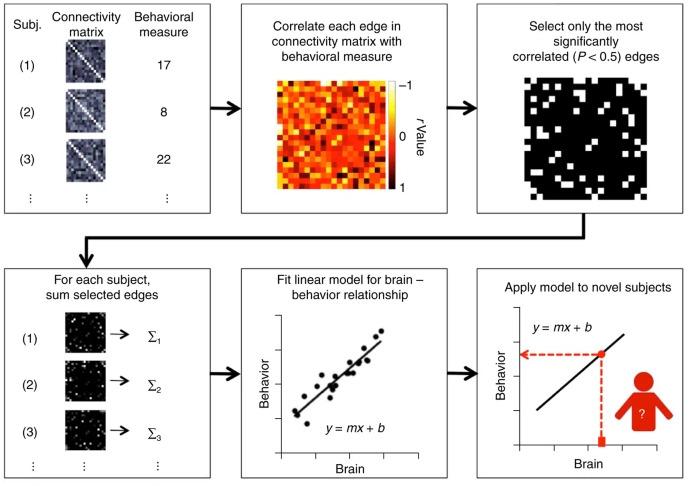
Conceptually, brain states reflect some combination of the internal mental processes of a person, and the influence of their external environment. Importantly, for neuroimaging, brain states may impact brain-based modeling of a person's traits, which should be independent of moment-to-moment changes in behavior. Investigation of brain states, and modeling of traits or behaviors are both often done using fMRI-based functional connectivity. Brain states can fluctuate in time periods shorter than a typical fMRI scan, and an array of methods called dynamic functional connectivity analyses has been developed to measure them. It has previously been shown that brain state can be manipulated through the use of continuous performance tasks that put the brain in a particular configuration while the task is performed. Here, we focus on moment-to-moment changes in brain state and test the hypothesis that there are particular brain-states that maximize brain-trait modeling performance. We use a regression-based framework, Connectome-based Predictive Modelling, allied to a resample aggregating approach, to identify behavior and trait-related brain states, as represented by dynamic functional connectivity maps. We find that there is not a particular brain state that is optimal for trait-based prediction, and combining data from distinct brain states across the scan is better. We also find that this is not the case for in-scanner behavioral prediction where more isolated and temporally specific parts of the scan session are better for building predictive models of behavior. The resample aggregated dynamic functional connectivity models of behavior replicated in sample using unseen left-out data. The modeling framework also showed success in estimating variance in behavior in a separate dataset. The method detailed here may prove useful for both the study of behaviorally related brain states, and for short-time predictive modeling.
从概念上讲,大脑状态反映了一个人的内部心理过程以及外部环境的影响的某种组合。重要的是,对于神经成像而言,大脑状态可能会影响基于大脑的个人特质建模,而这种建模应该独立于行为的瞬间变化。大脑状态的研究以及特质或行为的建模通常都使用基于功能磁共振成像(fMRI)的功能连接性分析。大脑状态可以在比典型的fMRI扫描更短的时间段内波动,并且已经开发出一系列称为动态功能连接性分析的方法来测量它们。此前已经表明,可以通过使用持续执行任务来操纵大脑状态,这些任务在执行时会使大脑处于特定配置。在这里,我们关注大脑状态的瞬间变化,并检验是否存在特定的大脑状态能使大脑特质建模性能最大化这一假设。我们使用基于回归的框架,即基于连接组的预测建模,并结合重采样聚合方法,来识别由动态功能连接性图谱所代表的与行为和特质相关的大脑状态。我们发现,不存在对基于特质的预测而言最优的特定大脑状态,并且将扫描过程中不同大脑状态的数据结合起来会更好。我们还发现,对于扫描仪内的行为预测情况并非如此,在这种情况下,扫描会话中更孤立且时间上更特定的部分对于构建行为预测模型更好。使用未见过的留出数据在样本中复制的行为重采样聚合动态功能连接性模型。该建模框架在估计另一个数据集中行为的方差方面也取得了成功。这里详细介绍的方法可能对与行为相关的大脑状态研究以及短期预测建模都有用。




 Zotero 插件