
肌肉增强干预措施可改善患有肌少症肥胖的老年2型糖尿病患者的葡萄糖代谢。
Muscle-building interventions improve glucose metabolism in elderly type 2 diabetic patients with sarcopenic obesity.
作者信息
Han Tingting, Liang Xinyue, Liu Hongxia, Zhu Mingyu, Shen Sisi, Song Jia, Chen Hongwei, Chen Ningxin, Liu Yue, Wei Ziyi, Weng Yurong, Jin Xian, Hu Yaomin
机构信息
Department of Geriatrics, Ren Ji Hospital, Shanghai Jiao Tong University School of Medicine, No. 160 Pujian Road, Shanghai, 200127, China.
出版信息
Nutr Metab (Lond). 2025 Aug 13;22(1):98. doi: 10.1186/s12986-025-00993-2.
BACKGROUND
Among all the elderly patients with type 2 diabetes mellitus (T2DM) of different body compositions, patients with sarcopenic obesity exhibited the most severe degree of insulin resistance despite possessing a normal body weight. It is well-established that interventions encompassing resistance training alone or in combination with whey protein supplementation, referred to hereafter as muscle-building interventions, are effective for increasing muscle mass and function in the elderly population. However, the impact of these muscle-building interventions on glucose metabolism in elderly T2DM patients with sarcopenic obesity remains unclear. The objective of this study was to elucidate the effect of muscle-building interventions on blood glucose and insulin resistance in elderly T2DM patients with sarcopenic obesity.
METHODS
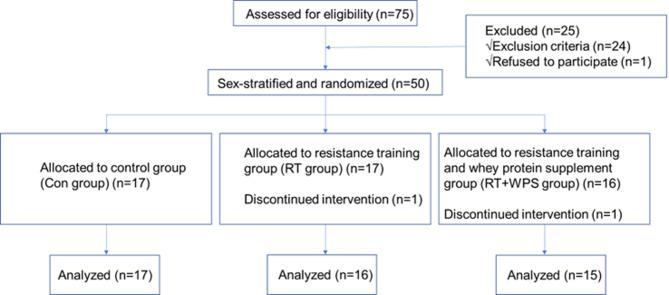
The muscle-building interventions in this study included resistance training alone and resistance training combined with whey protein supplementation. In this randomized controlled trial, elderly T2DM patients with sarcopenic obesity were divided into three distinct groups: the control group, the resistance training group, and the resistance training combined with whey protein supplement group. The muscle-building interventions were conducted for 12 weeks.
RESULTS
Implementing muscle-building interventions showed significant improvements in glycemic indices (HbA1c, OGTT 2-hour plasma glucose) and insulin resistance levels (HOMA-IR, Gutt index) for elderly T2DM patients with sarcopenic obesity. These muscle-building interventions enhanced muscle functional indices (handgrip strength, 5-time chair stand test). The combination of resistance training with whey protein supplementation did not significantly enhance the favorable effects on glucose metabolism compared to resistance exercise alone. Correlation analyses revealed that improvements in muscle strength were significantly associated with enhancements in glucose metabolism.
CONCLUSIONS
In elderly T2DM patients with sarcopenic obesity, muscle-building interventions (particularly resistance exercise) have been shown to significantly improve blood glucose control and insulin resistance.
背景
在所有不同身体成分的老年2型糖尿病(T2DM)患者中,肌少症肥胖患者尽管体重正常,但胰岛素抵抗程度最为严重。众所周知,单独进行抗阻训练或与补充乳清蛋白相结合的干预措施(以下简称增肌干预),对于增加老年人群的肌肉量和功能是有效的。然而,这些增肌干预对老年肌少症肥胖T2DM患者糖代谢的影响仍不清楚。本研究的目的是阐明增肌干预对老年肌少症肥胖T2DM患者血糖和胰岛素抵抗的影响。
方法
本研究中的增肌干预包括单独的抗阻训练以及抗阻训练与补充乳清蛋白相结合。在这项随机对照试验中,老年肌少症肥胖T2DM患者被分为三个不同的组:对照组、抗阻训练组和抗阻训练与补充乳清蛋白组。增肌干预进行12周。
结果
对老年肌少症肥胖T2DM患者实施增肌干预后,血糖指标(糖化血红蛋白、口服葡萄糖耐量试验2小时血糖)和胰岛素抵抗水平(稳态模型评估胰岛素抵抗、Gutt指数)有显著改善。这些增肌干预提高了肌肉功能指标(握力、5次起坐试验)。与单独的抗阻运动相比,抗阻训练与补充乳清蛋白相结合并没有显著增强对糖代谢的有益影响。相关性分析显示,肌肉力量的改善与糖代谢的增强显著相关。
结论
在老年肌少症肥胖T2DM患者中,增肌干预(尤其是抗阻运动)已被证明能显著改善血糖控制和胰岛素抵抗。
 Zotero 插件