
甲基化是头颈部鳞状细胞癌中p16/CDKN2基因失活的主要机制。
Methylation, a major mechanism of p16/CDKN2 gene inactivation in head and neck squamous carcinoma.
作者信息
El-Naggar A K, Lai S, Clayman G, Lee J K, Luna M A, Goepfert H, Batsakis J G
机构信息
Department of Pathology, The University of Texas, M.D. Anderson Cancer Center, Houston 77030, USA.
出版信息
Am J Pathol. 1997 Dec;151(6):1767-74.
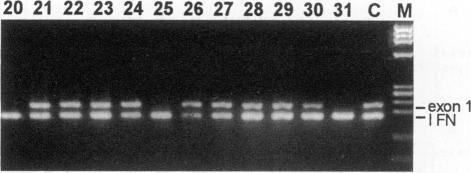
We studied 11 head and neck squamous carcinoma (HNSC) cell lines and 46 primary tumors for p16 gene status by protein, mRNA, and DNA genetic/epigenetic analyses to determine the incidence, the mechanism(s), and the potential biological significance of its inactivation. Of the 11 cell lines, only 1 showed intact p16 and 10 lacked its protein and mRNA; DNA analysis of these 10 cell lines showed 2 homozygous deletions, 6 methylations at exon 1 and 2, and 2 with no detectable abnormalities. In primary tumors, 16 (34.7%) of the 46 showed detectable p16 protein and mRNA; of these, 12 had no DNA abnormalities and 4 had only exon 2 methylation. Loss of p16 expression was found in three tumors with concurrent mutation at exon 2 and methylation at exon 2 (two) and both 1 and 2 (one). Of the 30 tumors that lacked p16 protein, 27 also lacked mRNA, 1 had detectable p16 mRNA, and 2 failed RT-PCR amplification. Twenty-two of the thirty tumors showed DNA alterations and eight manifested no abnormalities; DNA alterations comprised 6 homozygous deletions, 2 concurrent mutations and methylation of exon 2, and 13 with methylation at exon 1 and exons 1 and 2 (12 with methylation only and 1 with mutation) at exon 1. Except for patients' gender (P = 0.02), no significant correlation between p16 and clinicopathological factors was observed. We conclude that in HNSC 1) intragenic p16 alterations are infrequent events, 2) methylation of exon 1 constitutes a common mechanism in silencing the p16 gene, 3) p16 inactivation may play an important role in the early development and progression of HNSC, and 4) no association between p16 alterations and conventional clinicopathological factors was noted in this cohort.
我们通过蛋白质、mRNA及DNA遗传/表观遗传学分析,研究了11种头颈部鳞状细胞癌(HNSC)细胞系和46例原发性肿瘤的p16基因状态,以确定其失活的发生率、机制及潜在生物学意义。在11种细胞系中,仅1种显示p16完整,10种缺乏其蛋白质和mRNA;对这10种细胞系的DNA分析显示,2种存在纯合缺失,6种在外显子1和2处发生甲基化,2种未检测到异常。在原发性肿瘤中,46例中有16例(34.7%)显示可检测到p16蛋白质和mRNA;其中,12例无DNA异常,4例仅外显子2发生甲基化。在3例肿瘤中发现p16表达缺失,同时外显子2发生突变且外显子2(2例)以及外显子1和2(1例)均发生甲基化。在30例缺乏p16蛋白质的肿瘤中,27例也缺乏mRNA,1例可检测到p16 mRNA,2例RT-PCR扩增失败。30例肿瘤中有22例显示DNA改变,8例未显示异常;DNA改变包括6种纯合缺失、2种外显子2同时发生突变和甲基化,以及13种在外显子1处发生甲基化(12例仅发生甲基化,1例发生突变)和外显子1和2处发生甲基化。除患者性别(P = 0.02)外,未观察到p16与临床病理因素之间存在显著相关性。我们得出结论,在HNSC中:1)基因内p16改变是罕见事件;2)外显子1甲基化是使p16基因沉默的常见机制;3)p16失活可能在HNSC的早期发生和进展中起重要作用;4)在该队列中未发现p16改变与传统临床病理因素之间存在关联。


 Zotero 插件