
未治疗及接受替诺福韦治疗的慢性乙型肝炎(CHB)孕妇及产后随访患者中的乙型肝炎病毒(HBV)变异体
Hepatitis B Virus (HBV) Variants in Untreated and Tenofovir Treated Chronic Hepatitis B (CHB) Patients during Pregnancy and Post-Partum Follow-Up.
作者信息
Virine Boris, Osiowy Carla, Gao Shan, Wang Tong, Castillo Eliana, Martin Steven R, Lee Samuel S, Simmonds Kimberley, van Marle Guido, Coffin Carla S
机构信息
Liver Unit, Division of Gastroenterology and Hepatology, Cumming School of Medicine, University of Calgary, Calgary, AB, Canada; Department of Microbiology, Immunology and Infectious Diseases, Cumming School of Medicine, 3280 Hospital Drive NW, University of Calgary, Calgary, AB, Canada.
Bloodborne Pathogens and Hepatitis Laboratory of the National Microbiology Laboratory, Winnipeg, MB, Canada.
出版信息
PLoS One. 2015 Oct 16;10(10):e0140070. doi: 10.1371/journal.pone.0140070. eCollection 2015.
BACKGROUND
Chronic hepatitis B (CHB) is a dynamic disease that may be affected by immune changes in pregnancy. Guidelines suggest consideration of nucleos/tide analogs (NA), i.e., tenofovir, (TDF) in highly viremic mothers to reduce vertical transmission risk. HBV variability affects CHB outcome, but little is known about HBV genetic changes in pregnancy due to immune or NA selection.
OBJECTIVES
To evaluate HBV diversity in NA treated or untreated pregnant vs. post-partum CHB carriers.
STUDY DESIGN
In plasma collected from 21 mothers (7 matching pre/post-partum), HBV serological tests, genotype and viral load were assayed. The HBV pre-surface (S) /S overlapping polymerase (P) (N = 20), pre-core (C) /C (N = 11) and/or full genome PCR amplicons (N = 3) underwent clonal sequence analysis.
RESULTS
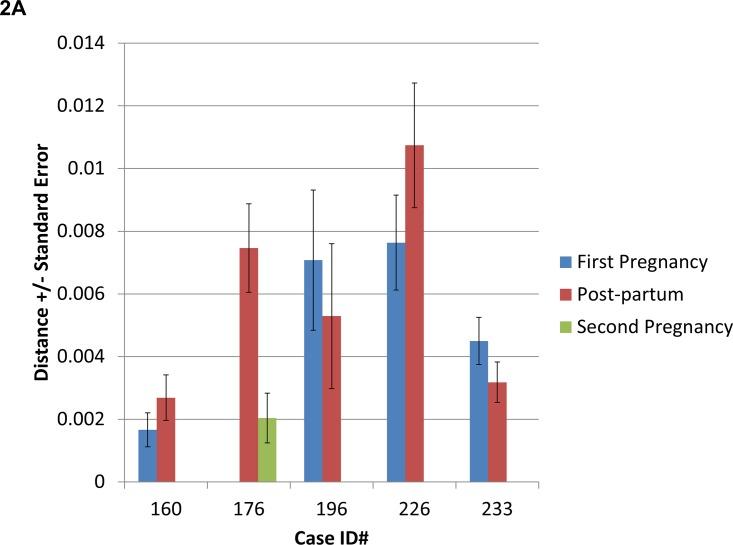
The median age was 31 y, 71% Asian, 68% genotype B or C, 33% HBV eAg+, 5 received TDF (median HBV DNA 8.5 log IU/ml). In untreated mothers, median antepartum vs. post-partum ALT was 21 vs. 24 U/L and HBV DNA was 2.7 vs. 2.4 log(10) IU/ml. ALT and/or HBV DNA flares occurred during pregnant and/or post-partum period in 47% (10/21). Clonal sequencing antepartum showed the presence of minor "a determinant" and/or vaccine escape mutants (VEM) but drug resistant variants were infrequent. Analysis of pregnant vs. post-partum samples showed different HBV variants and viral diversity.
CONCLUSIONS
Differences in immune and/or by NA selective pressures during pregnancy may affect HBV evolution during pregnancy. The presence of minor VEM warrant infant follow-up.
背景
慢性乙型肝炎(CHB)是一种动态疾病,可能受孕期免疫变化的影响。指南建议,对于高病毒血症的母亲,考虑使用核苷/核苷酸类似物(NA),即替诺福韦(TDF),以降低垂直传播风险。乙肝病毒(HBV)的变异性会影响CHB的病情转归,但对于孕期因免疫或NA选择导致的HBV基因变化知之甚少。
目的
评估接受或未接受NA治疗的孕期与产后CHB携带者的HBV多样性。
研究设计
对21名母亲(7对匹配的产前/产后样本)采集的血浆进行HBV血清学检测、基因分型和病毒载量检测。对HBV前S/S重叠聚合酶(P)(n = 20)、前C/C(n = 11)和/或全基因组PCR扩增子(n = 3)进行克隆序列分析。
结果
中位年龄为31岁,71%为亚洲人,68%为B或C基因型,33% HBeAg阳性,5人接受TDF治疗(中位HBV DNA为8.5 log IU/ml)。在未接受治疗的母亲中,产前与产后谷丙转氨酶(ALT)的中位数分别为21 U/L和24 U/L,HBV DNA分别为2.7 log(10) IU/ml和2.4 log(10) IU/ml。47%(10/21)的母亲在孕期和/或产后出现ALT和/或HBV DNA波动。产前克隆测序显示存在少量“a决定簇”和/或疫苗逃逸突变体(VEM),但耐药变异体罕见。对孕期与产后样本的分析显示HBV变异体和病毒多样性存在差异。
结论
孕期免疫和/或NA选择压力的差异可能影响孕期HBV的演变。少量VEM的存在值得对婴儿进行随访。

 Zotero 插件