• 文献检索
  • 文档翻译
  • 深度研究
  • 学术资讯
  • Suppr Zotero 插件Zotero 插件
  • 邀请有礼
  • 套餐&价格
  • 历史记录
应用&插件
Suppr Zotero 插件Zotero 插件浏览器插件Mac 客户端Windows 客户端微信小程序
定价
高级版会员购买积分包购买API积分包
服务
文献检索文档翻译深度研究API 文档MCP 服务
关于我们
关于 Suppr公司介绍联系我们用户协议隐私条款
关注我们

Suppr 超能文献

核心技术专利:CN118964589B侵权必究
粤ICP备2023148730 号-1Suppr @ 2026

文献检索

告别复杂PubMed语法,用中文像聊天一样搜索,搜遍4000万医学文献。AI智能推荐,让科研检索更轻松。

立即免费搜索

文件翻译

保留排版,准确专业,支持PDF/Word/PPT等文件格式,支持 12+语言互译。

免费翻译文档

深度研究

AI帮你快速写综述,25分钟生成高质量综述,智能提取关键信息,辅助科研写作。

立即免费体验

混乱还是清晰?

- Chaos or clarity?

作者信息

Videira S I R, Groenewald J Z, Nakashima C, Braun U, Barreto R W, de Wit P J G M, Crous P W

机构信息

Westerdijk Fungal Biodiversity Institute, Uppsalalaan 8, 3584 CT, Utrecht, The Netherlands.

Wageningen University and Research Centre (WUR), Laboratory of Phytopathology, Droevendaalsesteeg 1, 6708 PB, Wageningen, The Netherlands.

出版信息

Stud Mycol. 2017 Jun;87:257-421. doi: 10.1016/j.simyco.2017.09.003. Epub 2017 Sep 28.

DOI:10.1016/j.simyco.2017.09.003
PMID:29180830
原文链接:https://pmc.ncbi.nlm.nih.gov/articles/PMC5693839/
Abstract

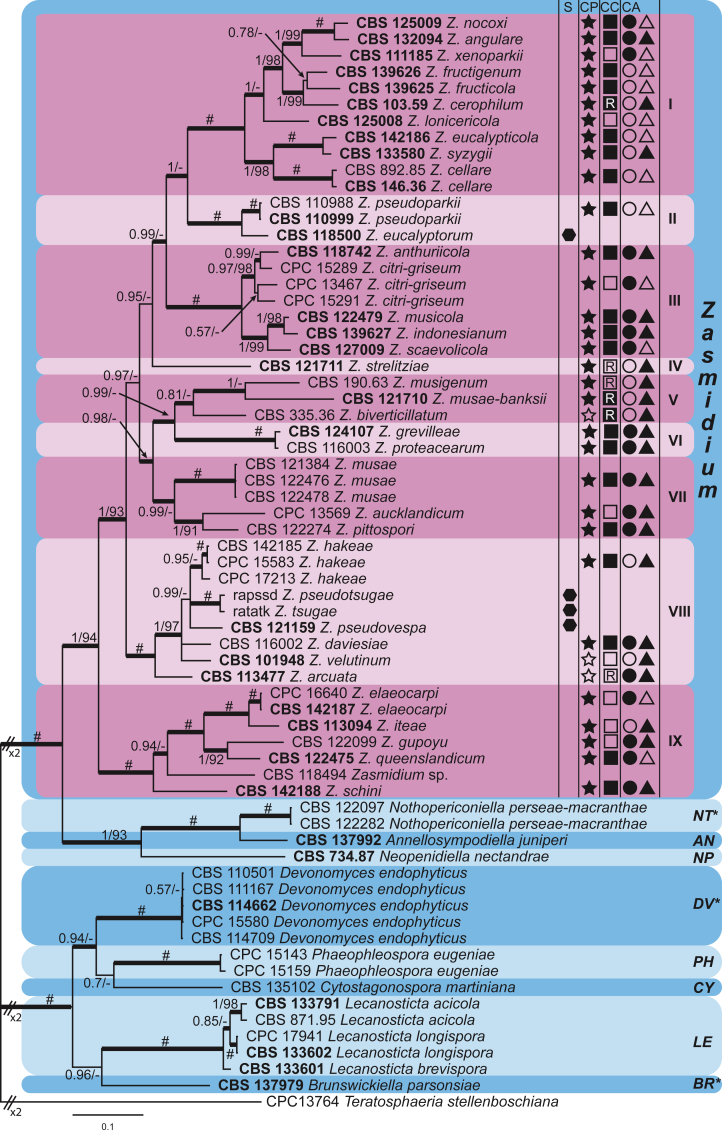
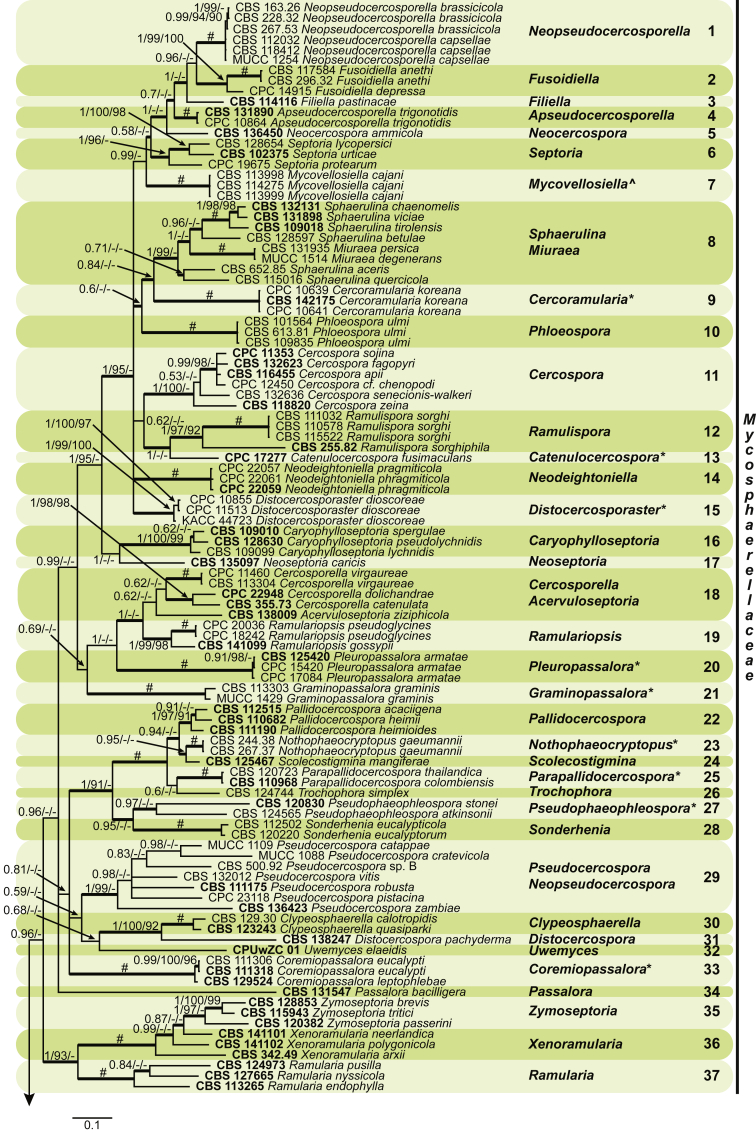
The represent thousands of fungal species that are associated with diseases on a wide range of plant hosts. Understanding and stabilising the taxonomy of genera and species of is therefore of the utmost importance given their impact on agriculture, horticulture and forestry. Based on previous molecular studies, several phylogenetic and morphologically distinct genera within the have been delimited. In this study a multigene phylogenetic analysis (LSU, ITS and ) was performed based on 415 isolates representing 297 taxa and incorporating ex-type strains where available. The main aim of this study was to resolve the phylogenetic relationships among the genera currently recognised within the family, and to clarify the position of the cercosporoid fungi among them. Based on these results many well-known genera are shown to be paraphyletic, with several synapomorphic characters that have evolved more than once within the family. As a consequence, several old generic names including , , , and are resurrected, and 32 additional genera are described as new. Based on phylogenetic data 120 genera are now accepted within the family, but many currently accepted cercosporoid genera still remain unresolved pending fresh collections and DNA data. The present study provides a phylogenetic framework for future taxonomic work within the .

摘要

它们代表了数千种与多种植物寄主疾病相关的真菌物种。鉴于它们对农业、园艺和林业的影响,了解并稳定该类真菌属和种的分类学至关重要。基于之前的分子研究,已界定了该类真菌中几个系统发育和形态上不同的属。在本研究中,基于代表297个分类单元的415个分离株进行了多基因系统发育分析(LSU、ITS和[此处原文缺失具体基因名称]),并在可行的情况下纳入了模式菌株。本研究的主要目的是解析该科目前公认的属之间的系统发育关系,并阐明尾孢菌属真菌在其中的位置。基于这些结果,许多知名属被证明是并系的,有几个共衍征在该科内不止一次进化。因此,包括[此处原文缺失具体属名]、[此处原文缺失具体属名]、[此处原文缺失具体属名]、[此处原文缺失具体属名]和[此处原文缺失具体属名]在内的几个旧属名被重新启用,并描述了另外32个新属。基于系统发育数据,该科目前接受120个属,但许多目前公认的尾孢菌属真菌在有待新的采集样本和DNA数据的情况下仍未得到解决。本研究为该类真菌未来的分类学工作提供了一个系统发育框架。
https://cdn.ncbi.nlm.nih.gov/pmc/blobs/0d4c/5693839/496a85175250/gr66.jpg
https://cdn.ncbi.nlm.nih.gov/pmc/blobs/0d4c/5693839/8ec7c324e8a7/gr1a.jpg
https://cdn.ncbi.nlm.nih.gov/pmc/blobs/0d4c/5693839/81c1bd54b3bb/gr2a.jpg
https://cdn.ncbi.nlm.nih.gov/pmc/blobs/0d4c/5693839/09e69fbd7247/gr3a.jpg
https://cdn.ncbi.nlm.nih.gov/pmc/blobs/0d4c/5693839/e36aaffb9f99/gr4a.jpg
https://cdn.ncbi.nlm.nih.gov/pmc/blobs/0d4c/5693839/684b5b40a5d1/gr5.jpg
https://cdn.ncbi.nlm.nih.gov/pmc/blobs/0d4c/5693839/6f94a322ada6/gr6.jpg
https://cdn.ncbi.nlm.nih.gov/pmc/blobs/0d4c/5693839/bea9a9e6b1ef/gr7.jpg
https://cdn.ncbi.nlm.nih.gov/pmc/blobs/0d4c/5693839/e846a6a09ce3/gr8.jpg
https://cdn.ncbi.nlm.nih.gov/pmc/blobs/0d4c/5693839/116621392a49/gr9.jpg
https://cdn.ncbi.nlm.nih.gov/pmc/blobs/0d4c/5693839/8d7a512c0af8/gr10.jpg
https://cdn.ncbi.nlm.nih.gov/pmc/blobs/0d4c/5693839/46335735630d/gr11.jpg
https://cdn.ncbi.nlm.nih.gov/pmc/blobs/0d4c/5693839/b854f4cb15c8/gr12.jpg
https://cdn.ncbi.nlm.nih.gov/pmc/blobs/0d4c/5693839/3b6b9f340e18/gr13.jpg
https://cdn.ncbi.nlm.nih.gov/pmc/blobs/0d4c/5693839/c68fe54722f5/gr14.jpg
https://cdn.ncbi.nlm.nih.gov/pmc/blobs/0d4c/5693839/edb9c3c0793a/gr15.jpg
https://cdn.ncbi.nlm.nih.gov/pmc/blobs/0d4c/5693839/17284e591dc9/gr16.jpg
https://cdn.ncbi.nlm.nih.gov/pmc/blobs/0d4c/5693839/73036e224135/gr17.jpg
https://cdn.ncbi.nlm.nih.gov/pmc/blobs/0d4c/5693839/b6ce8b07f334/gr18.jpg
https://cdn.ncbi.nlm.nih.gov/pmc/blobs/0d4c/5693839/a3cdf642e3e8/gr19.jpg
https://cdn.ncbi.nlm.nih.gov/pmc/blobs/0d4c/5693839/bbc79b5fe238/gr20.jpg
https://cdn.ncbi.nlm.nih.gov/pmc/blobs/0d4c/5693839/786a916a3cc2/gr21.jpg
https://cdn.ncbi.nlm.nih.gov/pmc/blobs/0d4c/5693839/b1c7bf162662/gr22.jpg
https://cdn.ncbi.nlm.nih.gov/pmc/blobs/0d4c/5693839/5b00fcd5a968/gr23.jpg
https://cdn.ncbi.nlm.nih.gov/pmc/blobs/0d4c/5693839/d5038caad589/gr24.jpg
https://cdn.ncbi.nlm.nih.gov/pmc/blobs/0d4c/5693839/654a251789ee/gr25.jpg
https://cdn.ncbi.nlm.nih.gov/pmc/blobs/0d4c/5693839/473812d0d7c6/gr26.jpg
https://cdn.ncbi.nlm.nih.gov/pmc/blobs/0d4c/5693839/0788390d0d73/gr27.jpg
https://cdn.ncbi.nlm.nih.gov/pmc/blobs/0d4c/5693839/f246e6142ba2/gr28.jpg
https://cdn.ncbi.nlm.nih.gov/pmc/blobs/0d4c/5693839/d80688594c87/gr29.jpg
https://cdn.ncbi.nlm.nih.gov/pmc/blobs/0d4c/5693839/794216731efc/gr30.jpg
https://cdn.ncbi.nlm.nih.gov/pmc/blobs/0d4c/5693839/2a7935121de2/gr31.jpg
https://cdn.ncbi.nlm.nih.gov/pmc/blobs/0d4c/5693839/bc8de6086686/gr32.jpg
https://cdn.ncbi.nlm.nih.gov/pmc/blobs/0d4c/5693839/4441768b8c4c/gr33.jpg
https://cdn.ncbi.nlm.nih.gov/pmc/blobs/0d4c/5693839/12123b7d82a7/gr34.jpg
https://cdn.ncbi.nlm.nih.gov/pmc/blobs/0d4c/5693839/812fbf7e0907/gr35.jpg
https://cdn.ncbi.nlm.nih.gov/pmc/blobs/0d4c/5693839/0a9dc739612f/gr36.jpg
https://cdn.ncbi.nlm.nih.gov/pmc/blobs/0d4c/5693839/ac1cc630bf0a/gr37.jpg
https://cdn.ncbi.nlm.nih.gov/pmc/blobs/0d4c/5693839/1e30fa2f96f7/gr38.jpg
https://cdn.ncbi.nlm.nih.gov/pmc/blobs/0d4c/5693839/359d656f36ad/gr40.jpg
https://cdn.ncbi.nlm.nih.gov/pmc/blobs/0d4c/5693839/8b3a13764534/gr41.jpg
https://cdn.ncbi.nlm.nih.gov/pmc/blobs/0d4c/5693839/0a517122c7e2/gr43.jpg
https://cdn.ncbi.nlm.nih.gov/pmc/blobs/0d4c/5693839/b32a452949e2/gr44.jpg
https://cdn.ncbi.nlm.nih.gov/pmc/blobs/0d4c/5693839/39698bf78889/gr46.jpg
https://cdn.ncbi.nlm.nih.gov/pmc/blobs/0d4c/5693839/125b27ca2d08/gr47.jpg
https://cdn.ncbi.nlm.nih.gov/pmc/blobs/0d4c/5693839/8bbdaa1c9acc/gr60.jpg
https://cdn.ncbi.nlm.nih.gov/pmc/blobs/0d4c/5693839/496a85175250/gr66.jpg
https://cdn.ncbi.nlm.nih.gov/pmc/blobs/0d4c/5693839/8ec7c324e8a7/gr1a.jpg
https://cdn.ncbi.nlm.nih.gov/pmc/blobs/0d4c/5693839/81c1bd54b3bb/gr2a.jpg
https://cdn.ncbi.nlm.nih.gov/pmc/blobs/0d4c/5693839/09e69fbd7247/gr3a.jpg
https://cdn.ncbi.nlm.nih.gov/pmc/blobs/0d4c/5693839/e36aaffb9f99/gr4a.jpg
https://cdn.ncbi.nlm.nih.gov/pmc/blobs/0d4c/5693839/684b5b40a5d1/gr5.jpg
https://cdn.ncbi.nlm.nih.gov/pmc/blobs/0d4c/5693839/6f94a322ada6/gr6.jpg
https://cdn.ncbi.nlm.nih.gov/pmc/blobs/0d4c/5693839/bea9a9e6b1ef/gr7.jpg
https://cdn.ncbi.nlm.nih.gov/pmc/blobs/0d4c/5693839/e846a6a09ce3/gr8.jpg
https://cdn.ncbi.nlm.nih.gov/pmc/blobs/0d4c/5693839/116621392a49/gr9.jpg
https://cdn.ncbi.nlm.nih.gov/pmc/blobs/0d4c/5693839/8d7a512c0af8/gr10.jpg
https://cdn.ncbi.nlm.nih.gov/pmc/blobs/0d4c/5693839/46335735630d/gr11.jpg
https://cdn.ncbi.nlm.nih.gov/pmc/blobs/0d4c/5693839/b854f4cb15c8/gr12.jpg
https://cdn.ncbi.nlm.nih.gov/pmc/blobs/0d4c/5693839/3b6b9f340e18/gr13.jpg
https://cdn.ncbi.nlm.nih.gov/pmc/blobs/0d4c/5693839/c68fe54722f5/gr14.jpg
https://cdn.ncbi.nlm.nih.gov/pmc/blobs/0d4c/5693839/edb9c3c0793a/gr15.jpg
https://cdn.ncbi.nlm.nih.gov/pmc/blobs/0d4c/5693839/17284e591dc9/gr16.jpg
https://cdn.ncbi.nlm.nih.gov/pmc/blobs/0d4c/5693839/73036e224135/gr17.jpg
https://cdn.ncbi.nlm.nih.gov/pmc/blobs/0d4c/5693839/b6ce8b07f334/gr18.jpg
https://cdn.ncbi.nlm.nih.gov/pmc/blobs/0d4c/5693839/a3cdf642e3e8/gr19.jpg
https://cdn.ncbi.nlm.nih.gov/pmc/blobs/0d4c/5693839/bbc79b5fe238/gr20.jpg
https://cdn.ncbi.nlm.nih.gov/pmc/blobs/0d4c/5693839/786a916a3cc2/gr21.jpg
https://cdn.ncbi.nlm.nih.gov/pmc/blobs/0d4c/5693839/b1c7bf162662/gr22.jpg
https://cdn.ncbi.nlm.nih.gov/pmc/blobs/0d4c/5693839/5b00fcd5a968/gr23.jpg
https://cdn.ncbi.nlm.nih.gov/pmc/blobs/0d4c/5693839/d5038caad589/gr24.jpg
https://cdn.ncbi.nlm.nih.gov/pmc/blobs/0d4c/5693839/654a251789ee/gr25.jpg
https://cdn.ncbi.nlm.nih.gov/pmc/blobs/0d4c/5693839/473812d0d7c6/gr26.jpg
https://cdn.ncbi.nlm.nih.gov/pmc/blobs/0d4c/5693839/0788390d0d73/gr27.jpg
https://cdn.ncbi.nlm.nih.gov/pmc/blobs/0d4c/5693839/f246e6142ba2/gr28.jpg
https://cdn.ncbi.nlm.nih.gov/pmc/blobs/0d4c/5693839/d80688594c87/gr29.jpg
https://cdn.ncbi.nlm.nih.gov/pmc/blobs/0d4c/5693839/794216731efc/gr30.jpg
https://cdn.ncbi.nlm.nih.gov/pmc/blobs/0d4c/5693839/2a7935121de2/gr31.jpg
https://cdn.ncbi.nlm.nih.gov/pmc/blobs/0d4c/5693839/bc8de6086686/gr32.jpg
https://cdn.ncbi.nlm.nih.gov/pmc/blobs/0d4c/5693839/4441768b8c4c/gr33.jpg
https://cdn.ncbi.nlm.nih.gov/pmc/blobs/0d4c/5693839/12123b7d82a7/gr34.jpg
https://cdn.ncbi.nlm.nih.gov/pmc/blobs/0d4c/5693839/812fbf7e0907/gr35.jpg
https://cdn.ncbi.nlm.nih.gov/pmc/blobs/0d4c/5693839/0a9dc739612f/gr36.jpg
https://cdn.ncbi.nlm.nih.gov/pmc/blobs/0d4c/5693839/ac1cc630bf0a/gr37.jpg
https://cdn.ncbi.nlm.nih.gov/pmc/blobs/0d4c/5693839/1e30fa2f96f7/gr38.jpg
https://cdn.ncbi.nlm.nih.gov/pmc/blobs/0d4c/5693839/359d656f36ad/gr40.jpg
https://cdn.ncbi.nlm.nih.gov/pmc/blobs/0d4c/5693839/8b3a13764534/gr41.jpg
https://cdn.ncbi.nlm.nih.gov/pmc/blobs/0d4c/5693839/0a517122c7e2/gr43.jpg
https://cdn.ncbi.nlm.nih.gov/pmc/blobs/0d4c/5693839/b32a452949e2/gr44.jpg
https://cdn.ncbi.nlm.nih.gov/pmc/blobs/0d4c/5693839/39698bf78889/gr46.jpg
https://cdn.ncbi.nlm.nih.gov/pmc/blobs/0d4c/5693839/125b27ca2d08/gr47.jpg
https://cdn.ncbi.nlm.nih.gov/pmc/blobs/0d4c/5693839/8bbdaa1c9acc/gr60.jpg
https://cdn.ncbi.nlm.nih.gov/pmc/blobs/0d4c/5693839/496a85175250/gr66.jpg

相似文献

1
- Chaos or clarity?混乱还是清晰?
Stud Mycol. 2017 Jun;87:257-421. doi: 10.1016/j.simyco.2017.09.003. Epub 2017 Sep 28.
2
Phylogenetic lineages in Pseudocercospora.拟尾孢菌中的系统发育谱系。
Stud Mycol. 2013 Jun 30;75(1):37-114. doi: 10.3114/sim0005.
3
Genera of phytopathogenic fungi: GOPHY 4.植物病原真菌属:GOPHY 4。
Stud Mycol. 2022 Jul;101:417-564. doi: 10.3114/sim.2022.101.06. Epub 2022 Jun 2.
4
: more than a node or a foot-shaped basal cell.不仅仅是一个结节或足形基底细胞。
Stud Mycol. 2021 Aug 17;98:100116. doi: 10.1016/j.simyco.2021.100116. eCollection 2021 Apr.
5
All that glitters is not Ramularia.闪闪发光的未必都是柱隔孢菌。
Stud Mycol. 2016;83:49-163. doi: 10.1016/j.simyco.2016.06.001. Epub 2016 Jun 29.
6
Resolving the Phoma enigma.解开茎点霉之谜。
Stud Mycol. 2015 Sep;82:137-217. doi: 10.1016/j.simyco.2015.10.003. Epub 2015 Nov 26.
7
Sizing up Septoria.评估叶点霉。
Stud Mycol. 2013 Jun 30;75(1):307-90. doi: 10.3114/sim0017.
8
Redisposition of phoma-like anamorphs in Pleosporales.球腔菌样无性型在散斑壳目内的重新分类。
Stud Mycol. 2013 Jun 30;75(1):1-36. doi: 10.3114/sim0004.
9
Foliar pathogens of eucalypts.桉树的叶部病原体。
Stud Mycol. 2019 Aug 8;94:125-298. doi: 10.1016/j.simyco.2019.08.001. eCollection 2019 Sep.
10
..
Stud Mycol. 2020 Apr 9;96:185-308. doi: 10.1016/j.simyco.2020.03.001. eCollection 2020 Jun.

引用本文的文献

1
Morphology and molecular phylogeny of fungi associated with plants.与植物相关真菌的形态学与分子系统发育
Front Cell Infect Microbiol. 2025 Aug 11;15:1550824. doi: 10.3389/fcimb.2025.1550824. eCollection 2025.
2
Fungal Planet description sheets: 1781-1866.真菌星球描述表:1781 - 1866年
Persoonia. 2025 Jun;54:327-587. doi: 10.3114/persoonia.2025.54.10. Epub 2025 Jul 8.
3
Overview of the Genus on Vitaceous Plants in Korea with Introduction of sp. nov.韩国葡萄科植物上该属概述及新种介绍

本文引用的文献

1
Disease Severity and Microsclerotium Properties of the Sorghum Sooty Stripe Pathogen, Ramulispora sorghi.高粱煤烟条纹病菌(Ramulispora sorghi)的病害严重程度及微菌核特性
Plant Dis. 2011 Jul;95(7):853-859. doi: 10.1094/PDIS-10-10-0742.
2
Fungal Planet description sheets: 469-557.真菌星球描述单:469 - 557。
Persoonia. 2016 Dec;37:218-403. doi: 10.3767/003158516X694499. Epub 2016 Dec 21.
3
Novel fungi from an ancient niche: cercosporoid and related sexual morphs on ferns.来自古老生态位的新型真菌:蕨类植物上的尾孢菌及其相关有性形态
Mycobiology. 2025 Jul 1;53(4):507-519. doi: 10.1080/12298093.2025.2518787. eCollection 2025.
4
Adaptive evolution of sesquiterpene deoxyphomenone in mycoparasitism by associated with horizontal gene transfer from species.倍半萜脱氧伏马菌素在菌寄生中的适应性进化与来自物种的水平基因转移有关。
mBio. 2025 Apr 9;16(4):e0400724. doi: 10.1128/mbio.04007-24. Epub 2025 Mar 20.
5
Piecing together the taxonomic puzzle of .拼凑……的分类难题。 你提供的原文不完整,“of”后面缺少具体内容。
Fungal Syst Evol. 2024 Dec;14:171-190. doi: 10.3114/fuse.2024.14.11. Epub 2024 Jun 7.
6
Emended Neodactylariales (Dothideomycetes): gen. nov. and phylogenetically related genera.修订的新指孢目(座囊菌纲):新属及系统发育相关属
MycoKeys. 2024 Dec 27;111:211-228. doi: 10.3897/mycokeys.111.139620. eCollection 2024.
7
Community assembly and potential function analysis of the endophyte in Eucommia ulmoides.杜仲内生菌的群落组装和潜在功能分析。
BMC Microbiol. 2024 Nov 7;24(1):460. doi: 10.1186/s12866-024-03601-0.
8
Filamentous Fungi Associated with Disease Symptoms in Non-Native Giant Sequoia () in Germany-A Gateway for Alien Fungal Pathogens?与德国非本土巨杉()疾病症状相关的丝状真菌——外来真菌病原体的通道?
Pathogens. 2024 Aug 23;13(9):715. doi: 10.3390/pathogens13090715.
9
Arthrocatenales, a new order of extremophilic fungi in the Dothideomycetes.关节链孢目,座囊菌纲中的一个新的嗜极真菌目。
MycoKeys. 2024 Aug 22;108:47-74. doi: 10.3897/mycokeys.108.128033. eCollection 2024.
10
Exploring the Antifungal Activity of Moroccan Bacterial and Fungal Isolates and a Strobilurin Fungicide in the Control of , the Causal Agent of Tomato Leaf Mold Disease.探索摩洛哥细菌和真菌分离株以及一种甲氧基丙烯酸酯类杀菌剂对番茄叶霉病病原菌的抗真菌活性。
Plants (Basel). 2024 Aug 9;13(16):2213. doi: 10.3390/plants13162213.
Persoonia. 2016 Dec;37:106-141. doi: 10.3767/003158516X690934. Epub 2016 Feb 1.
4
Wood staining fungi revealed taxonomic novelties in : New order and new species .木材染色真菌展现出分类学新发现:新目及新物种。
Stud Mycol. 2016 Sep;85:107-124. doi: 10.1016/j.simyco.2016.11.008. Epub 2016 Nov 27.
5
Fungal Planet description sheets: 400-468.《真菌星球》描述单:400 - 468页。
Persoonia. 2016 Jun;36:316-458. doi: 10.3767/003158516X692185. Epub 2016 Jul 4.
6
All that glitters is not Ramularia.闪闪发光的未必都是柱隔孢菌。
Stud Mycol. 2016;83:49-163. doi: 10.1016/j.simyco.2016.06.001. Epub 2016 Jun 29.
7
Comparative Genomics of the Sigatoka Disease Complex on Banana Suggests a Link between Parallel Evolutionary Changes in Pseudocercospora fijiensis and Pseudocercospora eumusae and Increased Virulence on the Banana Host.香蕉叶斑病病原菌复合体的比较基因组学研究表明,斐济尾孢菌和香蕉尾孢菌的平行进化变化与对香蕉寄主的毒力增强之间存在联系。
PLoS Genet. 2016 Aug 11;12(8):e1005904. doi: 10.1371/journal.pgen.1005904. eCollection 2016 Aug.
8
Cercosporoid fungi (Mycosphaerellaceae) 5. Species on dicots (Anacardiaceae to Annonaceae).尾孢菌属真菌(球腔菌科)5. 双子叶植物上的物种(从漆树科到番荔枝科)。
IMA Fungus. 2016 Jun;7(1):161-216. doi: 10.5598/imafungus.2016.07.01.10. Epub 2016 Jun 16.
9
Naming and outline of -2014 including proposals for the protection or suppression of generic names.2014年的命名与概述,包括关于保护或抑制通用名的提议。
Fungal Divers. 2014 Nov;69(1):1-55. doi: 10.1007/s13225-014-0309-2. Epub 2014 Nov 4.
10
Cladosporium fulvum Effectors: Weapons in the Arms Race with Tomato.球腔菌效应物:与番茄军备竞赛中的武器
Annu Rev Phytopathol. 2016 Aug 4;54:1-23. doi: 10.1146/annurev-phyto-011516-040249. Epub 2016 May 23.