Veronese Vanessa, Ryan Kathleen Elizabeth, Hughes Chad, Lim Megan Sc, Pedrana Alisa, Stoové Mark
Disease Elimination Program, Burnet Institute, Melbourne, Australia.
J Med Internet Res. 2020 Jul 28;22(7):e14230. doi: 10.2196/14230.
HIV continues to disproportionately affect men who have sex with men (MSM) and transgender women (TW). Undiagnosed HIV is a major driver of HIV transmission rates, and increasing the uptake of regular HIV testing and facilitating timely initiation of HIV treatment is a global HIV prevention priority. However, MSM and TW experience a range of barriers that limit their access to testing and other prevention services. Given their growing ubiquity, digital communication technologies are increasingly being used to support HIV prevention efforts, and a growing number of studies have trialed the use of digital technology to promote HIV testing among MSM and TW.
We undertook a systematic review and meta-analysis to assess the impact of digital communication technology on HIV testing uptake among MSM and TW. Subanalyses aimed to identify the features and characteristics of digital interventions associated with greater impact.
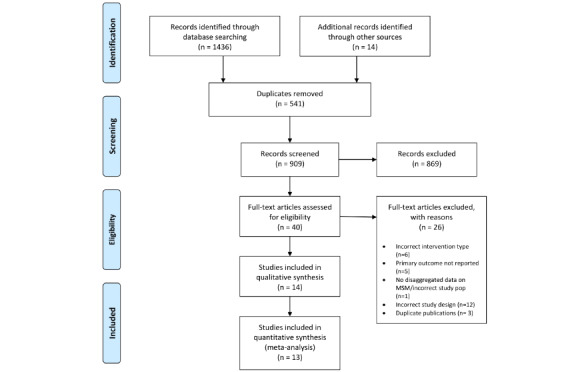
A systematic literature review was undertaken using select databases and conference repositories. Studies describing the use of a digital technology-internet-enabled devices, including phones, tablets, and computers-to increase HIV testing uptake among MSM or TW using either randomized or observational cohort design with measurement of HIV testing rates measured pre- and postintervention, and published in English between 2010 and 2018 were included. Pooled effect estimates were calculated using a random effects meta-analysis. Subanalyses calculated effect estimates grouped by selected features of digital interventions.
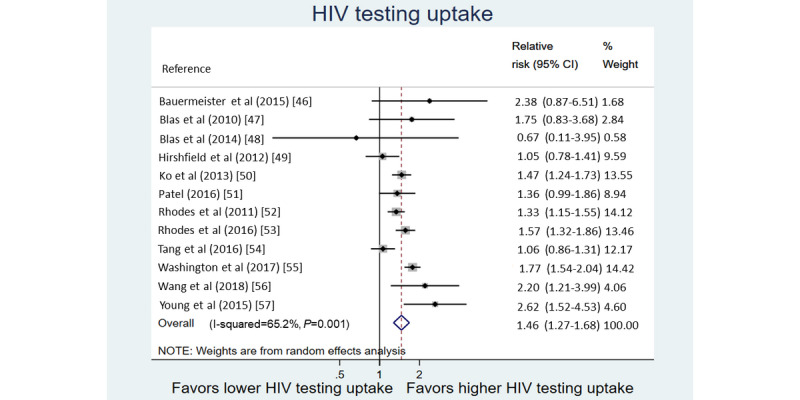
A total of 13 randomized or observational studies were included in the final review. Digital interventions most commonly used mainstream, existing social media platforms (n=7) or promotion through online peer educators (n=5). Most interventions (n=8) were categorized as interactive and allowed user engagement and most directly facilitated testing (n=7) either by providing self-testing kits or referral to testing services. A total of 1930 participants were included across the 13 studies. HIV testing uptake among MSM and TW exposed to digital interventions was 1.5 times higher than that of unexposed MSM and TW (risk ratio [RR] 1.5; 95% CI 1.3-1.7). Subanalyses suggested an increased impact on HIV testing uptake among interventions that were delivered through mainstream social media-based platforms (RR 1.7; 95% CI 1.3-2.1), included direct facilitation of HIV testing (RR 1.6; 95% CI 1.4-1.9), were interactive (RR 1.6; 95% CI 1.4-1.8), and involved end users in the design process (RR 1.6; 95% CI 1.3-2.0).
These findings provide broad support for the integration of technology with existing approaches to promote and facilitate HIV testing among MSM and TW. Our findings identified key features that may be associated with greater impact on HIV testing uptake and can be used to inform future development efforts given the growing interest and application of digital technologies in HIV prevention.
PROSPERO International Prospective Register of Systematic Reviews CRD42017070055; https://www.crd.york.ac.uk/prospero/display_record.php?ID=CRD42017070055.
艾滋病毒对男男性行为者(MSM)和跨性别女性(TW)的影响仍然不成比例。未被诊断出的艾滋病毒是艾滋病毒传播率的主要驱动因素,提高定期艾滋病毒检测的接受率并促进及时开始艾滋病毒治疗是全球艾滋病毒预防的重点。然而,男男性行为者和跨性别女性面临一系列障碍,限制了他们获得检测和其他预防服务的机会。鉴于数字通信技术的日益普及,其越来越多地被用于支持艾滋病毒预防工作,并且越来越多的研究已经试验使用数字技术来促进男男性行为者和跨性别女性中的艾滋病毒检测。
我们进行了一项系统评价和荟萃分析,以评估数字通信技术对男男性行为者和跨性别女性中艾滋病毒检测接受率的影响。亚分析旨在确定与更大影响相关的数字干预措施的特征。
使用选定的数据库和会议文献库进行系统的文献综述。纳入了描述使用数字技术(包括手机、平板电脑和计算机等联网设备)通过随机或观察性队列设计来提高男男性行为者或跨性别女性中艾滋病毒检测接受率的研究,干预前后均测量艾滋病毒检测率,且研究于2010年至2018年期间以英文发表。使用随机效应荟萃分析计算合并效应估计值。亚分析按数字干预措施的选定特征对效应估计值进行分组计算。
最终综述共纳入13项随机或观察性研究。数字干预措施最常使用主流的现有社交媒体平台(n = 7)或通过在线同伴教育者进行推广(n = 5)。大多数干预措施(n = 8)被归类为交互式的,允许用户参与,并且大多数(n = 7)通过提供自我检测试剂盒或转介到检测服务来最直接地促进检测。13项研究共纳入1930名参与者。接触数字干预措施的男男性行为者和跨性别女性中的艾滋病毒检测接受率比未接触的男男性行为者和跨性别女性高1.5倍(风险比[RR] 1.5;95%置信区间1.3 - 1.7)。亚分析表明,通过基于主流社交媒体的平台进行的干预措施(RR 1.7;95%置信区间1.3 - 2.1)、包括直接促进艾滋病毒检测(RR 1.6;95%置信区间1.4 - 1.9)、具有交互性(RR 1.6;95%置信区间1.4 - 1.8)以及让最终用户参与设计过程(RR 1.6;95%置信区间1.3 - 2.0)对艾滋病毒检测接受率的影响更大。
这些发现为将技术与现有方法相结合以促进和便利男男性行为者和跨性别女性中的艾滋病毒检测提供了广泛支持。我们的发现确定了可能与对艾滋病毒检测接受率有更大影响相关的关键特征,鉴于数字技术在艾滋病毒预防方面的兴趣和应用不断增加,这些特征可用于为未来的发展努力提供信息。
国际系统评价前瞻性注册库PROSPERO CRD42017070055;https://www.crd.york.ac.uk/prospero/display_record.php?ID=CRD42017070055 。