
四种不同感染小麦病毒之间的差异协同相互作用
Differential Synergistic Interactions Among Four Different Wheat-Infecting Viruses.
作者信息
Tatineni Satyanarayana, Alexander Jeff, Qu Feng
机构信息
United States Department of Agriculture-Agricultural Research Service, Wheat, Sorghum, and Forage Research Unit, Lincoln, NE, United States.
Department of Plant Pathology, University of Nebraska-Lincoln, Lincoln, NE, United States.
出版信息
Front Microbiol. 2022 Jan 13;12:800318. doi: 10.3389/fmicb.2021.800318. eCollection 2021.
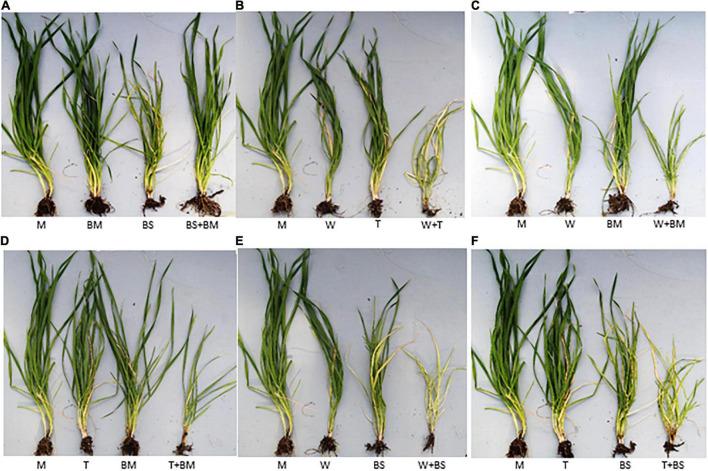
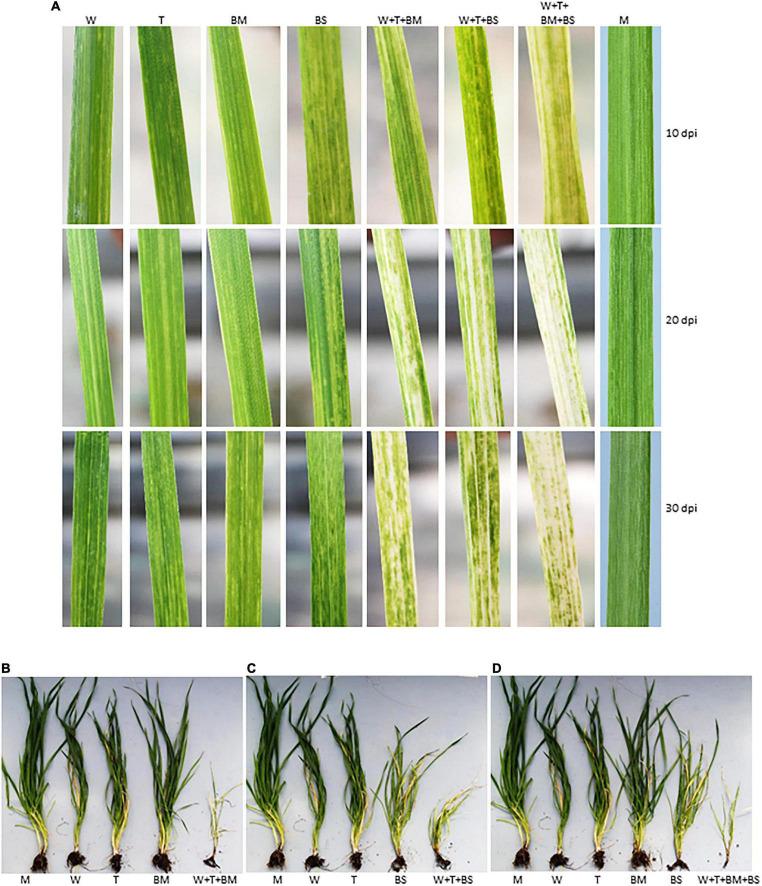
Field-grown wheat ( L.) plants can be co-infected by multiple viruses, including wheat streak mosaic virus (WSMV), Triticum mosaic virus (TriMV), brome mosaic virus (BMV), and barley stripe mosaic virus (BSMV). These viruses belong to four different genera in three different families and are, hence, genetically divergent. However, the impact of potential co-infections with two, three, or all four of them on the viruses themselves, as well as the wheat host, has yet to be examined. This study examined bi-, tri-, and quadripartite interactions among these viruses in wheat for disease development and accumulation of viral genomic RNAs, in comparison with single virus infections. Co-infection of wheat by BMV and BSMV resulted in BMV-like symptoms with a drastic reduction in BSMV genomic RNA copies and coat protein accumulation, suggesting an antagonism-like effect exerted by BMV toward BSMV. However, co-infection of either BMV or BSMV with WSMV or TriMV led to more severe disease than singly infected wheat, but with a decrease or no significant change in titers of interacting viruses in the presence of BMV or BSMV, respectively. These results were in stark contrast with exacerbated disease phenotype accompanied with enhanced virus titers caused by WSMV and TriMV co-infection. Co-infection of wheat by WSMV, TriMV, and BMV or BSMV resulted in enhanced synergistic disease accompanied by increased accumulation of TriMV and BMV but not WSMV or BSMV. Quadripartite interactions in co-infected wheat by all four viruses resulted in very severe disease synergism, leading to the death of the most infected plants, but paradoxically, a drastic reduction in BSMV titer. Our results indicate that interactions among different viruses infecting the same plant host are more complex than previously thought, do not always entail increases in virus titers, and likely involve multiple mechanisms. These findings lay the foundation for additional mechanistic dissections of synergistic interactions among unrelated plant viruses.
田间种植的小麦(L.)植株可能会被多种病毒共同感染,包括小麦线条花叶病毒(WSMV)、小麦花叶病毒(TriMV)、雀麦花叶病毒(BMV)和大麦条纹花叶病毒(BSMV)。这些病毒分属于三个不同科的四个不同属,因此在遗传上存在差异。然而,同时感染其中两种、三种或全部四种病毒对病毒本身以及小麦宿主的影响尚未得到研究。本研究检测了这些病毒在小麦中的双病毒、三病毒和四病毒相互作用对病害发展以及病毒基因组RNA积累的影响,并与单一病毒感染进行了比较。BMV和BSMV共同感染小麦会导致出现类似BMV的症状,同时BSMV基因组RNA拷贝数和外壳蛋白积累大幅减少,这表明BMV对BSMV具有类似拮抗的作用。然而,BMV或BSMV与WSMV或TriMV共同感染会导致病害比单一感染小麦时更严重,但在存在BMV或BSMV的情况下,相互作用病毒的滴度分别降低或无显著变化。这些结果与WSMV和TriMV共同感染导致病害表型加剧且病毒滴度升高形成了鲜明对比。WSMV、TriMV和BMV或BSMV共同感染小麦会导致协同病害加剧,同时TriMV和BMV的积累增加,但WSMV或BSMV没有增加。所有四种病毒共同感染小麦时的四病毒相互作用会导致非常严重的病害协同作用,导致大多数受感染植株死亡,但矛盾的是,BSMV滴度大幅降低。我们的结果表明,感染同一植物宿主的不同病毒之间的相互作用比以前认为的更为复杂,并不总是导致病毒滴度增加,而且可能涉及多种机制。这些发现为进一步深入剖析不相关植物病毒之间的协同相互作用机制奠定了基础。




 Zotero 插件