
从手动临床标准到机器学习算法:比较源自不同电子健康记录数据模式的结局终点。
From manual clinical criteria to machine learning algorithms: Comparing outcome endpoints derived from diverse electronic health record data modalities.
作者信息
Chappidi Shreya, Belue Mason J, Harmon Stephanie A, Jagasia Sarisha, Zhuge Ying, Tasci Erdal, Turkbey Baris, Singh Jatinder, Camphausen Kevin, Krauze Andra V
机构信息
Radiation Oncology Branch, Center for Cancer Research, National Cancer Institute, National Institutes of Health, Bethesda, Maryland, United States of America.
Department of Computer Science and Technology, University of Cambridge, Cambridge, United Kingdom.
出版信息
PLOS Digit Health. 2025 May 14;4(5):e0000755. doi: 10.1371/journal.pdig.0000755. eCollection 2025 May.
BACKGROUND
Progression free survival (PFS) is a critical clinical outcome endpoint during cancer management and treatment evaluation. Yet, PFS is often missing from publicly available datasets due to the current subjective, expert, and time-intensive nature of generating PFS metrics. Given emerging research in multi-modal machine learning (ML), we explored the benefits and challenges associated with mining different electronic health record (EHR) data modalities and automating extraction of PFS metrics via ML algorithms.
METHODS
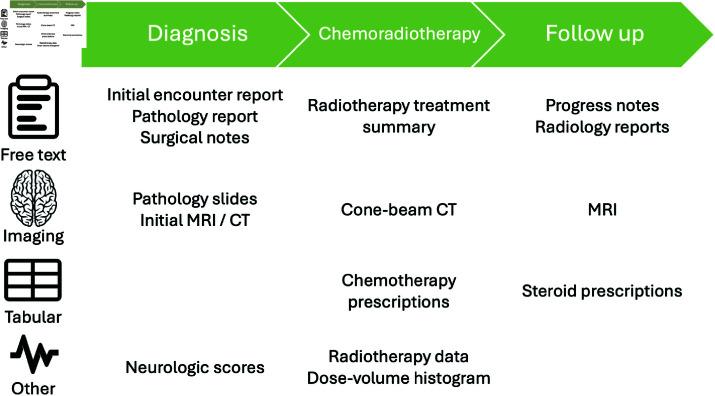
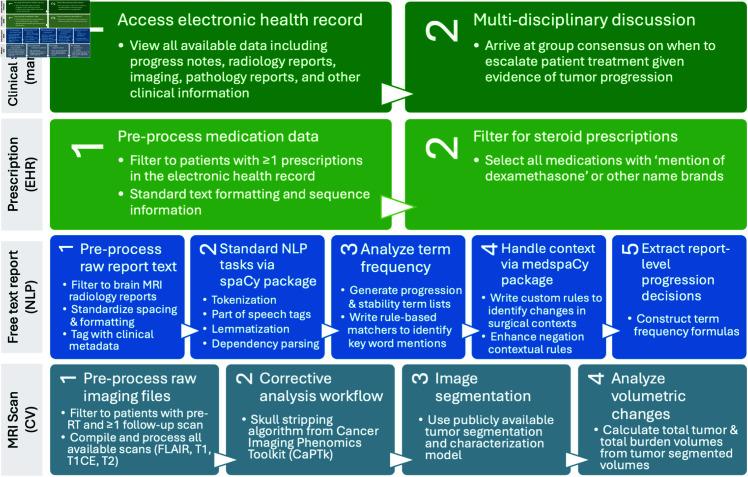
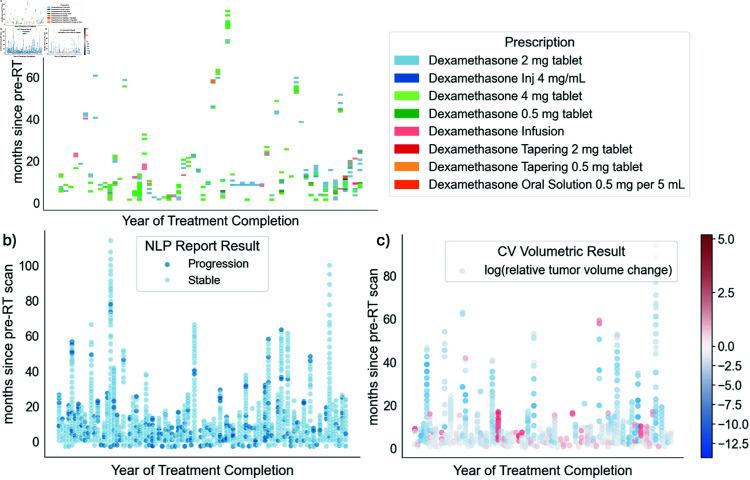
We analyzed EHR data from 92 pathology-proven GBM patients, obtaining 233 corticosteroid prescriptions, 2080 radiology reports, and 743 brain MRI scans. Three methods were developed to derive clinical PFS: 1) frequency analysis of corticosteroid prescriptions, 2) natural language processing (NLP) of reports, and 3) computer vision (CV) volumetric analysis of imaging. Outputs from these methods were compared to manually annotated clinical guideline PFS metrics.
RESULTS
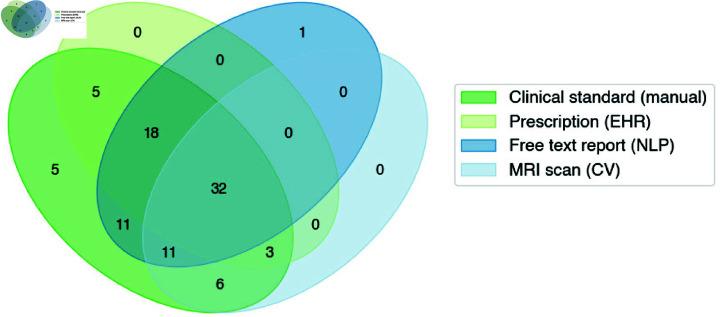
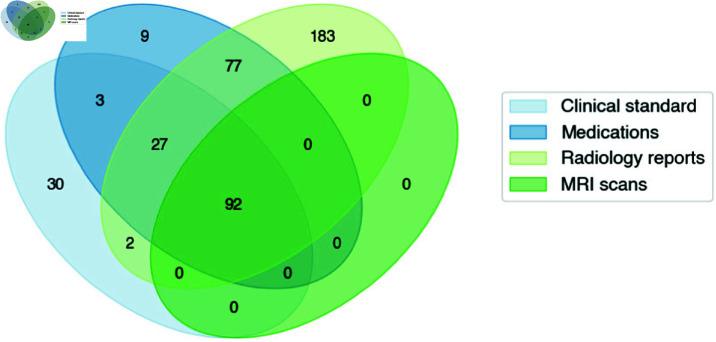
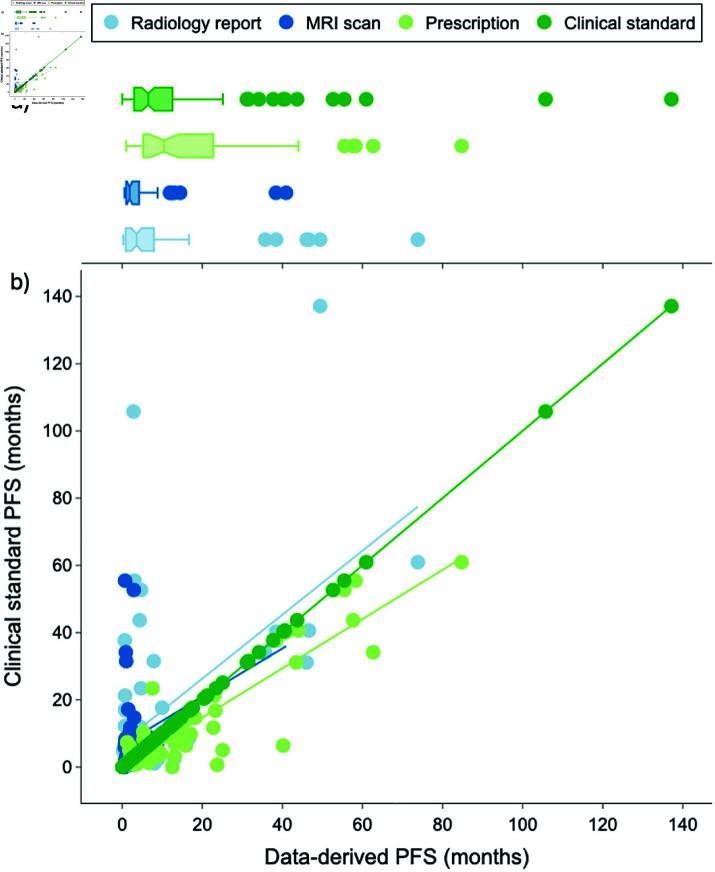
Employing data-driven methods, standalone progression rates were 63% (prescription), 78% (NLP), and 54% (CV), compared to the 99% progression rate from manually applied clinical guidelines using integrated data sources. The prescription method identified progression an average of 5.2 months later than the clinical standard, while the CV and NLP algorithms identified progression earlier by 2.6 and 6.9 months, respectively. While lesion growth is a clinical guideline progression indicator, only half of patients exhibited increasing contrast-enhancing tumor volumes during scan-based CV analysis.
CONCLUSION
Our results indicate that data-driven algorithms can extract tumor progression outcomes from existing EHR data. However, ML methods are subject to varying availability bias, supporting contextual information, and pre-processing resource burdens that influence the extracted PFS endpoint distributions. Our scan-based CV results also suggest that the automation of clinical criteria may not align with human intuition. Our findings indicate a need for improved data source integration, validation, and revisiting of clinical criteria in parallel to multi-modal ML algorithm development.
背景
无进展生存期(PFS)是癌症管理和治疗评估过程中的关键临床结局终点。然而,由于目前生成PFS指标具有主观性、依赖专家且耗时的特点,公开可用的数据集中常常缺少PFS数据。鉴于多模态机器学习(ML)的新研究,我们探讨了挖掘不同电子健康记录(EHR)数据模式以及通过ML算法自动提取PFS指标的益处和挑战。
方法
我们分析了92例经病理证实的胶质母细胞瘤患者的EHR数据,获得了233份皮质类固醇处方、2080份放射学报告和743次脑部MRI扫描。开发了三种方法来推导临床PFS:1)皮质类固醇处方的频率分析,2)报告的自然语言处理(NLP),3)成像的计算机视觉(CV)体积分析。将这些方法的输出与手动注释的临床指南PFS指标进行比较。
结果
采用数据驱动方法,独立进展率分别为63%(处方)、78%(NLP)和54%(CV),而使用综合数据源的手动应用临床指南的进展率为99%。处方方法确定进展的时间比临床标准平均晚5.2个月,而CV和NLP算法分别比临床标准早2.6个月和6.9个月确定进展。虽然病变生长是临床指南中的进展指标,但在基于扫描的CV分析中,只有一半的患者显示增强扫描肿瘤体积增加。
结论
我们的结果表明,数据驱动算法可以从现有EHR数据中提取肿瘤进展结果。然而,ML方法存在不同程度的可用性偏差、支持性上下文信息以及影响提取的PFS终点分布的预处理资源负担。我们基于扫描的CV结果还表明,临床标准的自动化可能与人类直觉不一致。我们的研究结果表明,在开发多模态ML算法的同时,需要改进数据源整合、验证并重新审视临床标准。
 Zotero 插件