Marcuello E, Altés A, Menoyo A, Del Rio E, Gómez-Pardo M, Baiget M
Department of Medical Oncology, Hospital de la Santa Creu i Sant Pau. Avda. S. Antoni M Claret 167, 08025 Barcelona, Spain.
Br J Cancer. 2004 Aug 16;91(4):678-82. doi: 10.1038/sj.bjc.6602042.
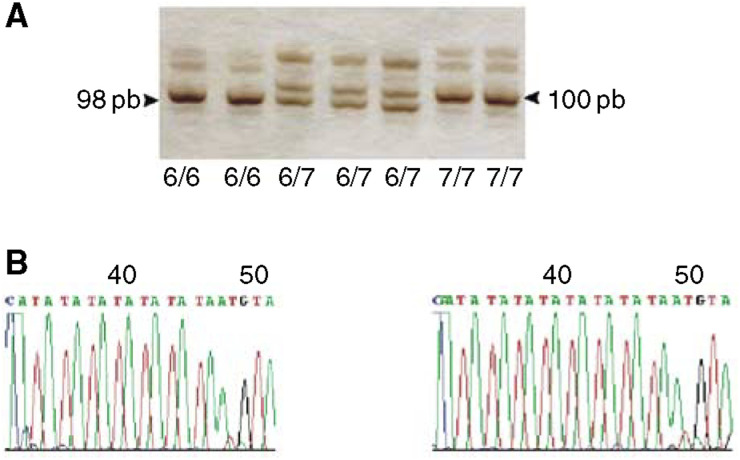
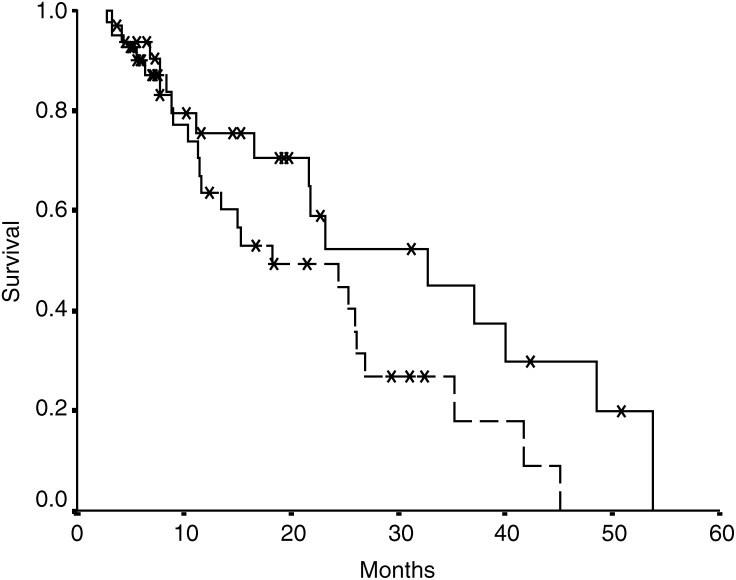
SN-38 is the active metabolite of irinotecan and it is metabolised through conjugation by uridine diphosphate glucuronosyl transferase (UGT1A1). The major toxicity of irinotecan therapy is diarrhoea, which has been related to the enzymatic activity of UGT1A1. We examined the influence of the UGT1A1 gene promoter polymorphism in the toxicity profile, in the response rate and in the overall survival (OS) in 95 patients with metastatic colorectal cancer treated with an irinotecan-containing chemotherapy. Genotypes were determined by analysing the sequence of TATA box of UGT1A1 of genomic DNA from the patients. Clinical parameters and genotypes were compared by univariate and multivariate statistical methods. The more frequent adverse effects were asthenia (34 patients), diarrhoea (29 patients) and neutropenia (20 patients). Severe diarrhoea was observed in 7/10 homozygous (70%) and 15/45 heterozygous (33%) in comparison to 7/40 (17%) wild-type patients (P=0.005). These results maintained the statistical significance in logistic regression analysis (P=0.01) after adjustment for other clinical relevant variables. The presence of severe haematological toxicity increased from wild-type patients to UGT1A1()28 homozygotes, but without achieving statistical significance. No relationship was found between the UGT1A1()28 genotypes and infection, nausea or mucositis. In univariate studies, patients with the UGT1A1()28 polymorphism showed a trend to a poorer OS (P=0.09). In the multivariate analysis, the genotype was not related to clinical response or to OS. The role of the UGT1A1 genotype as a predictor of toxicity in cancer patients receiving irinotecan demands the performance of a randomized trial to ascertain whether genotype-adjusted dosages of the drug can help to establish safe and effective doses not only for patients with the UGT1A1()28 homozygous genotype but also for those with the most common UGT1A1 6/6 or 6/7 genotype.
SN-38是伊立替康的活性代谢产物,它通过尿苷二磷酸葡萄糖醛酸基转移酶(UGT1A1)的结合作用进行代谢。伊立替康治疗的主要毒性是腹泻,这与UGT1A1的酶活性有关。我们研究了UGT1A1基因启动子多态性对95例接受含伊立替康化疗的转移性结直肠癌患者的毒性特征、缓解率和总生存期(OS)的影响。通过分析患者基因组DNA中UGT1A1的TATA盒序列来确定基因型。采用单因素和多因素统计方法比较临床参数和基因型。较常见的不良反应有乏力(34例)、腹泻(29例)和中性粒细胞减少(20例)。与7/40(17%)野生型患者相比,7/10纯合子(70%)和15/45杂合子(33%)出现严重腹泻(P = 0.005)。在对其他临床相关变量进行校正后,这些结果在逻辑回归分析中仍保持统计学显著性(P = 0.01)。从野生型患者到UGT1A1()28纯合子,严重血液学毒性的发生率增加,但未达到统计学显著性。未发现UGT1A1()28基因型与感染、恶心或口腔炎之间存在关联。在单因素研究中,具有UGT1A1()28多态性的患者总生存期有较差趋势(P = 0.09)。在多因素分析中,基因型与临床缓解或总生存期无关。UGT1A1基因型作为接受伊立替康治疗的癌症患者毒性预测指标的作用,需要通过一项随机试验来确定根据基因型调整药物剂量是否不仅有助于为UGT1A1()28纯合基因型患者,也为最常见的UGT1A1 6/6或6/7基因型患者确定安全有效的剂量。