
低剂量普拉克索在帕金森病的MPTP小鼠模型中具有神经保护作用,并通过D3受体下调多巴胺转运体。
Low dose pramipexole is neuroprotective in the MPTP mouse model of Parkinson's disease, and downregulates the dopamine transporter via the D3 receptor.
作者信息
Joyce Jeffrey N, Woolsey Cheryl, Ryoo Han, Borwege Sabine, Hagner Diane
机构信息
Thomas H Christopher Center for Parkinson's Disease Research, Sun Health Research Institute, 10515 West Santa Fe Dr, Sun City, AZ 85352, USA.
出版信息
BMC Biol. 2004 Oct 11;2:22. doi: 10.1186/1741-7007-2-22.
BACKGROUND
Our aim was to determine if pramipexole, a D3 preferring agonist, effectively reduced dopamine neuron and fiber loss in the 1-methyl-4-phenyl-1,2,3,6-tetrahydropyridine (MPTP) mouse model when given at intraperitoneal doses corresponding to clinical doses. We also determined whether subchronic treatment with pramipexole regulates dopamine transporter function, thereby reducing intracellular transport of the active metabolite of MPTP, 1-methyl-4-phenylpyridinium (MPP+).
METHODS
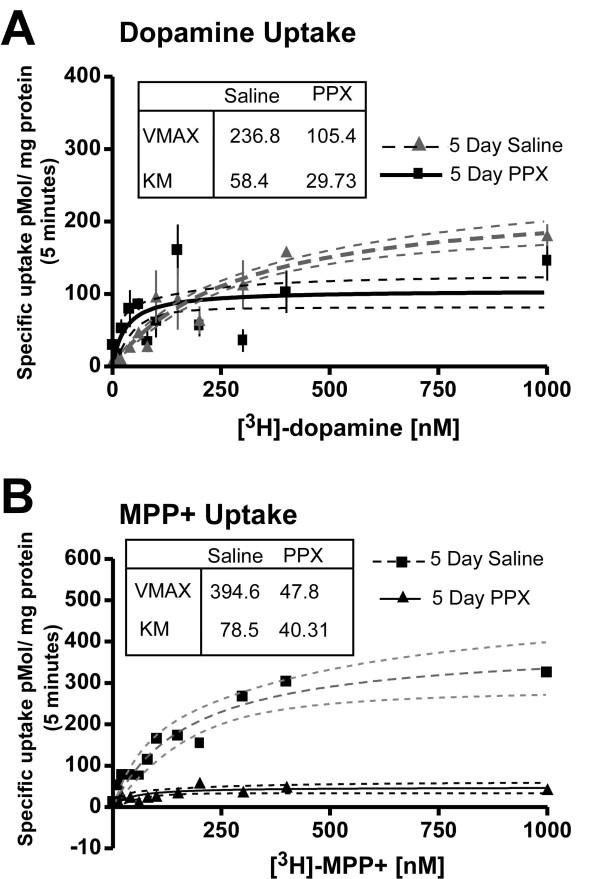
Ten 12-month old C57BL/6 mice were treated with MPTP (or saline) twice per day at 20 mg/kg s.c. (4 injections over 48 h). Mice were pretreated for 3 days and during the 2-day MPTP regimen with pramipexole (0.1 mg/kg/day) or saline. Stereological quantification of dopamine neuron number and optical density measurement of dopamine fiber loss were carried out at 1 week after treatment, using immunostaining for dopamine transporter (DAT) and tyrosine hydroxylase (TH). Additional wild-type (WT) and D3 receptor knockout (KO) mice were treated for 5 days with pramipexole (0.1 mg/kg/day) or vehicle. The kinetics of [3H]MPP+ and [3H]DA uptake (Vmax and Km) were determined 24 h later; and at 24 h and 14 days dopamine transporter density was measured by quantitative autoradiography.
RESULTS
Pramipexole treatment completely antagonized the neurotoxic effects of MPTP, as measured by substantia nigra and ventral tegmental area TH-immunoreactive cell counts. MPTP- induced loss of striatal innervation, as measured by DAT-immunoreactivity, was partially prevented by pramipexole, but not with regard to TH-IR. Pramipexole also reduced DAT- immunoreactivity in non-MPTP treated mice. Subchronic treatment with pramipexole lowered the Vmax for [3H]DA and [3H]MPP+ uptake into striatal synaptosomes of WT mice. Pramipexole treatment lowered Vmax in WT but not D3 KO mice; however, D3 KO mice had lower Vmax for [3H]DA uptake. There was no change in DAT number in WT with pramipexole treatment or D3 KO mice at 24 h post-treatment, but there was a reduction in WT-pramipexole treated and not in D3 KO mice at 14 days post-treatment.
CONCLUSION
These results suggest that protection occurs at clinically suitable doses of pramipexole. Protection could be due to a reduced amount of MPP+ taken up into DA terminals via DAT. D3 receptor plays an important role in this regulation of transporter uptake and availability.
背景
我们的目的是确定普拉克索(一种对D3受体具有偏好性的激动剂)在腹腔注射相当于临床剂量时,是否能有效减少1-甲基-4-苯基-1,2,3,6-四氢吡啶(MPTP)小鼠模型中的多巴胺能神经元和纤维损失。我们还确定了普拉克索的亚慢性治疗是否能调节多巴胺转运体功能,从而减少MPTP的活性代谢产物1-甲基-4-苯基吡啶鎓(MPP+)的细胞内转运。
方法
10只12月龄的C57BL/6小鼠,每天皮下注射20mg/kg的MPTP(或生理盐水)两次(48小时内注射4次)。小鼠在MPTP给药前3天以及给药的2天期间,用普拉克索(0.1mg/kg/天)或生理盐水进行预处理。在治疗后1周,使用多巴胺转运体(DAT)和酪氨酸羟化酶(TH)免疫染色,对多巴胺能神经元数量进行体视学定量分析,并对多巴胺纤维损失进行光密度测量。另外,野生型(WT)和D3受体基因敲除(KO)小鼠用普拉克索(0.1mg/kg/天)或溶剂处理5天。24小时后测定[3H]MPP+和[3H]多巴胺摄取的动力学参数(Vmax和Km);在24小时和14天时,通过定量放射自显影法测量多巴胺转运体密度。
结果
通过黑质和腹侧被盖区TH免疫反应性细胞计数测量,普拉克索治疗完全拮抗了MPTP的神经毒性作用。通过DAT免疫反应性测量,MPTP诱导的纹状体神经支配丧失,部分被普拉克索预防,但TH免疫反应性方面未被预防。普拉克索还降低了未用MPTP处理小鼠的DAT免疫反应性。普拉克索的亚慢性治疗降低了WT小鼠纹状体突触体中[3H]多巴胺和[3H]MPP+摄取的Vmax。普拉克索治疗降低了WT小鼠而非D3 KO小鼠的Vmax;然而,D3 KO小鼠[3H]多巴胺摄取的Vmax较低。治疗后24小时,WT小鼠和D3 KO小鼠用普拉克索治疗后DAT数量均无变化,但治疗后14天,WT小鼠用普拉克索治疗后DAT数量减少,而D3 KO小鼠未减少。
结论
这些结果表明,普拉克索在临床合适剂量下具有神经保护作用。这种保护作用可能是由于通过DAT进入多巴胺能终末的MPP+量减少。D3受体在这种转运体摄取和可用性的调节中起重要作用。


 Zotero 插件