Follis Kathryn E, York Joanne, Nunberg Jack H
Montana Biotechnology Center, The University of Montana, Science Complex Room 221, Missoula, MT 59812, USA.
Virology. 2005 Oct 10;341(1):122-9. doi: 10.1016/j.virol.2005.07.005.
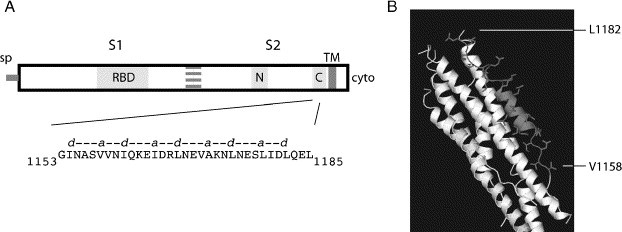
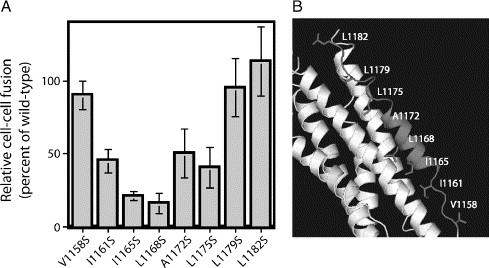
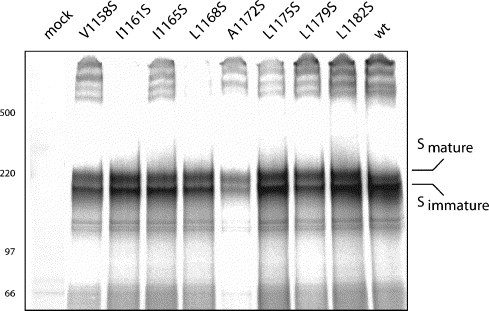
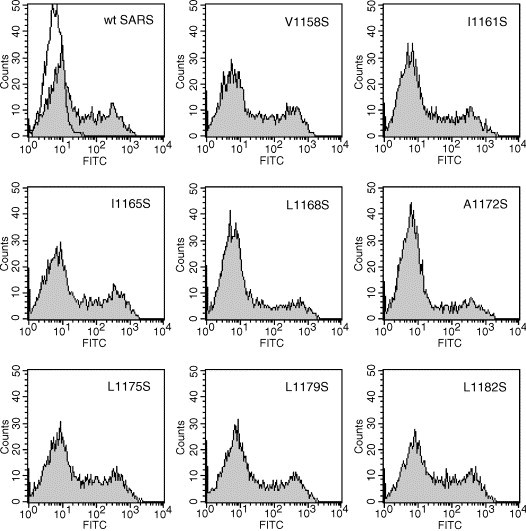
The fusion subunit of the SARS-CoV S glycoprotein contains two regions of hydrophobic heptad-repeat amino acid sequences that have been shown in biophysical studies to form a six-helix bundle structure typical of the fusion-active core found in Class I viral fusion proteins. Here, we have applied serine-scanning mutagenesis to the C-terminal-most heptad-repeat region in the SARS-CoV S glycoprotein to investigate the functional role of this region in membrane fusion. We show that hydrophobic sidechains at a and d positions only within the short helical segment of the C-terminal heptad-repeat region (I1161, I1165, L1168, A1172, and L1175) are critical for cell-cell fusion. Serine mutations at outlying heptad-repeat residues that form an extended chain in the core structure (V1158, L1179, and L1182) do not affect fusogenicity. Our study provides genetic evidence for the important role of alpha-helical packing in promoting S glycoprotein-mediated membrane fusion.
严重急性呼吸综合征冠状病毒(SARS-CoV)刺突糖蛋白的融合亚基包含两个疏水性七肽重复氨基酸序列区域,生物物理研究表明,这两个区域形成了典型的六螺旋束结构,是I类病毒融合蛋白中发现的融合活性核心。在此,我们对SARS-CoV刺突糖蛋白中最末端的七肽重复区域进行了丝氨酸扫描诱变,以研究该区域在膜融合中的功能作用。我们发现,只有在C末端七肽重复区域短螺旋段内的a和d位置的疏水性侧链(I1161、I1165、L1168、A1172和L1175)对细胞间融合至关重要。在核心结构中形成延伸链的外围七肽重复残基(V1158、L1179和L1182)处的丝氨酸突变不影响融合能力。我们的研究为α螺旋堆积在促进刺突糖蛋白介导的膜融合中的重要作用提供了遗传学证据。