Jiang H, Zacharias W, Amirhaeri S
Department of Biochemistry, School of Medicine, University of Alabama, Birmingham 35294.
Nucleic Acids Res. 1991 Dec 25;19(24):6943-8. doi: 10.1093/nar/19.24.6943.
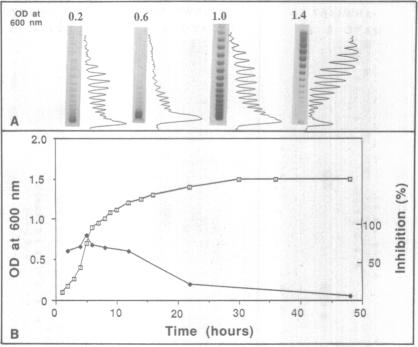
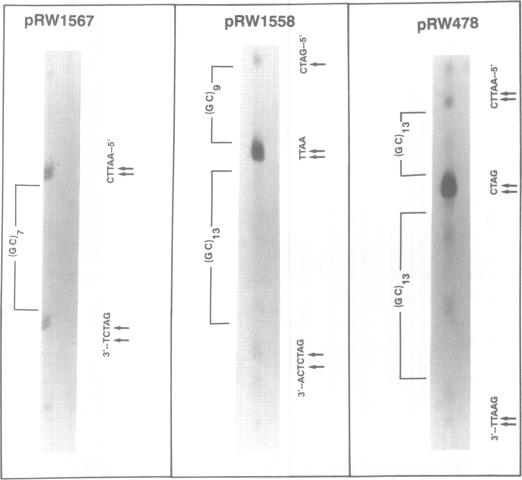
The availability of DNA structural probes that can be applied to living cells is essential for the analysis of biological functions of unusual DNA structures adopted in vivo. We have developed a chemical probe assay to detect and quantitate left-handed Z-DNA structures in recombinant plasmids in growing E. coli cells. Potassium permanganate selectively reacts with B-Z or Z-Z junction regions in supercoiled plasmids harbored in the cells. Restriction enzyme recognition sites located at these junctions are not cleaved by the corresponding endonuclease after modification with KMnO4. This inhibition of cleavage allows the determination of the relative amounts of B- and Z-forms of the cloned inserts inside the cell. We have successfully applied this method to monitor the extent of Z-DNA formation in E. coli as a function of the growth phase and mutated topoisomerase or gyrase activities. The assay can in principle be used for any unusual DNA structure that contains a restriction recognition site inside or near the structural alteration. It can be a useful tool to analyze in vivo correlations between DNA structure and gene regulatory events.
能够应用于活细胞的DNA结构探针对于分析体内所采用的异常DNA结构的生物学功能至关重要。我们开发了一种化学探针检测法,用于检测和定量生长中的大肠杆菌细胞中重组质粒中的左旋Z-DNA结构。高锰酸钾选择性地与细胞中携带的超螺旋质粒中的B-Z或Z-Z交界区域发生反应。在用KMnO4修饰后,位于这些交界处的限制性内切酶识别位点不会被相应的内切酶切割。这种切割抑制作用使得能够确定细胞内克隆插入片段的B型和Z型的相对含量。我们已成功应用此方法来监测大肠杆菌中Z-DNA形成的程度与生长阶段以及突变的拓扑异构酶或回旋酶活性的关系。原则上,该检测法可用于任何在结构改变内部或附近包含限制性识别位点的异常DNA结构。它可能是分析DNA结构与基因调控事件之间体内相关性的有用工具。