
传统抗原和Mls超抗原激活CD4 + T细胞后干扰素γ基因表达的差异诱导
Differential induction of interferon gamma gene expression after activation of CD4+ T cells by conventional antigen and Mls superantigen.
作者信息
Patarca R, Wei F Y, Iregui M V, Cantor H
机构信息
Department of Pathology, Harvard Medical School, Dana, Farber Cancer Institute, Boston, MA 02115.
出版信息
Proc Natl Acad Sci U S A. 1991 Apr 1;88(7):2736-9. doi: 10.1073/pnas.88.7.2736.
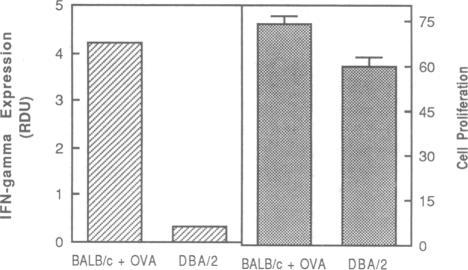
We have analyzed cytokine gene expression by a murine CD4+ T-cell clone that expresses three forms of T-cell recognition. The clone employs a V beta 6-containing T-cell receptor to recognize (i) a self class II major histocompatibility complex and an ovalbumin-derived peptide (OVA), (ii) an I-Ab alloantigen, and (iii) Mls-1a. All three responses are accompanied by similar levels of cell proliferation. However, although interferon gamma gene expression is strongly induced during both physiological recognition of the OVA peptide and allogeneic major histocompatibility complex recognition, expression of this gene was not detected during the Mls response. These studies indicate that Mls recognition is functionally distinct from T-cell recognition of peptides and alloantigens and leads to an alternative pattern of cytokine gene expression. They also suggest the possibility that encounter with these two classes of T-cell antigen in vivo may generate subsets of T helper cells that display different patterns of cytokine gene expression.
我们已经通过一个表达三种形式T细胞识别的小鼠CD4 + T细胞克隆分析了细胞因子基因表达。该克隆采用含Vβ6的T细胞受体来识别:(i)一种自身II类主要组织相容性复合体和一种卵清蛋白衍生肽(OVA),(ii)一种I-Ab同种异体抗原,以及(iii)Mls-1a。所有这三种反应都伴随着相似水平的细胞增殖。然而,尽管在OVA肽的生理性识别和同种异体主要组织相容性复合体识别过程中都强烈诱导了干扰素γ基因表达,但在Mls反应过程中未检测到该基因的表达。这些研究表明,Mls识别在功能上不同于T细胞对肽和同种异体抗原的识别,并导致细胞因子基因表达的另一种模式。它们还表明,在体内遇到这两类T细胞抗原可能会产生显示不同细胞因子基因表达模式的辅助性T细胞亚群。

 Zotero 插件