Lapish Christopher C, Kroener Sven, Durstewitz Daniel, Lavin Antonieta, Seamans Jeremy K
Department of Neurosciences, Medical University of South Carolina, Suite 430 BSB 173 Ashley, Charleston, SC, USA.
Psychopharmacology (Berl). 2007 Apr;191(3):609-25. doi: 10.1007/s00213-006-0527-8. Epub 2006 Nov 4.
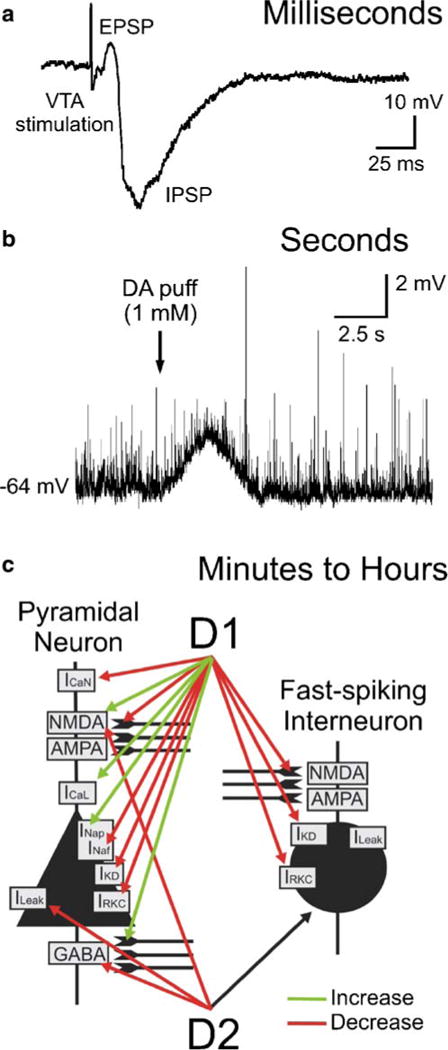
This review discusses evidence that cells in the mesocortical dopamine (DA) system influence information processing in target areas across three distinct temporal domains.
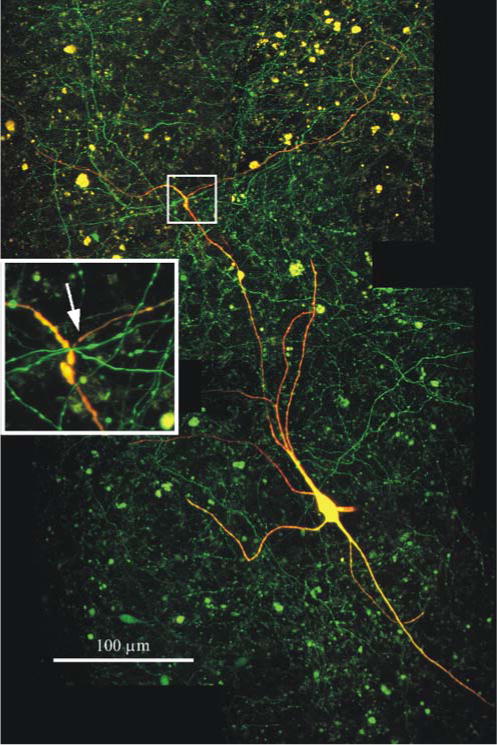
Phasic bursting of midbrain DA neurons may provide temporally precise information about the mismatch between expected and actual rewards (prediction errors) that has been hypothesized to serve as a learning signal in efferent regions. However, because DA acts as a relatively slow modulator of cortical neurotransmission, it is unclear whether DA can indeed act to precisely transmit prediction errors to prefrontal cortex (PFC). In light of recent physiological and anatomical evidence, we propose that corelease of glutamate from DA and/or non-DA neurons in the VTA could serve to transmit this temporally precise signal. In contrast, DA acts in a protracted manner to provide spatially and temporally diffuse modulation of PFC pyramidal neurons and interneurons. This modulation occurs first via a relatively rapid depolarization of fast-spiking interneurons that acts on the order of seconds. This is followed by a more protracted modulation of a variety of other ionic currents on timescales of minutes to hours, which may bias the manner in which cortical networks process information. However, the prolonged actions of DA may be curtailed by counteracting influences, which likely include opposing actions at D1 and D2-like receptors that have been shown to be time- and concentration-dependent. In this way, the mesocortical DA system optimizes the characteristics of glutamate, GABA, and DA neurotransmission both within the midbrain and cortex to communicate temporally precise information and to modulate network activity patterns on prolonged timescales.
本综述讨论了中脑皮质多巴胺(DA)系统中的细胞在三个不同时间域影响靶区域信息处理的证据。
中脑DA神经元的相位性爆发可能提供关于预期奖励与实际奖励之间不匹配(预测误差)的时间精确信息,据推测该信息在传出区域作为学习信号。然而,由于DA作为皮质神经传递的相对缓慢的调节剂,尚不清楚DA是否确实能将预测误差精确传递至前额叶皮质(PFC)。鉴于最近的生理学和解剖学证据,我们提出腹侧被盖区(VTA)中DA和/或非DA神经元共同释放谷氨酸可能有助于传递这种时间精确信号。相比之下,DA以持久的方式对PFC锥体神经元和中间神经元进行空间和时间上的弥散性调节。这种调节首先通过快速放电中间神经元相对快速的去极化发生,作用时间约为几秒。随后在数分钟至数小时的时间尺度上对多种其他离子电流进行更持久的调节,这可能会影响皮质网络处理信息的方式。然而,DA的长期作用可能会受到抵消性影响的限制,这些影响可能包括在D1和D2样受体上的相反作用,已证明这些作用具有时间和浓度依赖性。通过这种方式,中脑皮质DA系统优化了中脑和皮质内谷氨酸、γ-氨基丁酸(GABA)和DA神经传递的特性,以传递时间精确信息并在较长时间尺度上调节网络活动模式。