
化疗耐药通过下调神经细胞黏附分子(NCAM)的表面表达诱导神经母细胞瘤细胞的黏附增强及跨内皮穿透能力增强。
Chemoresistance induces enhanced adhesion and transendothelial penetration of neuroblastoma cells by down-regulating NCAM surface expression.
作者信息
Blaheta Roman A, Daher Frederick H, Michaelis Martin, Hasenberg Christoph, Weich Eva M, Jonas Dietger, Kotchetkov Rouslan, Doerr Hans Willhelm, Cinatl Jindrich
机构信息
Zentrum der Chirurgie, Klinik für Urologie und Kinderurologie, Johann Wolfgang Goethe-Universität, Frankfurt am Main, Germany.
出版信息
BMC Cancer. 2006 Dec 21;6:294. doi: 10.1186/1471-2407-6-294.
BACKGROUND
Drug resistance to chemotherapy is often associated with increased malignancy in neuroblastoma (NB). One explanation for the link between resistance and malignancy might be that resistance facilitates cancer progression and invasion. To investigate this hypothesis, adhesion, transendothelial penetration and NCAM (CD56) adhesion receptor expression of drug-resistant versus drug-sensitive NB tumor cells were evaluated.
METHODS
Acquired drug resistance was mimicked by exposing parental UKF-NB-2, UKF-NB-3 or IMR-32 tumor cells to increasing concentrations of vincristine- (VCR) or doxorubicin (DOX) to establish the resistant tumor cell sublines UKF-NB-2VCR, UKF-NB-2DOX, UKF-NB-3VCR, UKF-NB-3DOX, IMR-32VCR and IMR-32DOX. Additionally, the malignant behaviour of UKF-NB-4, which already possessed the intrinsic multidrug resistance (MDR) phenotype, was analyzed. UKF-NB-4 exposed to VCR or DOX were designated UKF-NB-4VCR or UKF-NB-4DOX. Combined phase contrast - reflection interference contrast microscopy was used to separately evaluate NB cell adhesion and penetration. NCAM was analyzed by flow cytometry, western blot and RT-PCR.
RESULTS
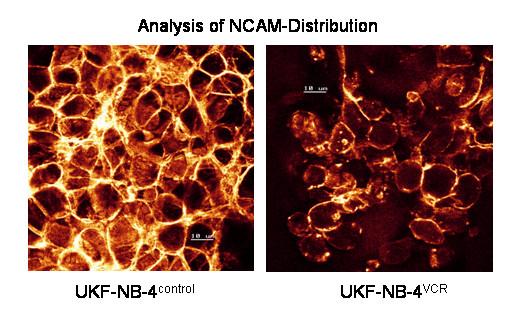
VCR and DOX resistant tumor sublines showed enhanced adhesion and penetration capacity, compared to their drug naïve controls. Strongest effects were seen with UKF-NB-2VCR, UKF-NB-3VCR and IMR-32DOX. DOX or VCR treatment also evoked increased invasive behaviour of UKF-NB-4. The process of accelerated tumor invasion was accompanied by decreased NCAM surface and protein expression, and down-regulation of NCAM coding mRNA. Transfection of UKF-NB-4VCR cells with NCAM cDNA led to a significant receptor up-regulation, paralleled by diminished adhesion to an endothelial cell monolayer.
CONCLUSION
It is concluded that NB cells resistant to anticancer drugs acquire increased invasive capacity relative to non-resistant parental cells, and that enhanced invasion is caused by strong down-regulation of NCAM adhesion receptors.
背景
化疗耐药性常与神经母细胞瘤(NB)的恶性程度增加相关。耐药性与恶性程度之间联系的一种解释可能是,耐药性促进了癌症进展和侵袭。为了研究这一假设,评估了耐药与敏感NB肿瘤细胞的黏附、跨内皮穿透及NCAM(CD56)黏附受体表达情况。
方法
通过将亲本UKF-NB-2、UKF-NB-3或IMR-32肿瘤细胞暴露于浓度递增的长春新碱(VCR)或阿霉素(DOX),模拟获得性耐药,以建立耐药肿瘤细胞亚系UKF-NB-2VCR、UKF-NB-2DOX、UKF-NB-3VCR、UKF-NB-3DOX、IMR-32VCR和IMR-32DOX。此外,分析了已具有固有多药耐药(MDR)表型的UKF-NB-4的恶性行为。暴露于VCR或DOX的UKF-NB-4分别命名为UKF-NB-4VCR或UKF-NB-4DOX。采用相差-反射干涉对比显微镜联合技术分别评估NB细胞的黏附和穿透情况。通过流式细胞术、蛋白质印迹法和逆转录-聚合酶链反应分析NCAM。
结果
与未接触药物的对照相比,VCR和DOX耐药肿瘤亚系表现出增强的黏附和穿透能力。在UKF-NB-2VCR、UKF-NB-3VCR和IMR-32DOX中观察到最强的效果。DOX或VCR处理也诱发了UKF-NB-4侵袭行为的增加。肿瘤侵袭加速的过程伴随着NCAM表面和蛋白质表达的降低,以及NCAM编码mRNA的下调。用NCAM cDNA转染UKF-NB-4VCR细胞导致受体显著上调,同时对内皮细胞单层的黏附减少。
结论
得出的结论是,相对于非耐药亲本细胞,对抗癌药物耐药的NB细胞获得了增强的侵袭能力,且侵袭增强是由NCAM黏附受体的强烈下调所致。




 Zotero 插件