
加巴喷丁与术后疼痛:一项定性与定量的系统评价,重点关注手术操作
Gabapentin and postoperative pain: a qualitative and quantitative systematic review, with focus on procedure.
作者信息
Mathiesen Ole, Møiniche Steen, Dahl Jørgen B
机构信息
Department of Anaesthesia, Copenhagen University Hospital, Glostrup, Denmark.
出版信息
BMC Anesthesiol. 2007 Jul 7;7:6. doi: 10.1186/1471-2253-7-6.
BACKGROUND
Gabapentin is an antiepileptic drug used in a variety of chronic pain conditions. Increasing numbers of randomized trials indicate that gabapentin is effective as a postoperative analgesic. This procedure-specific systematic review aims to analyse the 24-hour postoperative effect of gabapentin on acute pain in adults.
METHODS
Medline, The Cochrane Library and Google Scholar were searched for double-blind randomized placebo controlled trials of gabapentin for postoperative pain relief compared with placebo, in adults undergoing a surgical procedure. Qualitative analysis of postoperative effectiveness was evaluated by assessment of significant difference (P < 0.05) in pain relief using consumption of supplemental analgesic and pain scores between study groups. Quantitative analyses of combined data from similar procedures, were performed by calculating the weighted mean difference (WMD) of 24-hour cumulated opioid requirements, and the WMD for visual analogue scale (VAS) pain, (early (6 h) and late (24 h) postoperatively), between study groups. Side-effects (nausea, vomiting, dizziness and sedation) were extracted for calculation of their relative risk (RR).
RESULTS
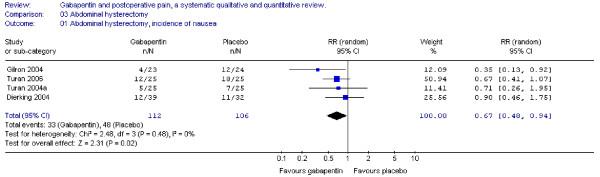
Twenty-three trials with 1529 patients were included. In 12 of 16 studies with data on postoperative opioid requirement, the reported 24-hour opioid consumption was significantly reduced with gabapentin. Quantitative analysis of five trials in abdominal hysterectomy showed a significant reduction in morphine consumption (WMD - 13 mg, 95% confidence interval (CI) -19 to -8 mg), and in early pain scores at rest (WMD - 11 mm on the VAS, 95% CI -12 to -2 mm) and during activity (WMD -8 mm on the VAS; 95% CI -13 to -3 mm), favouring gabapentin. In spinal surgery, (4 trials), analyses demonstrated a significant reduction in morphine consumption (WMD of - 31 mg (95%CI - 53 to -10 mg) and pain scores, early (WMD - 17 mm on the VAS; 95 % CI -31 to -3 mm) and late (WMD -12 mm on the VAS; 95% CI -23 to -1 mm) also favouring gabapentin treatment. Nausea was improved with gabapentin in abdominal hysterectomy (RR 0.7; 95 % CI 0.5 to 0.9). Other side-effects were unaffected.
CONCLUSION
Perioperative use of gabapentin has a significant 24-hour opioid sparing effect and improves pain score for both abdominal hysterectomy and spinal surgery. Nausea may be reduced in abdominal hysterectomy.
背景
加巴喷丁是一种抗癫痫药物,用于多种慢性疼痛病症。越来越多的随机试验表明,加巴喷丁作为术后镇痛药是有效的。本特定手术系统评价旨在分析加巴喷丁对成人术后急性疼痛的24小时效果。
方法
检索了Medline、Cochrane图书馆和谷歌学术,以查找加巴喷丁用于术后疼痛缓解的双盲随机安慰剂对照试验,试验对象为接受外科手术的成人,并与安慰剂进行比较。通过评估研究组之间使用补充镇痛药的情况和疼痛评分的疼痛缓解差异(P<0.05)来评估术后有效性的定性分析。对相似手术的合并数据进行定量分析,通过计算研究组之间24小时累积阿片类药物需求量的加权平均差(WMD)以及视觉模拟量表(VAS)疼痛(术后早期(6小时)和晚期(24小时))的WMD。提取副作用(恶心、呕吐、头晕和镇静)以计算其相对风险(RR)。
结果
纳入了23项试验,共1529例患者。在16项有术后阿片类药物需求量数据的研究中,有12项报告加巴喷丁使24小时阿片类药物消耗量显著降低。对腹部子宫切除术的5项试验进行定量分析显示,吗啡消耗量显著降低(WMD -13 mg,95%置信区间(CI)-19至-8 mg),静息时早期疼痛评分(VAS上WMD -11 mm,95%CI -12至-2 mm)和活动时疼痛评分(VAS上WMD -8 mm;95%CI -13至-3 mm)均有利于加巴喷丁。在脊柱手术中(4项试验),分析表明吗啡消耗量显著降低(WMD为-31 mg(95%CI -53至-10 mg)),疼痛评分早期(VAS上WMD -17 mm;95%CI -31至-3 mm)和晚期(VAS上WMD -12 mm;95%CI -23至-1 mm)也有利于加巴喷丁治疗。腹部子宫切除术中加巴喷丁可改善恶心(RR 0.7;95%CI 0.5至0.9)。其他副作用未受影响。
结论
围手术期使用加巴喷丁具有显著的24小时阿片类药物节省效应,并可改善腹部子宫切除术和脊柱手术的疼痛评分。腹部子宫切除术中恶心可能会减轻。




 Zotero 插件