Yin Xue-ren, Chen Kun-song, Allan Andrew C, Wu Rong-mei, Zhang Bo, Lallu Nagin, Ferguson Ian B
Laboratory of Fruit Molecular Physiology and Biotechnology/The State Agriculture Ministry Laboratory of Horticultural Plant Growth, Development and Biotechnology, Zhejiang University, Huajiachi Campus, Hangzhou 310029, PR China.
J Exp Bot. 2008;59(8):2097-108. doi: 10.1093/jxb/ern067.
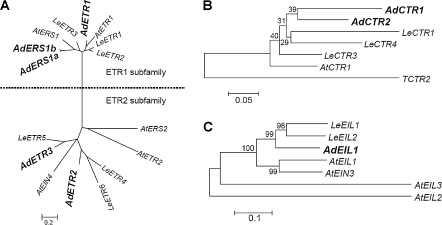
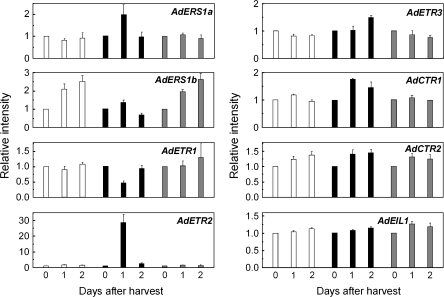
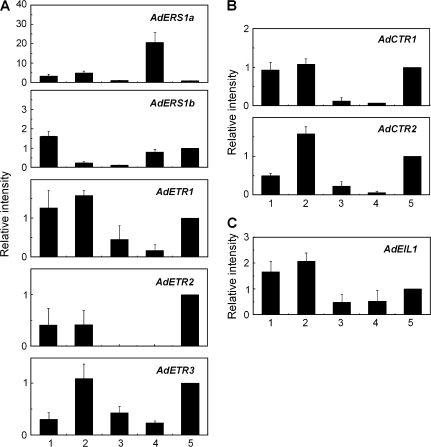
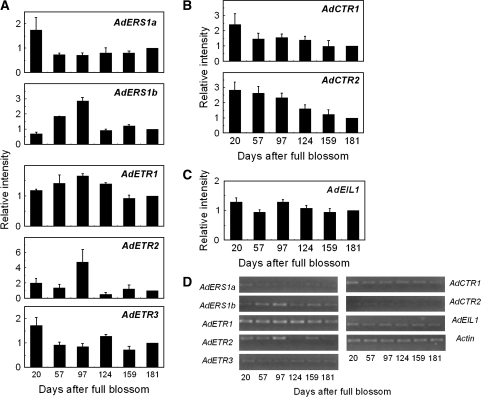
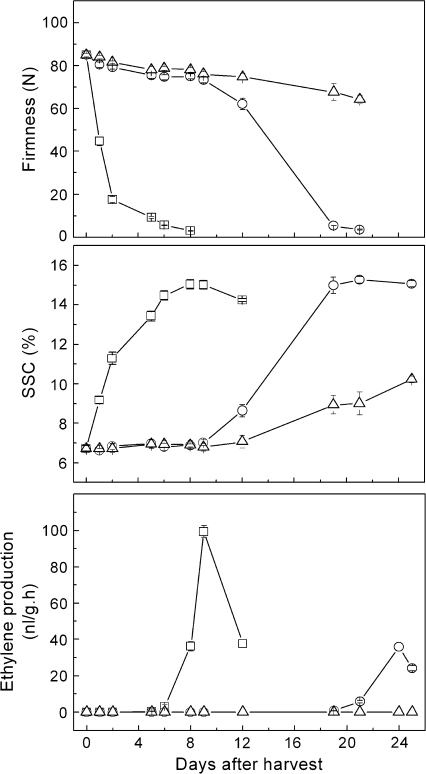
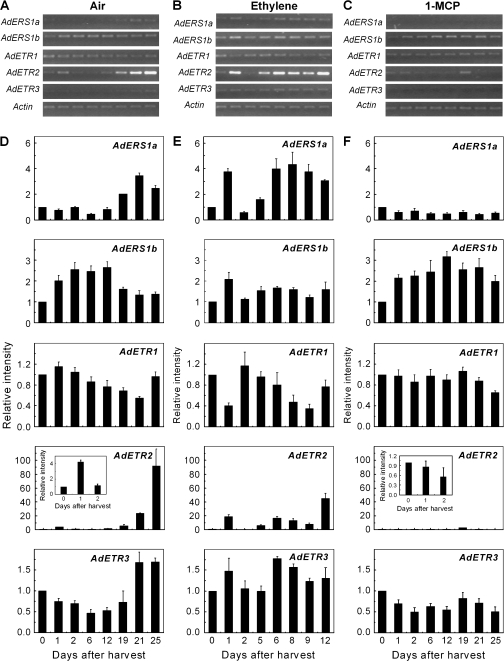
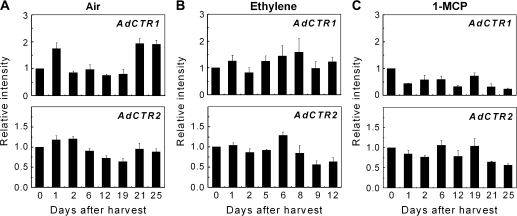
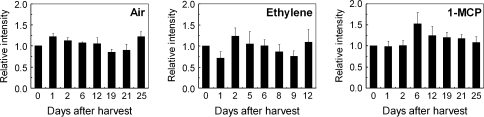
Gene families associated with the ethylene signal transduction pathway in ripening kiwifruit (Actinidia deliciosa [A. Chev.] C.F. Liang et A.R. Ferguson var. deliciosa cv. Hayward) were isolated from a kiwifruit expressed sequence tag (EST) database, including five ethylene receptor genes, two CTR1-like genes, and an EIN3-like gene AdEIL1. All were differentially expressed among various kiwifruit vine tissues, and none was fruit specific. During fruit development, levels of transcripts of AdERS1a, AdETR3, and the two CTR1-like genes decreased, whereas those of AdERS1b and AdETR2 peaked at 97 d after full bloom. In ripening kiwifruit, there was a diverse response of the ethylene receptor family to internal and external ethylene. AdERS1a, AdETR2, and AdETR3 expression increased at the climacteric stage and transcripts were induced by external ethylene treatment, while AdERS1b showed no response to ethylene. AdETR1 was negatively regulated by internal and external ethylene in ripening fruit. The two CTR1-like genes also had different expression patterns, with AdCTR1 increasing at the climacteric stage and AdCTR2 undergoing little change. 1-Methylcyclopropene treatment prevented the ethylene response of all components, but transient down-regulation was only found with AdETR2 and AdCTR1. Similar gene and ethylene responses were found in both fruit flesh and core tissues. The ethylene-induced down-regulation of AdETR1 suggests that it may have a role in sensing ethylene and transmitting this response to other members of the receptor family, thus activating the signal transduction pathway.
从猕猴桃表达序列标签(EST)数据库中分离出了与成熟猕猴桃(美味猕猴桃[A. Chev.] C.F. Liang和A.R. Ferguson var. deliciosa cv. Hayward)乙烯信号转导途径相关的基因家族,包括5个乙烯受体基因、2个CTR1样基因和1个EIN3样基因AdEIL1。所有这些基因在猕猴桃植株的不同组织中均有差异表达,没有一个是果实特异性的。在果实发育过程中,AdERS1a、AdETR3和2个CTR1样基因的转录本水平下降,而AdERS1b和AdETR2的转录本在盛花后97天达到峰值。在成熟的猕猴桃中,乙烯受体家族对内部和外部乙烯有不同的反应。AdERS1a、AdETR2和AdETR3的表达在跃变期增加,转录本受外部乙烯处理诱导,而AdERS1b对乙烯无反应。AdETR1在成熟果实中受内部和外部乙烯的负调控。2个CTR1样基因也有不同的表达模式,AdCTR1在跃变期增加,AdCTR2变化不大。1-甲基环丙烯处理可阻止所有组分的乙烯反应,但仅在AdETR2和AdCTR1中发现短暂下调。在果肉和果心组织中发现了类似的基因和乙烯反应。乙烯诱导的AdETR1下调表明,它可能在感知乙烯并将这种反应传递给受体家族的其他成员从而激活信号转导途径中发挥作用。