Department of Neuroscience, Mayo Clinic, 4500 San Pablo Road, Jacksonville, FL 32224, USA.
Mol Neurodegener. 2008 Nov 1;3:19. doi: 10.1186/1750-1326-3-19.
Overexpression of alpha-synuclein (SNCA) in families with multiplication mutations causes parkinsonism and subsequent dementia, characterized by diffuse Lewy Body disease post-mortem. Genetic variability in SNCA contributes to risk of idiopathic Parkinson's disease (PD), possibly as a result of overexpression. SNCA downregulation is therefore a valid therapeutic target for PD.
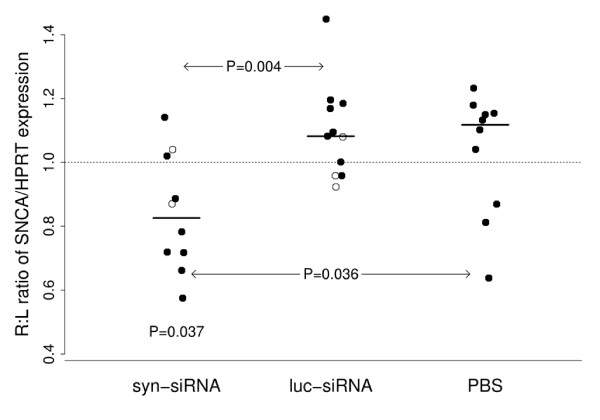
We have identified human and murine-specific siRNA molecules which reduce SNCA in vitro. As a proof of concept, we demonstrate that direct infusion of chemically modified (naked), murine-specific siRNA into the hippocampus significantly reduces SNCA levels. Reduction of SNCA in the hippocampus and cortex persists for a minimum of 1 week post-infusion with recovery nearing control levels by 3 weeks post-infusion.
We have developed naked gene-specific siRNAs that silence expression of SNCA in vivo. This approach may prove beneficial toward our understanding of the endogenous functional equilibrium of SNCA, its role in disease, and eventually as a therapeutic strategy for alpha-synucleinopathies resulting from SNCA overexpression.
家族中α-突触核蛋白 (SNCA) 的过度表达会导致帕金森病和随后的痴呆症,其特征是死后弥漫性路易体病。SNCA 的遗传变异会增加特发性帕金森病 (PD) 的风险,这可能是由于过度表达所致。因此,SNCA 的下调是 PD 的一个有效治疗靶点。
我们已经鉴定出了人类和鼠类特异性的 siRNA 分子,可以在体外降低 SNCA 的表达。作为概念验证,我们证明了将化学修饰的(裸)、鼠类特异性 siRNA 直接注入海马体可以显著降低 SNCA 水平。海马体和皮质中的 SNCA 减少至少持续 1 周,在 3 周后接近对照水平。
我们已经开发出了裸基因特异性 siRNAs,可以在体内沉默 SNCA 的表达。这种方法可能有助于我们理解 SNCA 的内源性功能平衡、其在疾病中的作用,以及最终作为 SNCA 过度表达导致的α-突触核蛋白病的治疗策略。