
通过临床和放射学测量预测糖尿病患者的峰值压力。
Prediction of peak pressure from clinical and radiological measurements in patients with diabetes.
作者信息
Guldemond Nick A, Leffers Pieter, Walenkamp Geert H I M, Schaper Nicolaas C, Sanders Antal P, Nieman Fred H M, van Rhijn Lodewijk W
机构信息
Department of Orthopaedic Surgery, University Hospital Maastricht, the Netherlands.
出版信息
BMC Endocr Disord. 2008 Dec 2;8:16. doi: 10.1186/1472-6823-8-16.
BACKGROUND
Various structural and functional factors of foot function have been associated with high local plantar pressures. The therapist focuses on these features which are thought to be responsible for plantar ulceration in patients with diabetes. Risk assessment of the diabetic foot would be made easier if locally elevated plantar pressure could be indicated with a minimum set of clinical measures.
METHODS
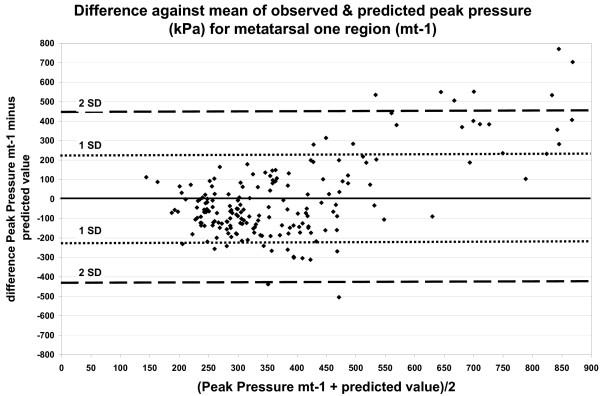
Ninety three patients were evaluated through vascular, orthopaedic, neurological and radiological assessment. A pressure platform was used to quantify the barefoot peak pressure for six forefoot regions: big toe (BT) and metatarsals one (MT-1) to five (MT-5). Stepwise regression modelling was performed to determine which set of the clinical and radiological measures explained most variability in local barefoot plantar peak pressure in each of the six forefoot regions. Comprehensive models were computed with independent variables from the clinical and radiological measurements. The difference between the actual plantar pressure and the predicted value was examined through Bland-Altman analysis.
RESULTS
Forefoot pressures were significant higher in patients with neuropathy, compared to patients without neuropathy for the whole forefoot, the MT-1 region and the MT-5 region (respectively 138 kPa, 173 kPa and 88 kPa higher: mean difference). The clinical models explained up to 39 percent of the variance in local peak pressures. Callus formation and toe deformity were identified as relevant clinical predictors for all forefoot regions. Regression models with radiological variables explained about 26 percent of the variance in local peak pressures. For most regions the combination of clinical and radiological variables resulted in a higher explained variance. The Bland and Altman analysis showed a major discrepancy between the predicted and the actual peak pressure values.
CONCLUSION
At best, clinical and radiological measurements could only explain about 34 percent of the variance in local barefoot peak pressure in this population of diabetic patients. The prediction models constructed with linear regression are not useful in clinical practice because of considerable underestimation of high plantar pressure values. Identification of elevated plantar pressure without equipment for quantification of plantar pressure is inadequate. The use of quantitative plantar pressure measurement for diabetic foot screening is therefore advocated.
背景
足部功能的各种结构和功能因素都与局部足底压力升高有关。治疗师关注这些被认为是糖尿病患者足底溃疡原因的特征。如果能用最少的临床测量指标来指示局部足底压力升高,糖尿病足的风险评估将会更容易。
方法
对93名患者进行了血管、骨科、神经和放射学评估。使用压力平台对六个前足区域的赤脚峰值压力进行量化:大脚趾(BT)以及第一跖骨(MT-1)至第五跖骨(MT-5)。进行逐步回归建模,以确定哪一组临床和放射学测量指标能解释六个前足区域中每个区域局部赤脚足底峰值压力的最大变异性。使用来自临床和放射学测量的自变量计算综合模型。通过Bland-Altman分析检查实际足底压力与预测值之间的差异。
结果
与无神经病变的患者相比,有神经病变的患者前足压力显著更高,在整个前足、MT-1区域和MT-5区域分别高出138 kPa、173 kPa和88 kPa(平均差值)。临床模型最多可解释局部峰值压力方差的39%。胼胝形成和脚趾畸形被确定为所有前足区域的相关临床预测指标。包含放射学变量的回归模型解释了局部峰值压力方差的约26%。对于大多数区域,临床和放射学变量的组合导致更高的解释方差。Bland和Altman分析显示预测峰值压力值与实际峰值压力值之间存在较大差异。
结论
在这群糖尿病患者中,临床和放射学测量最多只能解释局部赤脚峰值压力方差的约34%。由于对高足底压力值的显著低估,用线性回归构建的预测模型在临床实践中无用。在没有足底压力量化设备的情况下识别足底压力升高是不够的。因此,提倡使用定量足底压力测量进行糖尿病足筛查。


 Zotero 插件