
Fas 配体功能的翻译后调控。
Posttranslational regulation of Fas ligand function.
机构信息
Molecular Immunology, Institute of Immunology, Medical Center Schleswig-Holstein Campus Kiel, Arnold-Heller-Str, 3, Bldg, 17, D-24105 Kiel, Germany.
出版信息
Cell Commun Signal. 2008 Dec 29;6:11. doi: 10.1186/1478-811X-6-11.
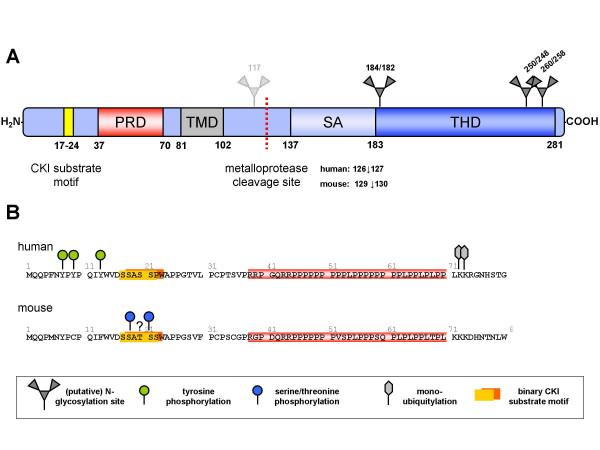
The TNF superfamily member Fas ligand acts as a prototypic death factor. Due to its ability to induce apoptosis in Fas (APO-1, CD95) expressing cells, Fas ligand participates in essential effector functions of the immune system. It is involved in natural killer cell- and T cell-mediated cytotoxicity, the establishment of immune privilege, and in termination of immune responses by induction of activation-induced cell death. In addition, Fas ligand-positive tumours may evade immune surveillance by killing Fas-positive tumour-infiltrating cells. Given these strong cytotoxic capabilities of Fas ligand, it is obvious that its function has to be strictly regulated to avoid uncontrolled damage. In hematopoietic cells, the death factor is stored in secretory lysosomes and is mobilised to the immunological synapse only upon activation. The selective sorting to and the release from this specific lysosomal compartment requires interactions of the Fas ligand cytosolic moiety, which mediates binding to various adapter proteins involved in trafficking and cytoskeletal reorganisation. In addition, Fas ligand surface expression is further regulated by posttranslational ectodomain shedding and subsequent regulated intramembrane proteolysis, releasing a soluble ectodomain cytokine into the extracellular space and an N-terminal fragment with a potential role in intracellular signalling processes. Moreover, other posttranslational modifications of the cytosolic domain, including phosphorylation and ubiquitylation, have been described to affect various aspects of Fas ligand biology. Since FasL is regarded as a potential target for immunotherapy, the further characterisation of its biological regulation and function will be of great importance for the development and evaluation of future therapeutic strategies.
肿瘤坏死因子超家族成员 Fas 配体是一种典型的死亡因子。由于它能够诱导 Fas(APO-1、CD95)表达细胞凋亡,Fas 配体参与了免疫系统的基本效应功能。它参与自然杀伤细胞和 T 细胞介导的细胞毒性、免疫特权的建立以及通过诱导激活诱导的细胞死亡来终止免疫反应。此外,Fas 配体阳性肿瘤可能通过杀死 Fas 阳性肿瘤浸润细胞来逃避免疫监视。鉴于 Fas 配体具有如此强大的细胞毒性,其功能显然必须受到严格调节,以避免失控的损伤。在造血细胞中,死亡因子储存在分泌性溶酶体中,只有在激活时才被动员到免疫突触。这种选择性的分选和从这个特定的溶酶体隔室中释放需要 Fas 配体胞质部分的相互作用,该部分介导与参与运输和细胞骨架重排的各种衔接蛋白的结合。此外,Fas 配体的表面表达还受到翻译后胞外结构域脱落和随后的调节性跨膜蛋白水解的进一步调节,将可溶性胞外结构域细胞因子释放到细胞外空间,并释放具有潜在细胞内信号转导过程作用的 N 端片段。此外,已经描述了胞质域的其他翻译后修饰,包括磷酸化和泛素化,以影响 Fas 配体生物学的各个方面。由于 FasL 被认为是免疫治疗的潜在靶点,因此进一步研究其生物学调节和功能对于开发和评估未来的治疗策略将非常重要。



 Zotero 插件