Rodriguez-Collazo Pedro, Leuba Sanford H, Zlatanova Jordanka
Department of Cell Biology and Physiology, Hillman Cancer Center, University of Pittsburgh, PA 15213, USA.
Nucleic Acids Res. 2009 Jun;37(11):e81. doi: 10.1093/nar/gkp273. Epub 2009 May 13.
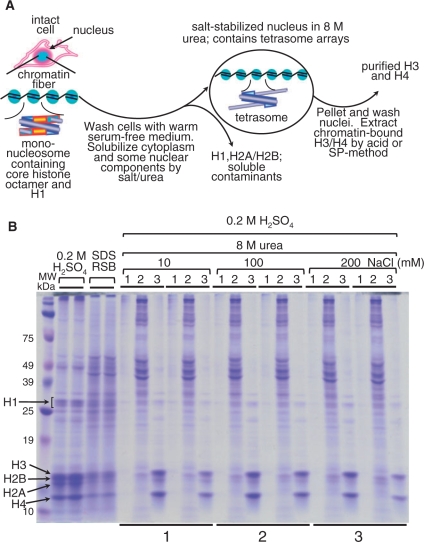
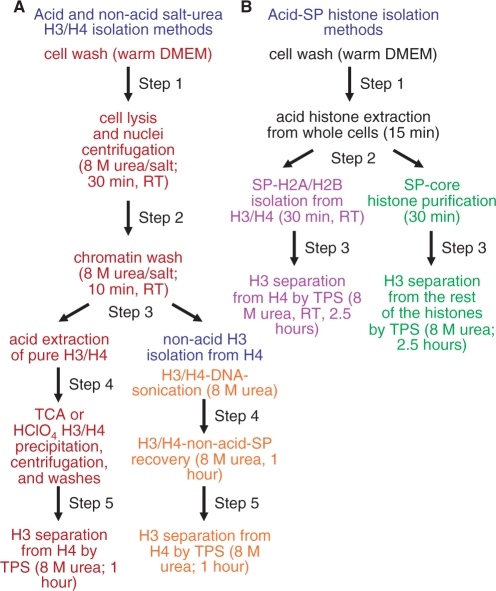
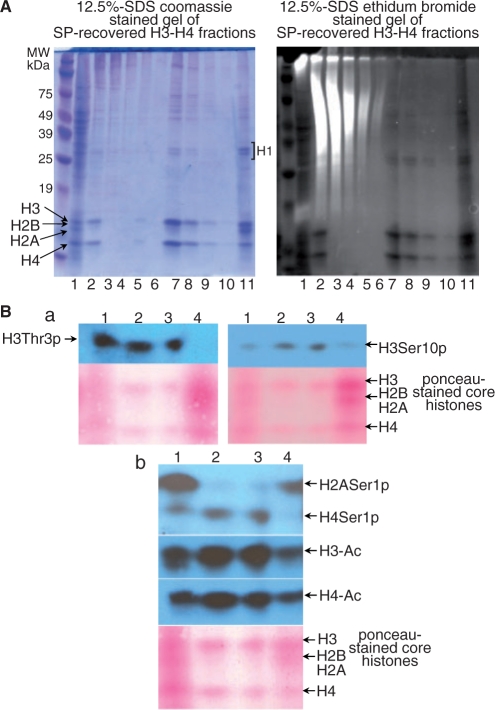
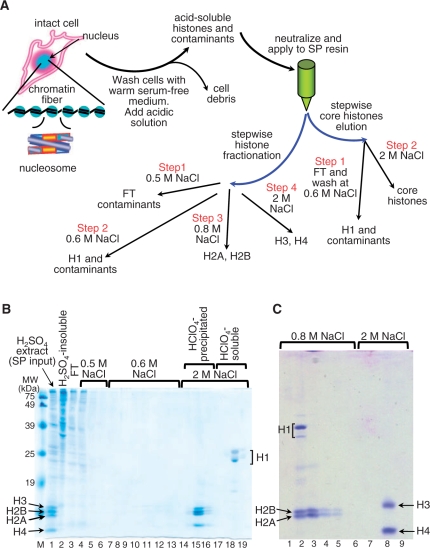
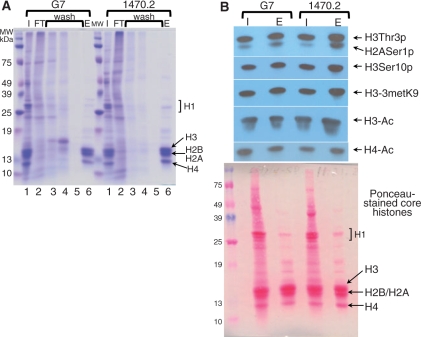
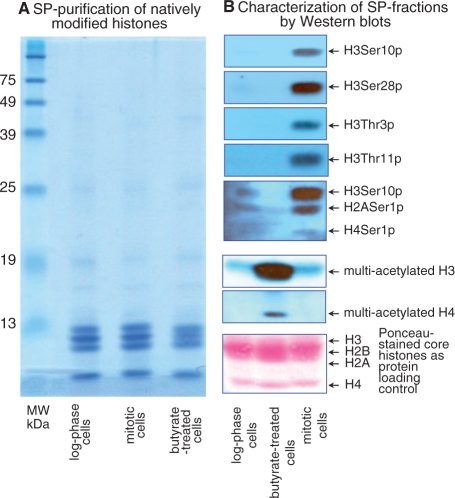
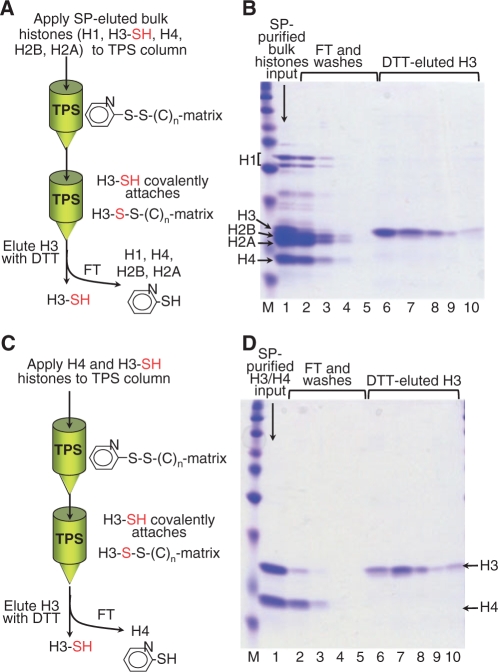
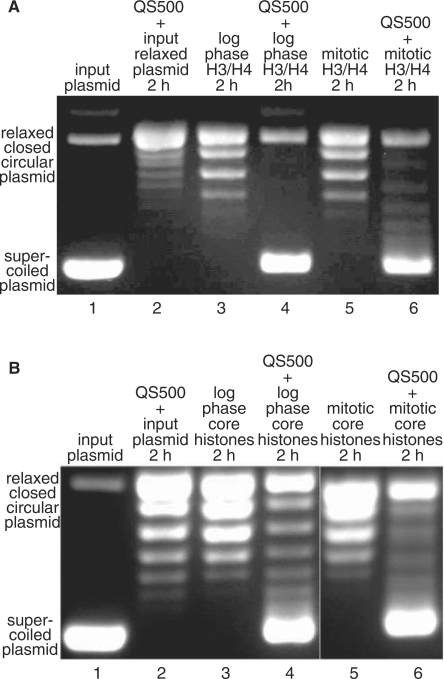
Post-translational modifications (PTMs) of histones play a role in modifying chromatin structure for DNA-templated processes in the eukaryotic nucleus, such as transcription, replication, recombination and repair; thus, histone PTMs are considered major players in the epigenetic control of these processes. Linking specific histone PTMs to gene expression is an arduous task requiring large amounts of highly purified and natively modified histones to be analyzed by various techniques. We have developed robust and complementary procedures, which use strong protein denaturing conditions and yield highly purified core and linker histones from unsynchronized proliferating, M-phase arrested and butyrate-treated cells, fully preserving their native PTMs without using enzyme inhibitors. Cell hypotonic swelling and lysis, nuclei isolation/washing and chromatin solubilization under mild conditions are bypassed to avoid compromising the integrity of histone native PTMs. As controls for our procedures, we tested the most widely used conventional methodologies and demonstrated that they indeed lead to drastic histone dephosphorylation. Additionally, we have developed methods for preserving acid-labile histone modifications by performing non-acid extractions to obtain highly purified H3 and H4. Importantly, isolation of histones H3, H4 and H2A/H2B is achieved without the use of HPLC. Functional supercoiling assays reveal that both hyper- and hypo-phosphorylated histones can be efficiently assembled into polynucleosomes. Notably, the preservation of fully phosphorylated mitotic histones and their assembly into polynucleosomes should open new avenues to investigate an important but overlooked question: the impact of mitotic phosphorylation in chromatin structure and function.
组蛋白的翻译后修饰(PTMs)在真核细胞核中参与修饰染色质结构,以进行DNA模板相关过程,如转录、复制、重组和修复;因此,组蛋白PTMs被认为是这些过程表观遗传调控的主要参与者。将特定的组蛋白PTMs与基因表达联系起来是一项艰巨的任务,需要大量高度纯化且保持天然修饰状态的组蛋白,并通过各种技术进行分析。我们开发了强大且互补的方法,这些方法采用强蛋白变性条件,可从不同步增殖、M期阻滞和丁酸盐处理的细胞中获得高度纯化的核心组蛋白和连接组蛋白,在不使用酶抑制剂的情况下完全保留其天然PTMs。省略了细胞低渗肿胀和裂解、细胞核分离/洗涤以及温和条件下的染色质溶解步骤,以避免破坏组蛋白天然PTMs的完整性。作为我们方法的对照,我们测试了最广泛使用的传统方法,并证明它们确实会导致组蛋白严重去磷酸化。此外,我们还开发了通过进行非酸性提取来保留酸不稳定组蛋白修饰的方法,以获得高度纯化的H3和H4。重要的是,无需使用高效液相色谱(HPLC)即可实现组蛋白H3、H4和H2A/H2B的分离。功能超螺旋分析表明,高磷酸化和低磷酸化的组蛋白均可有效组装成多聚核小体。值得注意的是,完全磷酸化的有丝分裂组蛋白的保留及其组装成多聚核小体应为研究一个重要但被忽视的问题开辟新途径:有丝分裂磷酸化对染色质结构和功能的影响。