Institute of Biomedical and Clinical Sciences, Peninsula Medical School, University of Exeter, Exeter, United Kingdom.
PLoS One. 2009 Nov 16;4(11):e7855. doi: 10.1371/journal.pone.0007855.
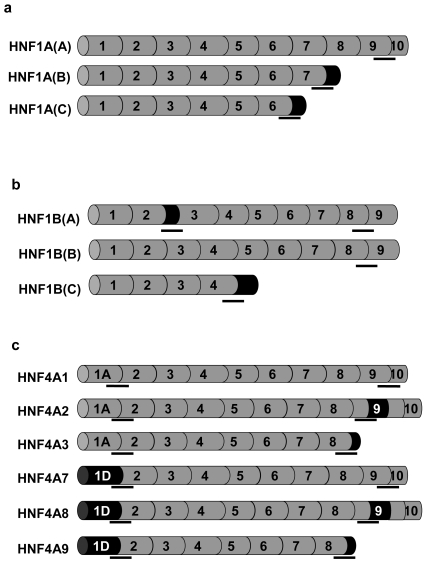
The HNF1A, HNF1B and HNF4A genes are part of an autoregulatory network in mammalian pancreas, liver, kidney and gut. The layout of this network appears to be similar in rodents and humans, but inactivation of HNF1A, HNF1B or HNF4A genes in animal models cause divergent phenotypes to those seen in man. We hypothesised that some differences may arise from variation in the expression profile of alternatively processed isoforms between species.
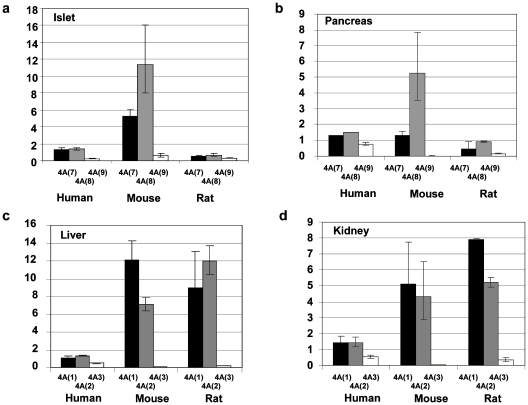
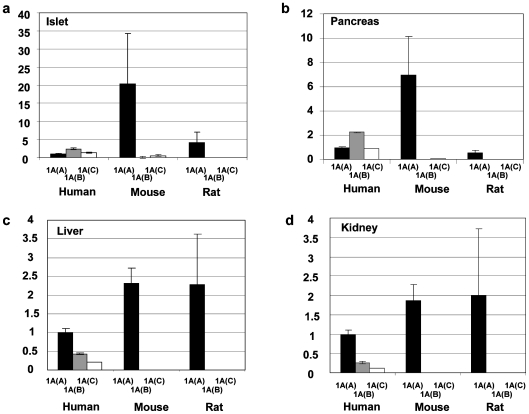
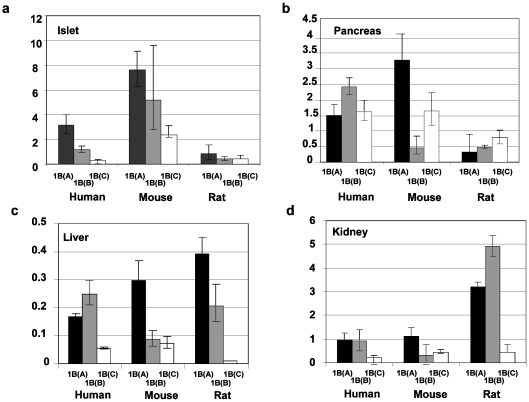
METHODOLOGY/PRINCIPAL FINDINGS: We measured the expression of the major isoforms of the HNF1A, HNF1B and HNF4A genes in human and rodent pancreas, islet, liver and kidney by isoform-specific quantitative real-time PCR and compared their expression by the comparative Ct (DeltaDeltaCt) method. We found major changes in the expression profiles of the HNF genes between humans and rodents. The principal difference lies in the expression of the HNF1A gene, which exists as three isoforms in man, but as a single isoform only in rodents. More subtle changes were to the balance of HNF1B and HNF4A isoforms between species; the repressor isoform HNF1B(C) comprised only 6% in human islets compared with 24-26% in rodents (p = 0.006) whereas HNF4A9 comprised 22% of HNF4A expression in human pancreas but only 11% in rodents (p = 0.001).
CONCLUSIONS/SIGNIFICANCE: The differences we note in the isoform-specific expression of the human and rodent HNF1A, HNF1B and HNF4A genes may impact on the absolute activity of these genes, and therefore on the activity of the pancreatic transcription factor network as a whole. We conclude that alterations to expression of HNF isoforms may underlie some of the phenotypic variation caused by mutations in these genes.
HNF1A、HNF1B 和 HNF4A 基因是哺乳动物胰腺、肝脏、肾脏和肠道中自身调控网络的一部分。该网络的布局在啮齿动物和人类中似乎相似,但在动物模型中敲除 HNF1A、HNF1B 或 HNF4A 基因导致的表型与人类所见的不同。我们假设,一些差异可能源于物种间差异表达的选择性加工异构体的表达谱。
方法/主要发现:我们通过异构体特异性定量实时 PCR 测量了人源和啮齿动物胰腺、胰岛、肝脏和肾脏中 HNF1A、HNF1B 和 HNF4A 基因的主要异构体的表达,并通过比较 Ct(DeltaDeltaCt)方法比较它们的表达。我们发现 HNF 基因在人类和啮齿动物之间的表达谱有很大差异。主要区别在于 HNF1A 基因的表达,该基因在人类中存在三种异构体,但在啮齿动物中仅存在一种异构体。物种间 HNF1B 和 HNF4A 异构体之间的平衡也存在更细微的变化;在人类胰岛中,抑制性异构体 HNF1B(C) 仅占 6%,而在啮齿动物中占 24-26%(p = 0.006),而 HNF4A9 占人胰腺中 HNF4A 表达的 22%,但在啮齿动物中仅占 11%(p = 0.001)。
结论/意义:我们注意到人类和啮齿动物 HNF1A、HNF1B 和 HNF4A 基因的异构体特异性表达的差异可能影响这些基因的绝对活性,从而影响整个胰腺转录因子网络的活性。我们得出结论,HNF 异构体表达的改变可能是这些基因突变引起的一些表型变异的基础。