College of Medicine, University of Arizona, Department of Neurology, Tucson, AZ 85724, USA.
Mol Neurodegener. 2009 Dec 10;4:49. doi: 10.1186/1750-1326-4-49.
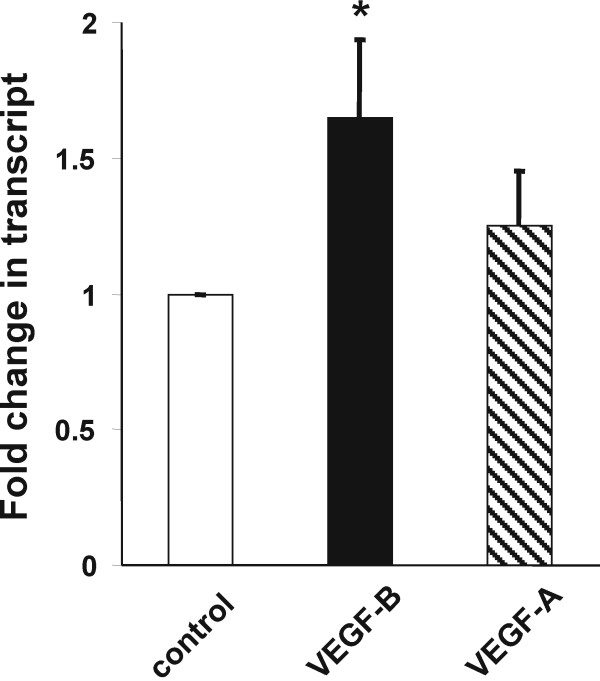
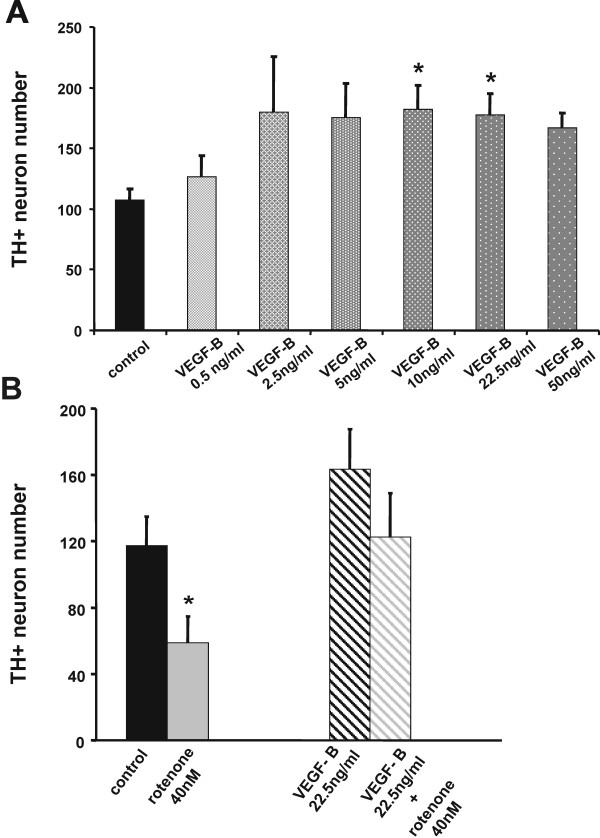
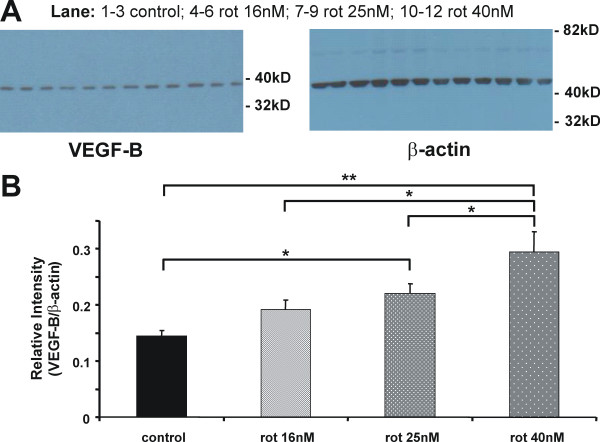
Parkinson's disease (PD) results from the degeneration of dopaminergic neurons in the substantia nigra and the consequent deficit of dopamine released in the striatum. Current oral dopamine replacement or surgical therapies do not address the underlying issue of neurodegeneration, they neither slow nor halt disease. Neurotrophic factors have shown preclinical promise, but the choice of an appropriate growth factor as well as the delivery has proven difficult. In this study, we used a rotenone rat midbrain culture model to identify genes that are changed after addition of the neurotoxin. (1) We challenged rat midbrain cultures with rotenone (20 nM), a pesticide that has been shown to be toxic for dopaminergic neurons and that has been a well-characterized model of PD. A gene chip array analysis demonstrated that several genes were up-regulated after the rotenone treatment. Interestingly transcriptional activation of vascular endothelial growth factor B (VEGF-B) was evident, while vascular endothelial growth factor A (VEGF-A) levels remained unaltered. The results from the gene chip array experiment were verified with real time PCR and semi-quantitative western analysis using beta-actin as the internal standard. (2) We have also found evidence that exogenously applied VEGF-B performed as a neuroprotective agent facilitating neuron survival in an even more severe rotenone culture model of PD (40 nM rotenone). VEGF-B has very recently been added to the list of trophic factors that reduce effects of neurodegeneration, as was shown in an in vivo model of motor neuron degeneration, while lacking potential adverse angiogenic activity. The data of an in vivo protective effect on motor neurons taken together with the presented results demonstrate that VEGF-B is a new candidate trophic factor distinct from the GDNF family of trophic factors. VEGF-B is activated by neurodegenerative challenges to the midbrain, and exogenous application of VEGF-B has a neuroprotective effect in a culture model of PD. Strengthening this natural protective response by either adding exogenous VEGF-B or up-regulating the endogenous VEGF-B levels may have the potential to be a disease modifying therapy for PD. We conclude that the growth factor VEGF-B can improve neuronal survival in a culture model of PD.
帕金森病(PD)源于黑质多巴胺能神经元的退化,导致纹状体中多巴胺的释放减少。目前的口服多巴胺替代或手术治疗并不能解决神经退行性变的根本问题,既不能减缓也不能阻止疾病的发展。神经营养因子在临床前研究中显示出了良好的前景,但选择合适的生长因子以及其传递方式一直是个难题。在这项研究中,我们使用鱼藤酮大鼠中脑培养模型来确定加入神经毒素后发生变化的基因。(1)我们用鱼藤酮(20 nM)处理大鼠中脑培养物,鱼藤酮是一种已被证明对多巴胺能神经元有毒的杀虫剂,也是 PD 的一种特征性模型。基因芯片阵列分析表明,鱼藤酮处理后有几个基因上调。有趣的是,血管内皮生长因子 B(VEGF-B)的转录激活很明显,而血管内皮生长因子 A(VEGF-A)水平保持不变。基因芯片阵列实验的结果通过实时 PCR 和半定量 Western 分析得到验证,β-肌动蛋白作为内参。(2)我们还发现证据表明,外源性应用 VEGF-B 可以作为一种神经保护剂,在更严重的 PD 鱼藤酮培养模型中促进神经元存活。VEGF-B 最近被添加到减少神经退行性变影响的营养因子列表中,如在运动神经元退行性变的体内模型中所示,同时缺乏潜在的不良血管生成活性。体内对运动神经元的保护作用数据与本研究结果表明,VEGF-B 是一种不同于 GDNF 家族营养因子的新型候选营养因子。VEGF-B 是由中脑的神经退行性挑战激活的,外源性应用 VEGF-B 在 PD 的培养模型中具有神经保护作用。通过添加外源性 VEGF-B 或上调内源性 VEGF-B 水平来增强这种自然保护反应,可能具有成为 PD 疾病修饰治疗的潜力。我们的结论是,生长因子 VEGF-B 可以改善 PD 培养模型中的神经元存活。