Klinik für Anaesthesiologie und operative Intensivmedizin, Freie Universität Berlin, Medizinische Fakultät Charité-Campus Benjamin Franklin, Krahmerstrasse 6, D-12207 Berlin, Germany.
Mol Pain. 2009 Dec 14;5:72. doi: 10.1186/1744-8069-5-72.
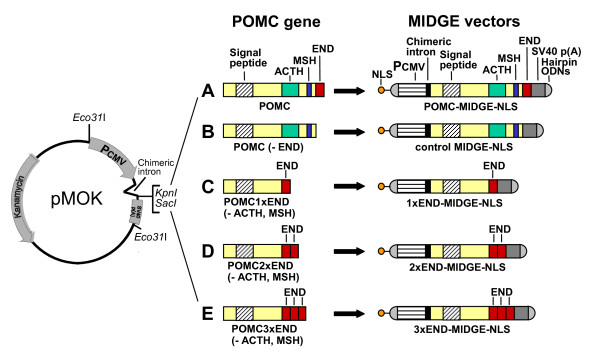
Leukocytes infiltrating inflamed tissue produce and release opioid peptides such as beta-endorphin, which activate opioid receptors on peripheral terminals of sensory nerves resulting in analgesia. Gene therapy is an attractive strategy to enhance continuous production of endogenous opioids. However, classical viral and plasmid vectors for gene delivery are hampered by immunogenicity, recombination, oncogene activation, anti-bacterial antibody production or changes in physiological gene expression. Non-viral, non-plasmid minimalistic, immunologically defined gene expression (MIDGE) vectors may overcome these problems as they carry only elements needed for gene transfer. Here, we investigated the effects of a nuclear localization sequence (NLS)-coupled MIDGE encoding the beta-endorphin precursor proopiomelanocortin (POMC) on complete Freund's adjuvant-induced inflammatory pain in rats.
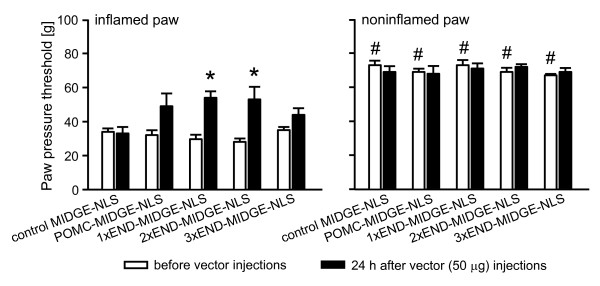
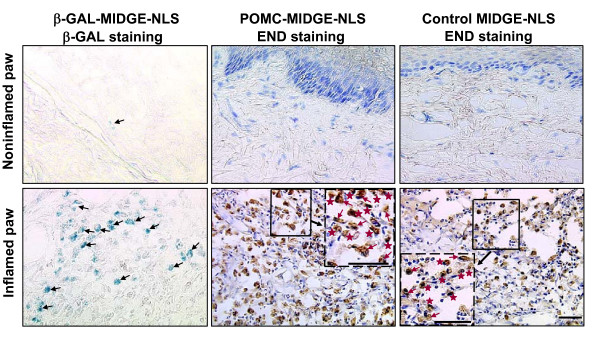
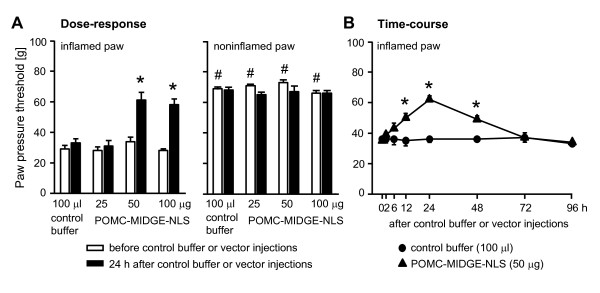
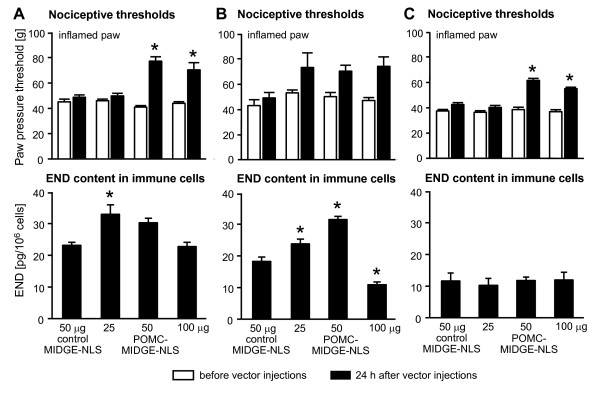
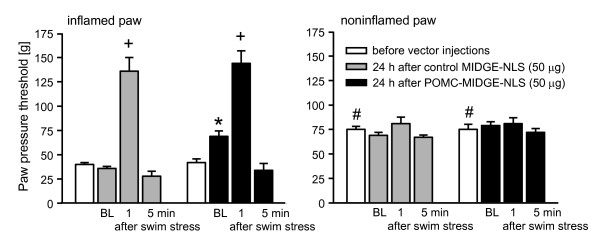
POMC-MIDGE-NLS injected into inflamed paws appeared to be taken up by leukocytes resulting in higher concentrations of beta-endorphin in these cells. POMC-MIDGE-NLS treatment reversed enhanced mechanical sensitivity compared with control MIDGE-NLS. However, both effects were moderate, not always statistically significant or directly correlated with each other. Also, the anti-hyperalgesic actions could not be increased by enhancing beta-endorphin secretion or by modifying POMC-MIDGE-NLS to code for multiple copies of beta-endorphin.
Although MIDGE vectors circumvent side-effects associated with classical viral and plasmid vectors, the current POMC-MIDGE-NLS did not result in reliable analgesic effectiveness in our pain model. This was possibly associated with insufficient and variable efficacy in transfection and/or beta-endorphin production. Our data point at the importance of the reproducibility of gene therapy strategies for the control of chronic pain.
浸润炎症组织的白细胞会产生并释放阿片肽,如β-内啡肽,后者可激活感觉神经末梢的阿片受体,从而产生镇痛作用。基因治疗是增强内源性阿片肽持续产生的一种有吸引力的策略。然而,经典的病毒和质粒载体用于基因传递会受到免疫原性、重组、癌基因激活、抗细菌抗体产生或生理基因表达变化的限制。非病毒、非质粒的最小化、免疫定义的基因表达(MIDGE)载体可能克服这些问题,因为它们只携带基因转移所需的元件。在这里,我们研究了一种核定位序列(NLS)偶联的 MIDGE 编码β-内啡肽前体 proopiomelanocortin(POMC)对完全弗氏佐剂诱导的大鼠炎症性疼痛的影响。
注射到炎症爪子中的 POMC-MIDGE-NLS 似乎被白细胞摄取,导致这些细胞中的β-内啡肽浓度升高。与对照 MIDGE-NLS 相比,POMC-MIDGE-NLS 治疗逆转了机械敏感性增强。然而,两种效果都比较温和,并不总是具有统计学意义或彼此直接相关。此外,通过增强β-内啡肽分泌或通过修饰 POMC-MIDGE-NLS 以编码多个β-内啡肽拷贝,都不能增加抗痛觉过敏作用。
尽管 MIDGE 载体规避了与经典病毒和质粒载体相关的副作用,但目前的 POMC-MIDGE-NLS 并未在我们的疼痛模型中产生可靠的镇痛效果。这可能与转染和/或β-内啡肽产生的效果不足和可变有关。我们的数据表明,控制慢性疼痛的基因治疗策略的重现性非常重要。