Neuro-Muscular Research Center, Boston University, Boston, MA 02215, USA.
IEEE Trans Neural Syst Rehabil Eng. 2009 Dec;17(6):585-94. doi: 10.1109/TNSRE.2009.2036615.
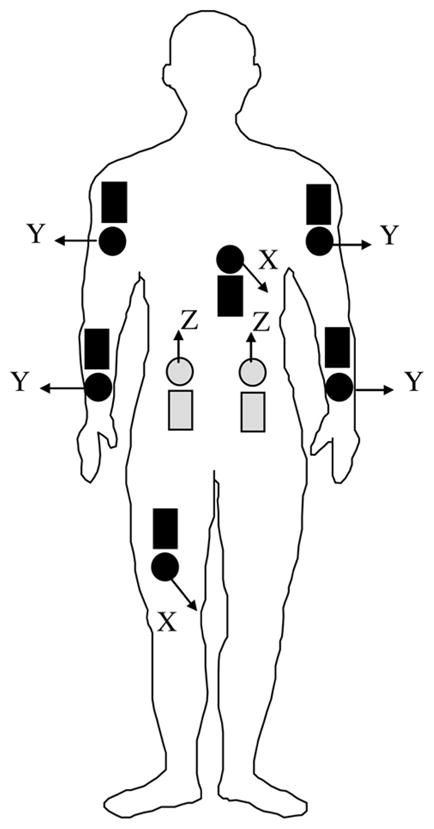
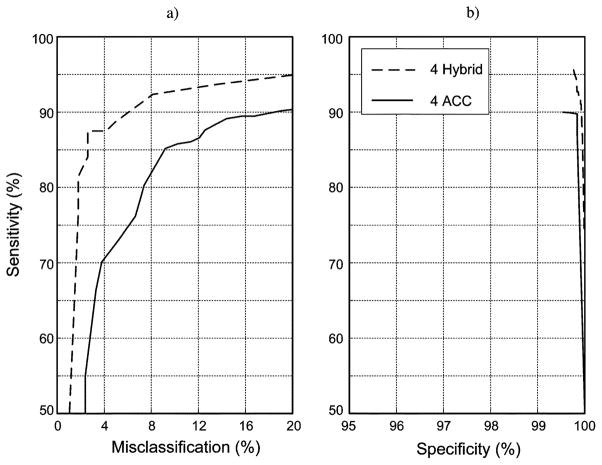
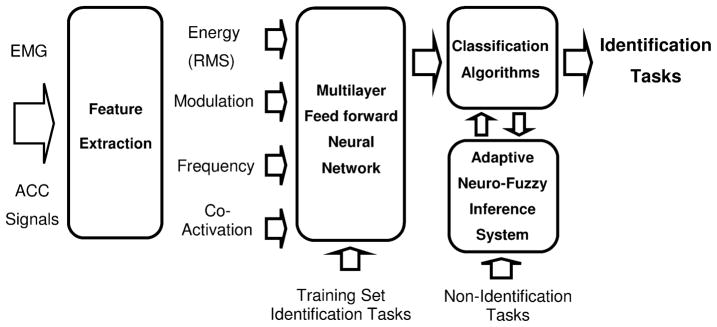
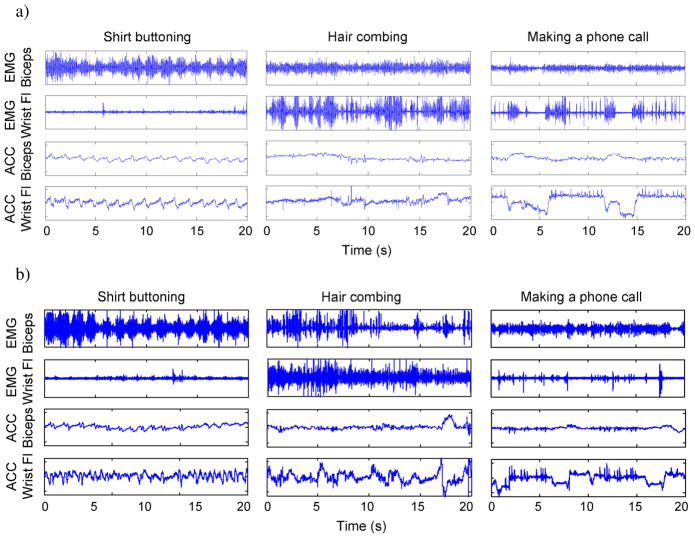
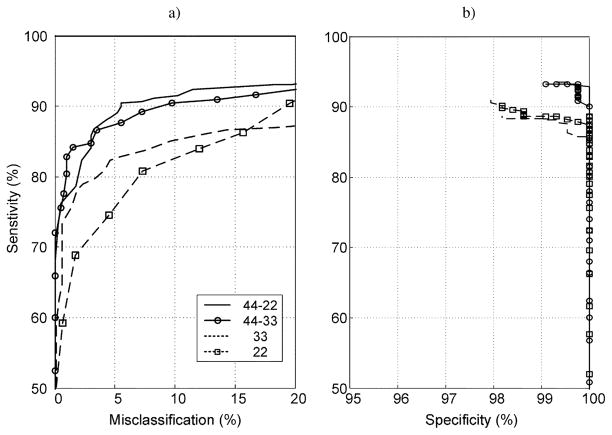
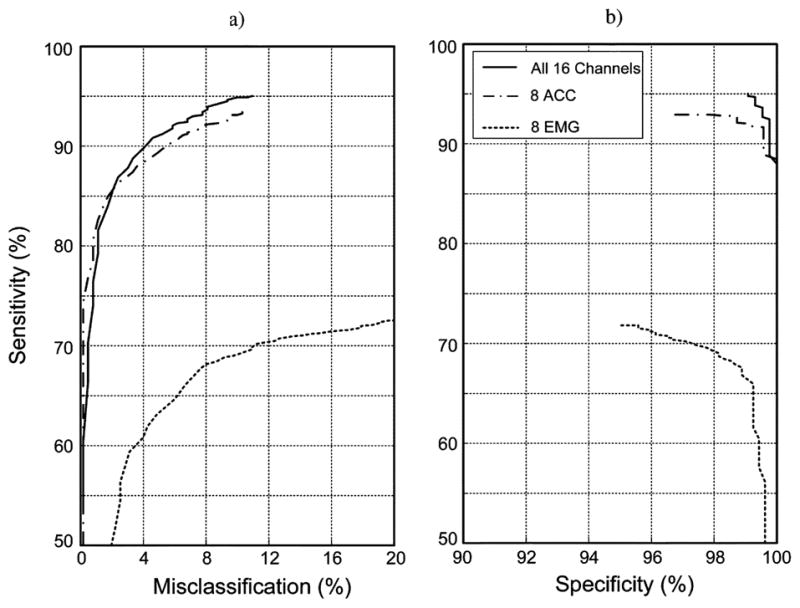
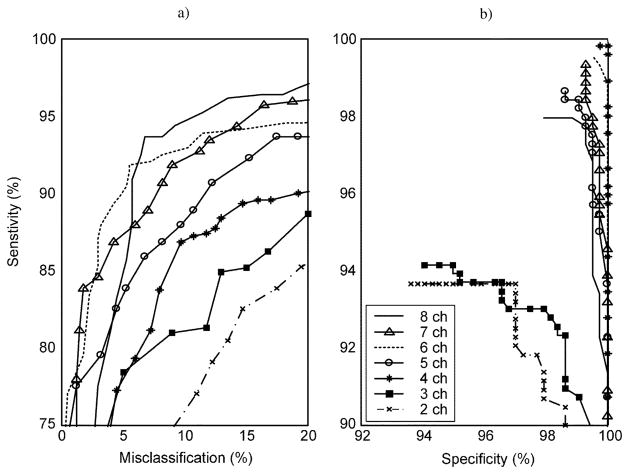
Remote monitoring of physical activity using body-worn sensors provides an alternative to assessment of functional independence by subjective, paper-based questionnaires. This study investigated the classification accuracy of a combined surface electromyographic (sEMG) and accelerometer (ACC) sensor system for monitoring activities of daily living in patients with stroke. sEMG and ACC data (eight channels each) were recorded from 10 hemiparetic patients while they carried out a sequence of 11 activities of daily living (identification tasks), and 10 activities used to evaluate misclassification errors (nonidentification tasks). The sEMG and ACC sensor data were analyzed using a multilayered neural network and an adaptive neuro-fuzzy inference system to identify the minimal sensor configuration needed to accurately classify the identification tasks, with a minimal number of misclassifications from the nonidentification tasks. The results demonstrated that the highest sensitivity and specificity for the identification tasks was achieved using a subset of four ACC sensors and adjacent sEMG sensors located on both upper arms, one forearm, and one thigh, respectively. This configuration resulted in a mean sensitivity of 95.0%, and a mean specificity of 99.7% for the identification tasks, and a mean misclassification error of < 10% for the nonidentification tasks. The findings support the feasibility of a hybrid sEMG and ACC wearable sensor system for automatic recognition of motor tasks used to assess functional independence in patients with stroke.
使用佩戴式传感器对身体活动进行远程监测,为通过主观的纸质问卷评估功能独立性提供了一种替代方法。本研究调查了一种组合表面肌电图(sEMG)和加速度计(ACC)传感器系统,用于监测脑卒中患者日常生活活动的分类准确性。在 10 名偏瘫患者进行一系列 11 项日常生活活动(识别任务)时,记录了 sEMG 和 ACC 数据(每个通道 8 个),并进行了 10 项活动以评估错误分类(非识别任务)。使用多层神经网络和自适应神经模糊推理系统对 sEMG 和 ACC 传感器数据进行分析,以确定需要最小数量传感器配置来准确分类识别任务的最小传感器配置,同时最小化非识别任务中的错误分类。结果表明,使用一组四个 ACC 传感器和位于两个上臂、一个前臂和一个大腿上的相邻 sEMG 传感器的子集,可获得识别任务的最高灵敏度和特异性。这种配置导致识别任务的平均灵敏度为 95.0%,平均特异性为 99.7%,非识别任务的平均错误分类率<10%。研究结果支持使用混合 sEMG 和 ACC 可穿戴传感器系统自动识别用于评估脑卒中患者功能独立性的运动任务的可行性。