Graduate Institute of Health Care Organization Administration, College of Public Health, National Taiwan University, Taipei, Taiwan.
BMC Health Serv Res. 2010 Jan 27;10:27. doi: 10.1186/1472-6963-10-27.
Although performance measurement for assessing care quality is an emerging area, a system for measuring the quality of cancer care at the hospital level has not been well developed. The purpose of this study was to develop organization-based core measures for colorectal cancer patient care and apply these measures to compare hospital performance.
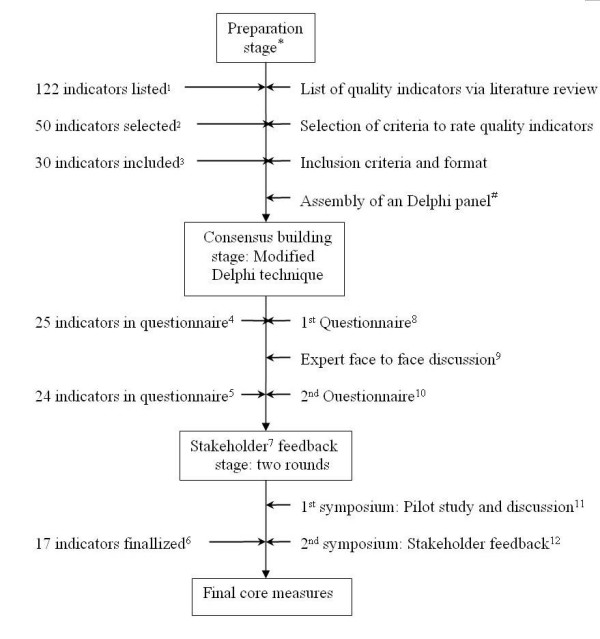
The development of core measures for colorectal cancer has undergone three stages including a modified Delphi method. The study sample originated from 2004 data in the Taiwan Cancer Database, a national cancer data registry. Eighteen hospitals and 5585 newly diagnosed colorectal cancer patients were enrolled in this study. We used indicator-based and case-based approaches to examine adherences simultaneously.
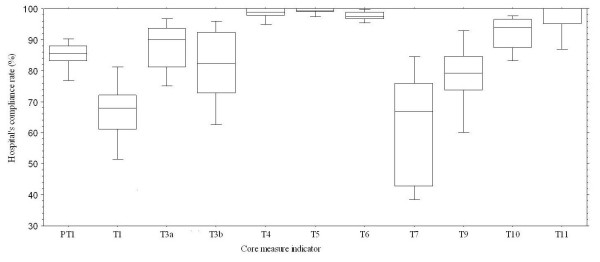
The final core measure set included seventeen indicators (1 pre-treatment, 11 treatment-related and 5 monitoring-related). There were data available for ten indicators. Indicator-based adherence possesses more meaningful application than case-based adherence for hospital comparisons. Mean adherence was 85.8% (79.8% to 91%) for indicator-based and 82.8% (77.6% to 88.9%) for case-based approaches. Hospitals performed well (>90%) for five out of eleven indicators. Still, the performance across hospitals varied for many indicators. The best and poorest system performance was reflected in indicators T5-negative surgical margin (99.3%, 97.2%-100.0%) and T7-lymph nodes harvest more than twelve(62.7%, 27.6%-92.2%), both of which related to surgical specimens.
In this nationwide study, quality of colorectal cancer care still shows room for improvement. These preliminary results indicate that core measures for cancer can be developed systematically and applied for internal quality improvement.
尽管绩效评估在评估医疗质量方面是一个新兴领域,但尚未建立完善的医院层面癌症护理质量评估体系。本研究旨在制定基于组织的结直肠癌患者护理核心指标,并应用这些指标来比较医院绩效。
结直肠癌核心指标的制定经过了三个阶段,包括改良德尔菲法。研究样本来源于台湾癌症数据库 2004 年的数据,该数据库是一个全国性的癌症数据登记处。共有 18 家医院和 5585 名新诊断的结直肠癌患者纳入本研究。我们同时采用指标和病例两种方法来检查一致性。
最终的核心指标集包括 17 个指标(1 个治疗前,11 个治疗相关,5 个监测相关)。有数据的指标有 10 个。基于指标的一致性比基于病例的一致性更有意义,适用于医院比较。基于指标的一致性的平均一致性为 85.8%(79.8%至 91%),基于病例的一致性为 82.8%(77.6%至 88.9%)。11 个指标中有 5 个医院的表现超过 90%。然而,许多指标的医院间绩效仍存在差异。最好和最差的系统表现反映在与手术标本相关的 T5-阴性手术切缘(99.3%,97.2%至 100.0%)和 T7-淋巴结采集超过 12 个(62.7%,27.6%至 92.2%)两个指标上。
在这项全国性研究中,结直肠癌护理质量仍有改进的空间。这些初步结果表明,可以系统地制定癌症核心指标,并应用于内部质量改进。