International Centre for Circulatory Health, National Heart and Lung Institute, Imperial College, London, UK.
Am Heart J. 2010 Feb;159(2):314-22. doi: 10.1016/j.ahj.2009.11.013.
Right ventricular (RV) long-axis function is known to be depressed after cardiac surgery, but the mechanism is not known. We hypothesized that intraoperative transesophageal echocardiography could pinpoint the time at which this happens to help narrow the range of plausible mechanisms.
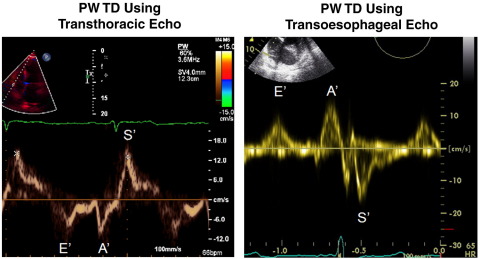
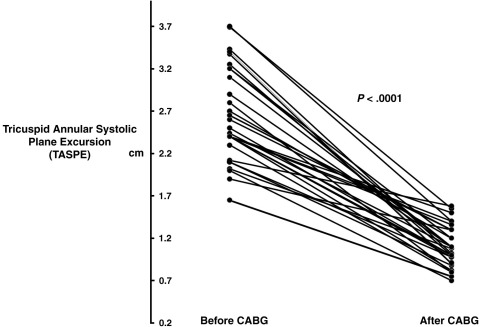
Transthoracic echocardiography was conducted in 33 patients before and after elective coronary artery bypass graft. In an intensively monitored cohort of 9 patients, we also monitored RV function intraoperatively using serial pulsed wave tissue Doppler (PW TD) transesophageal echocardiography.
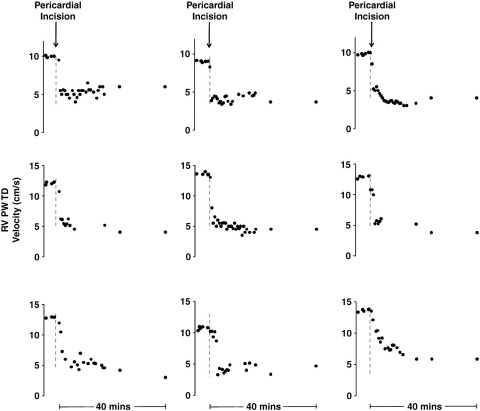
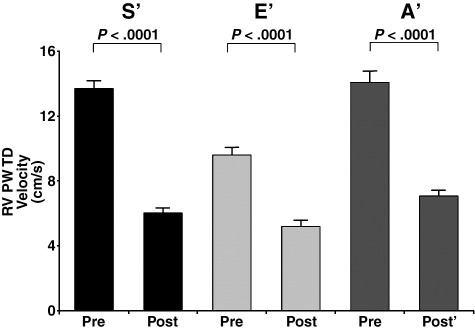
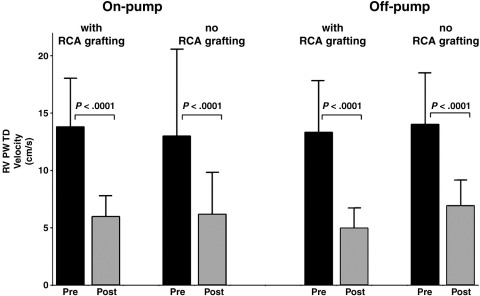
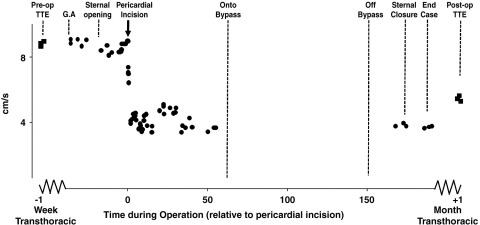
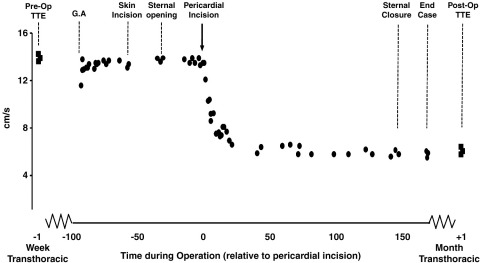
There was no significant difference in myocardial velocities from the onset of the operation up to the beginning of pericardial incision, change in RV PW TD S' velocities 3% +/- 2% (P = not significant). Within the first 3 minutes of opening the pericardium, RV PW TD S' velocities had reduced by 43% +/- 17% (P < .001). At 5 minutes postpericardial incision, 2 minutes later, the velocities had more than halved, by 54% +/- 11% (P < .0001). Velocities thereafter remained depressed throughout the operation, with final intraoperative S' reduction being 61% +/- 11% (P < .0001). One month after surgery, in the full 33-patient cohort, transthoracic echocardiogram data showed a 55% +/- 12% (P < .0001) reduction in RV S' velocities compared with preoperative values.
Minute-by-minute monitoring during cardiac surgery reveals that, virtually, all the losses in RV systolic velocity occurs within the first 3 minutes after pericardial incision. Right ventricular long-axis reduction during coronary bypass surgery results not from cardiopulmonary bypass but rather from pericardial incision.
已知右心室(RV)长轴功能在心脏手术后会受到抑制,但机制尚不清楚。我们假设术中经食管超声心动图可以确定这种情况发生的时间,以帮助缩小可能的机制范围。
33 例择期冠状动脉旁路移植术患者术前和术后均进行经胸超声心动图检查。在 9 例强化监测患者中,我们还使用连续脉冲波组织多普勒(PW TD)经食管超声心动图术中监测 RV 功能。
从手术开始到心包切开前,心肌速度没有明显差异,RV PW TD S'速度变化 3% +/- 2%(P = 无显著性)。在心包切开后的前 3 分钟内,RV PW TD S'速度降低了 43% +/- 17%(P <.001)。在心包切开后 5 分钟,即 2 分钟后,速度减半,为 54% +/- 11%(P <.0001)。此后,在整个手术过程中,速度仍然保持抑制状态,最终术中 S'降低为 61% +/- 11%(P <.0001)。术后 1 个月,在 33 例患者的全部队列中,与术前相比,经胸超声心动图数据显示 RV S'速度降低了 55% +/- 12%(P <.0001)。
心脏手术过程中的每分钟监测显示,RV 收缩速度的几乎所有损失都发生在心包切开后的前 3 分钟内。冠状动脉旁路手术过程中 RV 长轴的减少不是由体外循环引起的,而是由心包切开引起的。