Arya Swati O, Hiremath Gurumurthy M, Okonkwo Kingsley C, Pettersen Michael D
The Carman and Ann Adams Department of Pediatrics, Wayne State University and Division of Pediatric Cardiology, Children's Hospital of Michigan, Detroit, MI 48201, USA.
Int J Pediatr. 2009;2009:910208. doi: 10.1155/2009/910208. Epub 2010 Feb 9.
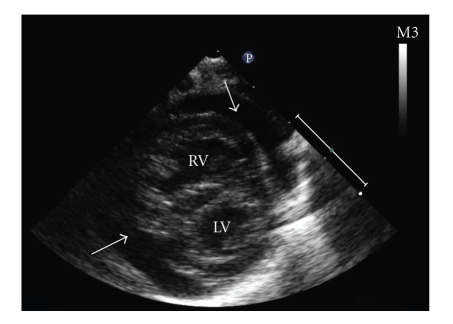
Introduction. Pericardial effusion (PCE) and tamponade can cause significant morbidity and mortality in neonates. Such cases have been reported in the literature in various contexts. Case Presentation. A 6-day old neonate with meconium aspiration syndrome and persistent pulmonary hypertension of newborn on high frequency oscillator ventilation and inhaled nitric oxide was referred to our hospital with a large pericardial effusion causing hemodynamic compromise. Prompt pericardiocentesis led to significant improvement in the cardio-respiratory status and removal of the central line prevented the fluid from reaccumulating. Cellular and biochemical analysis aided in the diagnosis of catheter related etiology with possibility of infusate diffusion into the pericardial space. Conclusion. We present this paper to emphasize the importance of recognizing this uncommon but serious complication of central venous catheters in intensive care units. We also discuss the proposed hypothesis for the mechanism of production of PCE.
引言。心包积液(PCE)和心包填塞可导致新生儿出现严重的发病和死亡情况。此类病例在文献中已有各种背景下的报道。病例报告。一名6日龄患有胎粪吸入综合征及新生儿持续性肺动脉高压的新生儿,在接受高频振荡通气和吸入一氧化氮治疗期间,因大量心包积液导致血流动力学不稳定而被转诊至我院。及时进行心包穿刺术使心肺状况得到显著改善,拔除中心静脉导管防止了液体再次积聚。细胞和生化分析有助于诊断与导管相关的病因,提示存在输注液扩散至心包腔的可能性。结论。我们撰写本文旨在强调认识到重症监护病房中这种罕见但严重的中心静脉导管并发症的重要性。我们还讨论了所提出的心包积液产生机制的假说。