
没有证据表明鸽子初级性别比例调节存在选择性卵泡流产现象。
No evidence for selective follicle abortion underlying primary sex ratio adjustment in pigeons.
作者信息
Goerlich Vivian C, Dijkstra Cor, Groothuis Ton G G
机构信息
Behavioural Biology, University of Groningen, Kerklaan 30, 9751NN Haren, The Netherlands.
出版信息
Behav Ecol Sociobiol. 2010 Mar;64(4):599-606. doi: 10.1007/s00265-009-0877-4. Epub 2009 Nov 14.
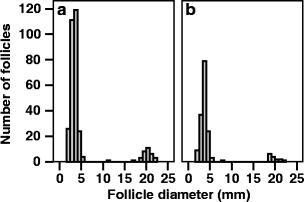
Primary sex ratio adjustment in birds has been extensively studied, yet the underlying physiological mechanisms are far from understood. Avian females are the heterogametic sex (ZW), and the future sex of the offspring is determined at chromosome segregation during meiosis I, shortly before the oocyte is ovulated. Assuming that the mother can detect the sex of the developing oocyte before ovulation, it has been suggested that a follicle of the un-preferred sex could selectively be induced to become atretic and regress instead of being ovulated (selective follicle abortion). This potential mechanism has been proposed to underlie biased primary sex ratios in birds, including the homing pigeon (Columba livia domestica), which produces a modal clutch size of two eggs. However, without replacement by an additional, already mature follicle, abortion of a preovulatory follicle would most likely result in either reduced clutch sizes or laying gaps, since a not-yet-recruited follicle still needed to undergo the whole maturation phase. In the current study we killed female pigeons, which were adjusting embryo sex of first eggs according to change in body mass. We examined ovaries for signs of follicle abortion but did not find any supporting evidence. All females produced one or two mature follicles but only two out of the 56 experimental birds produced an additional third mature follicle. Therefore, our results do not corroborate the hypothesis that pigeon mothers manipulate primary offspring sex by selectively aborting follicles of the un-preferred sex.
鸟类的初级性别比例调节已得到广泛研究,但其潜在的生理机制仍远未被理解。鸟类雌性为异配性别(ZW),后代的未来性别在减数分裂I期间染色体分离时确定,就在卵母细胞排卵前不久。假设母亲能够在排卵前检测出发育中卵母细胞的性别,有人提出,不受欢迎性别的卵泡可能会被选择性地诱导发生闭锁并退化,而不是排卵(选择性卵泡流产)。有人认为,这一潜在机制是鸟类包括家鸽(Columba livia domestica)初级性别比例偏差背后的原因,家鸽通常一窝产两个蛋。然而,如果没有额外的、已经成熟的卵泡来替代,排卵前卵泡的流产很可能会导致窝卵数减少或产蛋间隔,因为尚未募集的卵泡仍需要经历整个成熟阶段。在本研究中,我们处死了根据体重变化来调节第一枚蛋胚胎性别的雌性鸽子。我们检查了卵巢是否有卵泡流产的迹象,但未发现任何支持证据。所有雌性都产生了一个或两个成熟卵泡,但在56只实验鸟中只有两只产生了额外的第三个成熟卵泡。因此,我们的结果并未证实鸽子母亲通过选择性地使不受欢迎性别的卵泡流产来操纵后代初级性别的假设。



 Zotero 插件