Division of Endocrinology and Metabolism, Clinical Research Center, Biomedical Research Foundation of the Academy of Athens, Athens, Greece.
Eur J Clin Invest. 2010 Oct;40(10):932-42. doi: 10.1111/j.1365-2362.2010.02336.x. Epub 2010 Aug 19.
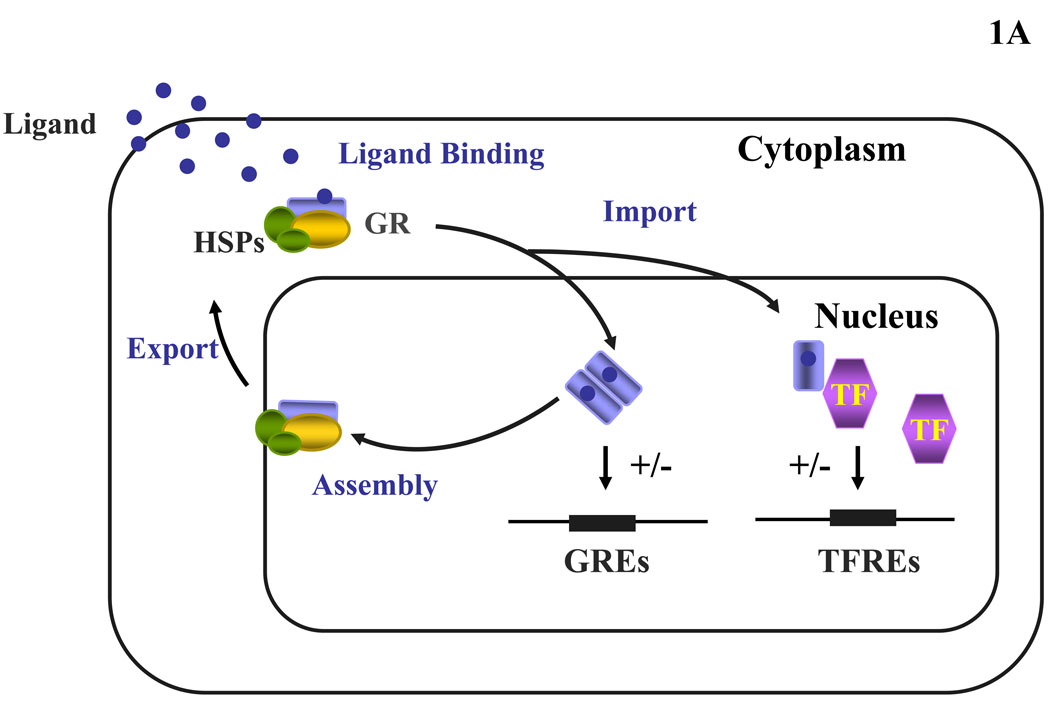
Glucocorticoids regulate a broad spectrum of physiologic functions and play important roles in resting and stress homeostasis. Their actions are mediated by the nuclear glucocorticoid receptor (GR).
Using a patient as a stimulus, we reviewed briefly the area of Primary Generalized Glucocorticoid Resistance in man and nonhuman primates.
In man, Primary Generalized Glucocorticoid Resistance is a rare sporadic or familial syndrome characterized by target-tissue insensitivity to glucocorticoids and compensatory elevations in adrenocorticotropic hormone (ACTH), leading to increased secretion of cortisol and adrenal steroids with mineralocorticoid and/or androgenic activity, and causing hypermineralocorticoidism and hyperandrogenism without Cushing stigmata. The presentation, diagnosis and therapy of this condition are summarized. Many or, most likely, all New World primates have markedly elevated cortisol and ACTH, and resistance to dexamethasone suppression, without any pathology. These primates in fact have 'pan-steroid/sterol' resistance, including all five steroid hormones and 1,25-dihydroxy-vitamin D. In humans, the molecular basis of Primary Generalized Glucocorticoid Resistance has been mainly ascribed to recent mutations in the GR gene, which impair glucocorticoid signal transduction. In contrast, in the primates, steroid/sterol signalling systems have adapted under yet unknown selective pressures or genetic drift over many million years. Of course, other molecules of the signaling pathways may also be involved in both states. There are now a host of human states associated with tissue-specific pathologic glucocorticoid target tissue changes. These include allergic, autoimmune, inflammatory and lymphoproliferative disorders.
In recognition of Professor George P. Chrousos' extensive ground-breaking research in this field, and for the sake of brevity, we propose that 'Chrousos syndrome' is used instead of 'Primary Generalized Familial or Sporadic Glucocorticoid Resistance'.
糖皮质激素调节广泛的生理功能,在休息和应激稳态中发挥重要作用。它们的作用是通过核糖皮质激素受体(GR)介导的。
以患者为刺激因素,我们简要回顾了人类和非人类灵长类动物原发性全身性糖皮质激素抵抗的领域。
在人类中,原发性全身性糖皮质激素抵抗是一种罕见的散发性或家族性综合征,其特征是靶组织对糖皮质激素不敏感,促肾上腺皮质激素(ACTH)代偿性升高,导致皮质醇和肾上腺类固醇的分泌增加,具有盐皮质激素和/或雄激素活性,并导致高盐皮质激素血症和高雄激素血症,而无库欣征。总结了这种情况的表现、诊断和治疗。许多(或很可能是所有)新世界灵长类动物的皮质醇和 ACTH 水平显著升高,对地塞米松抑制有抵抗作用,而没有任何病理学变化。这些灵长类动物实际上具有“泛甾体/固醇”抵抗性,包括所有五种甾体激素和 1,25-二羟维生素 D。在人类中,原发性全身性糖皮质激素抵抗的分子基础主要归因于 GR 基因的近期突变,这些突变损害了糖皮质激素信号转导。相比之下,在灵长类动物中,甾体/固醇信号系统在数百万年的未知选择压力或遗传漂变下已经适应。当然,信号通路的其他分子也可能参与这两种状态。现在有许多与组织特异性病理糖皮质激素靶组织变化相关的人类状态。这些包括过敏、自身免疫、炎症和淋巴增生性疾病。
鉴于乔治·P·邱罗斯教授在这一领域的广泛开创性研究,为了简洁起见,我们建议使用“Chrousos 综合征”代替“原发性全身性家族性或散发性糖皮质激素抵抗”。